












old magazine article typewriter
   
 
  Home
  About Us
  Log In / Register
  Contact Us
  Legal Disclaimer


Recently Added Articles
 1925: Going Green
 American Civil War Magazine Articles
 Chronology
 Gettysburg
 Lincoln
 Assorted Famous People and Celebrities
 Aviation Magazine Articles
 Charles Lindbergh
 Women Pilots
 Zeppelins and Dirigibles
 Benito Mussolini
 Black American Magazine Articles
 Ku Klux Klan
 Lynchings
 Cartoons 1914-1922
 China - 20th Century
 Sino-Japanese War
 Early Cars & Automotive History
 1950s Cars
 Early Television
 European Royalty
 Duke of Windsor
 Elizabeth II
 F.D.R. and the Depression
 Fashion
 1930s
 1940s
 Flappers
 Men’s Fashion
 Personal Beauty
 Football
 Golf Magazine Articles
 Immigration
 Canadian Immigration
 Jews in the 20th Century
 College Antisemitism
 Living History
 Mahatma Gandhi
 Manners and Society
 Modern Art
 Dada
 Movies
 Animation
 Gone with the Wind Articles
 Hollywood Blacklist
 It's A Wonderful Life
 Music
 Big Band 1930s-1940s
 Eric Satie
 Native Americans
 New York Magazine Articles
 Old Iraq
 Opinions About Americans
 American English
 Prohibition Cartoons
 Prohibition Magazine Articles
 Religion
 Silent Movie Articles
 Cartoons
 Charlie Chaplin
 D.W. Griffith
 Douglas Fairbanks & Mary Pickford
 Soviet History Articles
 Tennis Articles
 The Nazis
 Adolf Hitler
 Titanic Magazine Articles
 Twentieth Century Writers
 U.S. Army Uniforms of World War One
 Overseas Caps
 Trench Coats
 U.S. Armies, Corps and Divisions
 U.S. Navy Uniforms of World War One
 U.S. Marine Corps Uniforms
 Weird Inventions
 Women’s Suffrage
 Woodrow Wilson
 World War I Posters
 World War One
 African Americans
 Aftermath
 Animals
 Artists
 Belleau Wood
 British Uniforms
 Cemeteries
 Clip Art
 Color Photographs
 Doughboys
 Gas Warfare
 Inventions and Weapons
 Letters
 Lusitania
 Prelude
 Snipers
 Stars and Stripes Articles
 Versailles Treaty
 Women
 Writing
 World War Two
  Combat Training
 Aftermath
 At Home
 Atomic Bomb
 D-Day
 General Eisenhower
 Japanese Internment
 Kamikaze Attacks
 Paris
 Post-War Japan
 Prelude
 Prisoners of War
 VE Day
 VJ Day
 Weapons and Inventions
 Yank Magazine Articles
 General Marshall
  

World War One - Gas Warfare

Click here to email this page to a friend

W.W. I Gas Shells of the German Army (Almanach Hachette, 1919)

It is often believed that the Germans were the first to use chemical weapons during the Great War, but historians like to point out that they were second to the French in this matter: in August of 1914, French infantry fired tear-gas grenades and in October, the Germans one-upped them with chemical artillery shells during the battle of Neuve Chapelle. However, the Germans are properly credited for being the first of the combatants to use chemical artillery with the most devastating effect. On April 22, 1915, the German Army hurled 520 gas shells at British and Canadian units in Belgium, killing five thousand and incapacitating ten thousand more. Following this historic incident, both sides began producing large amounts of gas shells and, of course, gas masks. The following is a black and white diagram depicting five different German gas artillery shells that were manufactured to be fired from a number of different guns of varying calibers.

The Future of War and Chemical Weapons (Current Opinion, 1921)

Read this article and you will soon get a sense of what busy bees they must have been over at the United States Department of War within that year and a half following the close of World War One. General Amos A. Fries and the lads attached to the Chemical Warfare Service had been applying much cranium power to all matters involving mustard gas, tear gas, Lewisite and White Phosphorus. Much of the post-war dollar was devoted to making ships impervious to gas attacks, masks and uniforms suited to withstand nerve agents and offensive aircraft capable of deploying chemical bombs.

"As to the effectiveness of phosphorous and thermit against machine-gun nests, there is no recorded instance where our gas troops failed to silence German machine-gun nests once they were located...In the next war, no matter how soon it may occur, a deadly composition called Lewisite will be used with far more devastating effect than that of mustard gas."


The Blessings of Chemical Warfare (Literary Digest, 1927)

Having examined the collected data from the First World War, scientists and soldiers alike were drawing surprising conclusions as to the efficiency of chemical agents in warfare. No doubt, it was articles such as this that lead to the decision not to use gas in the Second World War:

"Poisonous gas as used in warfare is 'a blessing, not a curse,' and makes for the future security and peace of the world, declares J.E. Mills, of the U.S. Chemical Warfare Service...Theoretically one ton of mustard gas could kill 45,000,000 men. Actually one ton of mustard gas as used at the front caused about twenty-nine casualties, of which one died."

"Is gas warfare inhumane? All warfare is inhumane and barbarous, but the facts are that 2 percent of American gas casualties died, while more than 24 percent of American battle casualties died."

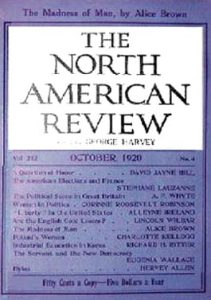
Chemical War (North American Review, 1922)

This article concerning the past and future of chemical warfare (as it was understood in 1922) was written by Captain J.M. Scammell, an Englishman who wrote extensively on the matter throughout much of the Twenties and Thirties. The essay is packed with a good number of surprising factoids regarding the manner in which gas warfare was practiced, the types of chemicals used and how many different agents were deployed at one time. Like so many other articles we find from the immediate post-war era, Captain Scammell argued that chemical warfare can be one of the most humane options available to a general:

"The really significant figures are those showing that while gas caused 27.3 percent of all casualties, of these only 1.87 percent died! That is less than one-twelfth the percentage that died from the effects of other wounds. Gas, moreover, does not mutilate or disfigure..."

Reconsidering Poison Gas as a Weapon (Current Opinion, 1925)

A one and a half page article about J.B.S. Haldane (1892 – 1964), formerly a British combatant of the Great War who became a chemist (and pioneer geneticist) during the inter-war years studying not merely the effectiveness of poison gas but the question as to whether the weapon was more humane than bullets and artillery shells:

"If it is right for me to fight my enemy with a sword, it is right for me to fight him with mustard gas; if the one is wrong, so is the other. The use of mustard gas in war on the largest possible scale would render it less expensive of life and property, shorter, and more dependent on brains rather than numbers."

His musings concerning atomic energy are referred to as are some of his quack-theories regarding the effects of gas warfare and people with dark skin.


© Copyright 2005 Old Magazine Articles