



































World War One

Find old World War 1 articles here. Find information on uniforms, women, gas warfare, prisoners of war and more.

1918: An Armistice Remembrance
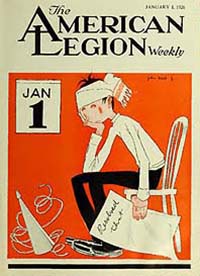
(American Legion Monthly, 1936)

St. NAZAIRE, 1918. It was eleven in the morning when we first heard the news. A piercing whistle from one of the steamers in the harbor, a sudden blast so loud and so startling that even the nurses in their rest camp in La Baule fifteen kilometers away could hear it…L’ARMISTICE EST SIGNÉ…by noon the entire town was outdoors; a truck load of German prisoners rolled past, apparently quite as happy as the rest of us.

The Demands of the 1918 Armistice
(The Stars and Stripes, 1918)

Attached herein are the terms of the 1918 Armistice as they appeared in the official newspaper of the American Expeditionary Forces:

The complete official translated text of the Armistice conditions to which the German plenipotentiaries set their signature is herewith reproduced:

1.) Cessations of operations by land and in air six hours after the signature of armistice.


II.)Immediate evacuation of the invaded countries…

etc, etc, etc…


There Are Additional Magazine
Articles About W.W. I

Her Armistice Poem
(American Legion Weekly, 1921)

At 11:00 a.m., November 11, 1918, an American woman volunteer was toiling away at her Service of Supply base in Tours when peace broke out all over the place. When she was asked to recall that moment three years later for the editors of THE AMERICAN LEGION WEEKLY – she wrote down the attached verses –

Advertisement

Use shortcode [oma_ad position="summary_top"] (or other position) in your theme or widgets to display OMA Promotions here.

The Cockpit of the Giant Goltha Bomber
(j’ai vu…, 1918)

During the spring of 1917 the Germans developed a squadron of large aircraft capable of dropping 660-pound bombs on London -and drop them they did, killing as many as 788 human beings between May of 1917 and May of 1918. The Giant Goltha Bombers conducted these raids primarily at night and utterly terrified the East End of London. Eventually, German losses escalated and the London raids were canceled in favor of Paris and various other French targets. In 1917 this image of a Goltha cockpit appeared in the French press.

Click here to read an article about the development of aerial reconnaissance during W.W. I.

The Monument at Vimy Ridge
(The Literary Digest, 1936)

The attached article was written nineteen years after the smoke cleared over Vimy Ridge and succinctly tells the story of that battle in order that we can better understand why thousands of Canadian World War One veterans crossed the ocean a second time in order to witness the unveiling of the memorial dedicated to those Canadians who died there:

Walter S. Allward (1876 – 1955), Canadian sculptor, worked fourteen years on the completion of the monument, which cost $1,500,000.

The article also touches upon some of the weird events that have taken place at Vimy Ridge since the war ended…


Click here to read an article about the German veterans of W.W. I.

Arranged Marriages to Seal the Peace in the Balkans
(Dress and Vanity Fair Magazine, 1913)

When the attached article first appeared in print the Balkan War (1912 – 1913) was over, however some of the swells of Europe put their crowned heads together and collectively came up with the best Medieval plan they could think of in order to insure the promise of peace in the region.


It was agreed that the Czar’s daughter, Grand Duchess Olga (1895 – 1918), would wed Serbia’s Crown Prince Alexander (1888 – 1934); while the Czar’s second daughter, Grand Duchess Tatiana (1897 – 1918) was promised to Romania’s Crown Prince Charles (1893 – 1959). All concerned felt that Romania’s Princess Elizabeth (1894-1956) and Crown Prince George of Greece (1890 – 1947) would make a simply splendid couple (they divorced in 1935).

Advertisement

Use shortcode [oma_ad position="summary_top"] (or other position) in your theme or widgets to display OMA Promotions here.

France, Germany & Alsace-Lorraine
(Literary Digest, 1900)

A printable article that illustrated the sensitive diplomatic status existing between France, Britain and Germany in 1900 when France was still smarting from their humiliating defeat in the Franco-Prussian War; recently allying themselves with Imperial Russia, Germany felt extremely ill at ease. The kaiser’s diplomats remarked openly that Britain, as the abusive tormentors of the Boer farmers in South Africa, were not likely to be on friendly terms with Germany any time soon.

The Feminist Rebellion of the Twenties
(The Dilineator, 1921)

It was estimated that there were as many as two million empty seats around the collective family dinner tables in Post World War One Britain. Such an absence of young men could not help but lead to a new social arrangement:

England is the great human laboratory of our generation – England with her surplus of two million women, her restless, well-equipped, unsatisfied women.


Too many European women were unable to find husbands and moved to America.

Liquid Fire
(Literary Digest, 1916)

– A well-illustrated article which sought to explain to American readers the workings of one of the most heinous inventions of the First World War:

This idea of projecting upon the adverse trenches and their occupants a rain of liquid fire was no sudden afterthought of the German mind. It was conceived, studied, and perfected for several years before the war, and its history may be traced in the German patent office.

Advertisement

Use shortcode [oma_ad position="summary_top"] (or other position) in your theme or widgets to display OMA Promotions here.

The Women’s Overseas Corps
(The Stars and Stripes, 1918)

Five thousand women are to be brought from the United States to be a part of the American Expeditionary Forces…The Women’s Overseas Corps (WOCS) will consist of companies of 50 women each. The members of the WOC will be under soldierly discipline and wear uniforms…It is not expected that they will march in formation or observe the formalities of the salute.

These women were recruited by Miss Elsie Gunther of the Labor Bureau in order to relieve the men posted to the Service of Supply of their clerical duties for service at the front; in light of the fact that the war ended six weeks later it is unlikely that the these women ever arrived.

The American Death Record
(American Legion Weekly, 1922)

Statistics of the World War prove, however, that war was, from the standpoint of mortality, not vastly different from other wars. In spite of the improvements in methods of killing by machinery,Nature managed to runup a higher score than the enemy’s bullets and shells. The Surgeon General of the Army, at the request of The American Legion Weekly, has prepared the following figures for the period of the war, from April 1, 1917 to December 31, 1919.

The American Army Occupies Coblenz, Germany
(The Stars and Stripes, 1918)

On the afternoon of December 8, 1918, the troops of the Third American Army entered Koblenz. This was the goal of the occupation. The Yankees had reached the Rhine.

Probably never in all its stressful history did enemy troops enter it so in quite the matter-of-fact manner which marked the American entry last Sunday. There was no band. There were no colors. ‘We’re just going in sort of casual like,’ one of our generals had said the day before, and he was right.

Advertisement

Use shortcode [oma_ad position="summary_top"] (or other position) in your theme or widgets to display OMA Promotions here.

The Case for Cavalry
(Vanity Fair Magazine, 1919)

Numbered among the many Monday-morning-quarterbacks who appeared in print throughout much of the Twenties and Thirties were the old horse soldiers of yore, bemoaning the fact that industrial warfare had deprived their kind of the glory that was their birthright. This was not the case on the Eastern Front, where Imperial Russian generals had seen fit to launch as many as 400 cavalry charges – while American troopers were ordered to dismount (along with most other cavalry units in the West) and suffer postings with the Service of Supply, among other assorted indignities.

A Diagram of the French Renault Tank
(Freedom’s Triumph, 1919)

The French made light Renault tank was first seen on the Western Front in 1918, it had a crew of two, measured 13 feet (4 meters) in length and weighed 6.5 tons. The tank’s 35 hp. engine moved it along at a top speed of 6 mph. The factory options were few: one turret was fashioned to accommodate a 37mm gun while the other was made for a machine gun. The American Army placed 227 of these tanks in the field; these Renaults were distinctly different from those commanded by their French allies: the American version sported an octagonal turret (the French used a circular one) and steel wheels (the French Army preferred wood).


If you wish to read about the only German tank of World War I, click here.


Read about the Patton tank in Korea…

The German View of the Next War
(Literary Digest, 1912)

Attached is a short review of a book that turned many heads in the diplomatic circles of Europe in 1911: Germany And The Next War, written by Germany’s General von Bernhardi (1849 – 1930):

A very influential military writer in Germany declares that Germany must win her place as a world power through warfare.

The book sales in Germany were quite meager up until the first shot was fired in August of 1914, when they picked up considerably.

Advertisement

Use shortcode [oma_ad position="summary_top"] (or other position) in your theme or widgets to display OMA Promotions here.

Germany Defends It’s Military Build Up
(Literary Digest, 1913)

A defense was offered for the growth of German military expenditures based on the spread of Slavik pride and the rise of a great Pan-Slavonic movement due to victory of their kinsmen in the Balkans. German leaders, furthermore, felt a deep uneasiness about the fact that about one-third of the population of the Hapsburg Monarchy consisted of Slavs and therefore felt that military aid from the Austro-Hungarian Empire was not guaranteed in the event of a war with Russia and France.

One German’s Opinion
(The Nation, 1922)

A few choice words concerning the Treaty of Versailles by the German anti-socialist author S. Miles Bouton (born 1876):

Such a treaty could not bring real peace to the world even if the conditions were less critical and complex. As they are, it will hasten and aggravate what the world will soon discover to be the most serious, vital, and revolutionary consequences of the war.


The quote above is an excerpt from THE NATION’s review of Bouton’s 1922 book, And The Kaiser Abdicates: The German Revolution, November, 1918.

German Post-War Thinking
(American Legion Weekly, 1922)

Thus any traveler in Germany feels that the future grows darker and darker for both Germany and Europe. There is no doubt that the German people have learned little from their war experiences and that it would require only a spark to set them off in another wild rush down through Europe behind Russian guns. It is a dismal prospect, and it is a terrible one, for it would mean, in the final analysis, the utter destruction of European civilization.

Advertisement

Use shortcode [oma_ad position="summary_top"] (or other position) in your theme or widgets to display OMA Promotions here.

Scroll to Top