












World War One

Find old World War 1 articles here. Find information on uniforms, women, gas warfare, prisoners of war and more.

Muirhead Bone at the Front
(Times Literary Supplement, 1918)

A book review covering a collection of drawings by one of the Official War Artists, Muirhead Bone (1873 – 1953). The book was titled, and it is not surprising to read that it was published by Country Life. The reviewer was not at all impressed with the artist’s renderings of, what was at that time, the most dangerous place on planet earth:

In these drawings Mr. Muirhead Bone has resolutely refused to become a journalist. He has not allowed the novelty of his subject-matter to affect his treatment. There he differs from Mr. Nevinson. Mr. Nevinson in his pictures of the war is not a journalist but at least an illustrator.

Nonetheless, Sir Douglas Haig wrote a supportive introduction to the book. Wilfred Owen (1893-1918) found his drawings to be highly inaccurate at best.

Advertisement

Use shortcode [oma_ad position="summary_top"] (or other position) in your theme or widgets to display OMA Promotions here.

The 36th Division
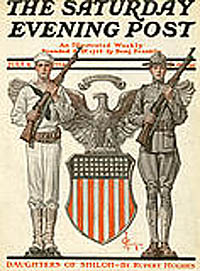
(The American Legion Weekly, 1922)

The 36th Division has a little corner by itself in the general field covered by the A.E.F. It was not brought into either of the American major operation or into any American sector. Off by itself, under French command, it came into line in Champagne… Theses troops came bang into the middle of the hardest fighting, without any quiet sector preliminaries, and without a relatively easy initiation like St. Mihiel.

The Ninetieth Division: Texas and Oklahoma
(Stars and Stripes, 1919)

An illustration of the insignia patch and a brief account of the origins, deployments and war-time activities of the U.S. Army’s 90th Infantry Division during World War One. We have also provided a review of A History of the 90th Division by Major George Wythe (which the reviewer didn’t especially care for but nonetheless provides a colorful account of the division’s history in France).

Advertisement

Use shortcode [oma_ad position="summary_top"] (or other position) in your theme or widgets to display OMA Promotions here.

1914: The Close of an Epoch
(The New Republic, 1915)

World War I had only been raging for six months when this article first appeared. As the journalist makes clear, one did not have to have an advanced degree in history to recognize that this war was unique; it involved almost every wealthy, industrialized European nation and their far-flung colonies; thousands of men were killed daily and many more thousands stepped forward to take their places. The writer recognized that this long anticipated war was an epic event and that, like the French Revolution, it would be seen by future generations as a marker which indicated that all changes began at that point:

Those who were but a few months ago assuring us that there never could be another general war are most vociferously informing the same audience that this will be the last.


Click here to read about the W.W. I efforts of Prince Edward, the future Duke of Windsor.


The War That Ended Peace: The Road to 1914style=border:none

The Size of the U.S. Army: 1917 – 1919
(U.S. Gov. 1931)

A diagram pulled from a 1931 U.S. Government study indicating the number of soldiers in the American Army each month from 1917 through 1919, and the number of Doughboys who were deployed in Europe.

Click here to read an interview with the World War I American fighter pilot Eddy Rickenbacker.

Advertisement

Use shortcode [oma_ad position="summary_top"] (or other position) in your theme or widgets to display OMA Promotions here.

W.W. I Poster Artists Criticized
(Vanity Fair Magazine, 1918)

VANITY FAIR‘s art critic, James Frederick Gregg, had a good deal to say concerning the art of the World War One American poster campaign:

…Indeed, so ineffective have most of the posters been as art, that it is ridiculous to imagine that they have had any effect whatever in stimulating in us the spiritual side of our share in the war.

James Montgomery Flagg and Six Other W.W. I Poster Artists
(The Poster, 1920)

Photographic portraits and brief interviews with seven artists who made important contributions to the
poster campaign of
1917 – 1918.


Included in this illustrious group:
• James Montgomery Flagg,
• Clyde Forsythe,
• Gerrit Baker,
• J. Scott Williams,
• L.A. Shafer and
• Euginie De Land Saugstad.

King Edward VII and Germany
(Review of Reviews, 1910)

An article that appeared in DEUTSCH REVIEW in 1910 by Lord Esher (1852 – 1930) entitled, King Edward VII and Germany. Published in the last year of Edward’s reign, it is plea to prolong that Indian summer before the First World War and a declaration of his affection for Germany and the German people as well as his deep support for all disarmament treaties.

Advertisement

Use shortcode [oma_ad position="summary_top"] (or other position) in your theme or widgets to display OMA Promotions here.

The Death of Edward VII & the Accession George V
(Review of Reviews, 1910)

This 1910 article from THE REVIEW OF REVIEWS discusses the probable effect (that) the change of sovereigns will have upon the present so-called constitutional crises [in Britain]. The writer also concentrates on the subject of Edward VII as diplomat, his thoughts concerning Germany and Austria, his general popularity and his unique relationship with the French. The character of the incoming George V is examined as it relates to the constitutional controversy of 1910.

Paris Fashions: Nine Months into W.W. I
(Vanity Fair Magazine, 1915)

By the Spring of 1915, the women of Paris, having seen that the Great War was not going away anytime soon, decided that it was time to add some gaiety into their wardrobe. Steadily – since the August of the previous year, there had been such bad news and although the rationing of fabric continued, there was still much available for the asking.

Click to read about the U.S. fabric rationing during W.W. II.

A Letter from a Bombardier in the French Air Corps
(Vanity Fair, 1916)

In the attached letter from the artist Bernard Boutet de Monvel (1884 – 1949), the artist explains thoroughly his thoughts and adventures as an bombardier in a Vosin biplane; experiences which contrast greatly with his days in the trenches and he writes well on the feelings of lonliness that an aviator can experience at 2000 feet.

For those who are interested in learning about the living conditions and daily life of World War One pilot officers this article can only help you. Click here

Advertisement

Use shortcode [oma_ad position="summary_top"] (or other position) in your theme or widgets to display OMA Promotions here.

The Uniforms of Women War Workers
(Touchstone Magazine, 1918)

Well-over 30,000 women participated in the United States war effort during World War One. The majority served as nurses, but there were also impressive numbers who volunteered to do their bit as drivers and telephone operators. Many chose to serve in the religious organizations, such as the Y.M.C.A., the Knights of Columbus or the Jewish Welfare Board. They all needed uniforms and that is what this well-illustrated article addresses. Never before had there been such a conflict requiring uniforms be cut in women’s sizes, and this matter was not simply new to American women, it was a new day in human history as well.

The background of women’s service uniforms is war, war of the most terrible kind.


How unseemly any attempt to make the costume pleasing to the eye.

Click here to visit an interesting site dealing with the history of American servicewomen.


If you would like to read about the U.S. Army uniforms for women during W.W. II, click here…


Dressed for Duty: America’s Women in Uniform, 1898-1973style=border:none

Gassing The Germans
(American Legion Weekly, 1922)

This is the story of the First Gas Regiment. It was organized at American University (Washington, D.C.) in August of 1917 and arrived in France in time to disperse noxious gas all over the Germans as they launched their March offensive in 1918:

Company B of the First Battalion was the outfit that participated in the first show. The attack was launched on a two-mile front extending from Lens to Hill 70 near Loos, and held by the Canadians… It was a tough job. The nature of the work was graphically described by a Yankee buck, who said in a moment of disgust: ‘This is a job for grave diggers, hod carriers and piano movers, instead of chemists, pipe fitters and mechanics.

The Airborne Machine Gun
(Literary Digest, 1912)

This remarkable aeroplane gun is the invention of Lieutenant-Colonel Isaac N. Lewis of the United States Army Coast Artillery Corps. Curiously enough, the gun was designed primarily for infantry and cavalry use.

Click here to read a 1918 article about the Lewis Gun.

Advertisement

Use shortcode [oma_ad position="summary_top"] (or other position) in your theme or widgets to display OMA Promotions here.

Scroll to Top