







Pic Magazine Articles
Photoplay Magazine Articles
Creative Art Magazine Articles
Outing Magazine Articles
Current Literature Magazine Articles
47 Magazine Articles
Ken Magazine Articles
Newsweek Articles
Touchstone Magazine Articles
Punch Magazine Articles
The Saturday Review Articles
The New Republic Articles
The Film Spectator Magazine Articles
The American Legion Monthly Articles
Scribner's Magazine Articles
Rob Wagner's Script Magazine Articles
Click Magazine Articles
Harper's Weekly Articles
Leslie's Magazine Articles
Harper's Bazaar Magazine Articles
Freedom's Triumph Articles
Theatre Arts Magazine Articles
The North American Review Articles
PM Tabloid Articles
The Flapper Magazine Articles
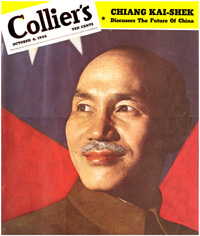
Collier's Magazine Articles
Hearst's Sunday American Articles
Film Daily Magazine Articles
Confederate Veteran Magazine Articles
Liberty Magazine Articles
Confidential Magazine Articles
Trench Warfare Articles
The Smart Set Articles
The Saturday Evening Post Articles
The Atlantic Monthly Articles
The Dial Magazine Articles
The American Legion Weekly Articles
Direction Magazine Articles
Outlook Magazine Articles
People Today Magazine Articles
Stage Magazine Articles
Vanity Fair Magazine Articles
The New York Times Articles
Life Magazine Articles
La Baionnette Articles
Sea Power Magazine Articles
Vogue Magazine Articles
G.I. Joe Magazine Articles
Men's Wear Magazine Articles
The National Park Service Articles

The Cold War

Find old cold war articles here. We have free newspaper articles from the 1950s cold war check them out today!

Henry Wallace: Was He Red?
(Collier’s Magazine, 1948)

Henry Wallace (1888 – 1965) was FDR’s second Vice President (1941 – 1945) and as a seasoned Washington politician he must have known that his political career was coming to an end when the attached editorial hit the newsstands in early October of 1948. Written by William L. Chenery, publisher of COLLIER’S MAGAZINE, one of the most staid, middle class news and fiction organs around – it was not the sort of organization that looked upon libel lightly; Chenery meant what he wrote when he slandered the former vice president as the spokesman of Russia.


Wallace, who at the time was taking a licking as the Progressive Party nominee for president in the 1948 race, left politics shortly afterward. In 1952 he wrote a book in which he admitted how wrong he was to have ever trusted Joseph Stalin.

The Soviets Get the Bomb
(Pathfinder Magazine, 1949)

A news column that is appropriately drenched in the gravitas of the day because it announced that the short-lived age of atomic security that brought W.W. II to a close had come to an end. A new epoch had arrived at 11:00 a.m., September 23, 1949, when President Harry Truman announced


We have evidence that within recent weeks an atomic explosion occurred in the USSR.


With nuclear bombs must come a nuclear strategy:
click here to read about that…

How the Soviets Would Have Attacked
(Pageant Magazine, 1950)

There wouldn’t be any warning.


Long-range Soviet bombers attempt to knock out our key industrial targets by atomic bombing. Some fly the 4,000, miles from Murmansk across the roof of the world to our East Coast; others strike from bases in Eastern Siberia at California and the Midwest… Simultaneously, organized sabotage breaks out in aviation plants, shipyards, power stations, etc., to complement the work of the bombers.

Advertisement

Use shortcode [oma_ad position="summary_top"] (or other position) in your theme or widgets to display OMA Promotions here.

The ICBM
(Collier’s Magazine, 1956)

The U.S. and Russia are engaged in a race whose outcome may determine the course of history. The goal: development of the most frightful weapon conceived by man – a virtually unstoppable 16,000-mph intercontinental ballistic missile that can drop a hydrogen warhead on a city 5,000 miles away. At stake is not only the security of the free world , but our position as the world’s most technological and industrial power.

Un-Americanism
(The American Magazine, 1946)

New York’s Cardinal Francis Joseph Spellman (1889 – 1967) wrote the attached editorial explaining why Marxism was the polar opposite of everything Americans holds dear:

My sole objective in writing is to help save America from the godless governings of totalitarianism…if you believe with me that freedom is the birthright of the great and the small, the strong and the weak, the poor and the afflicted, then you would be convicted as I that [Socialism] is the antithesis of American Democracy.


Click here to read another argument opposed to socialism.

Germany and the Next War
(Collier’s Magazine, 1951)

No sooner had the curtain descended on the tragedy that was World War II when the Allied nations found themselves having to put together a coalition of nations that would be willing to contain Soviet expansion throughout Europe. A COLLIER’S journalist wandered among the rubble of West Germany and found that a great number of draft-age men simply replied nein when asked if they would be willing to fight alongside the Americans, French and British. One of the wiser observers opined:

Remember that Germany is a convalescent country…These people have lost two world wars in a generation. The last one cost them nearly 3,000,000 dead and another 1,000,000 or so still missing, to say nothing of some 4,000,000 wounded. They just don’t want to take a chance of being on the losing side again.


The West Germans joined NATO in 1955.

Advertisement

Use shortcode [oma_ad position="summary_top"] (or other position) in your theme or widgets to display OMA Promotions here.

Forced Into Communism
(Quick Magazine, 1952)

In his illustrated five page reminiscence, former Communist refugee Ivan Pluhar (b. 1927), recalls those dreadful days following the end of the Second World War when it became clear to all the citizens of Czechoslovakia that their Soviet liberators would never leave their country. The article will clue you in as to what life was like during the earliest years of the occupation and how dissenters were treated throughout that period.


A Quick Read About Soviet-Enforced Atheism
Behind the Iron Curtain…

Ground Zero: Washington, D.C.
(Pathfinder Magazine, 1950)

When it became clear to all that the Soviets had the bomb – and Washington was the target – the egg-heads in D.C. decided it was time to disperse various government offices to the suburbs:

Given any warning at all, the National Security Resources Board now seems confident it can preserve at least a skeleton Government. But as for the run-of-the-mine Federal employee, he’ll have to take his chances amid the irradiated rubble…

The Marshall Plan: Rebuilding Europe
(Pathfinder Magazine, 1947)

The Marshall Plan was a U.S. Government aid program that was instrumental in the reconstruction and economic resurrection of 16 Western European nations following the devastation caused by the Second World War. It is named for Secretary of State George C. Marshall, who co-authored the initiative with the help of the prominent business leader William Clayton, and the American diplomat George F. Kennan.


The attached article concerns the first draft of the scheme that was drawn-up by Marshall and the representatives of these 16 nations during the Summer/Fall of 1947. The amount of cash to be distributed (and paid back over a period of 30 years) was $22.44 billion.


Marshall knew that such an economic stimulant (and the liberties that would follow) would serve to guarantee that Western Europe would not fall into clutches of the Soviet Union.


To read about the Soviet reaction to the Marshall Plan, Click here


Read more articles from PATHFINDER MAGAZINE…

Advertisement

Use shortcode [oma_ad position="summary_top"] (or other position) in your theme or widgets to display OMA Promotions here.

The Soviet Reaction to the Marshall Plan
(Pathfinder Magazine, 1947)

To paraphrase Second Corinthians: Europe’s despair was Stalin’s opportunity – he delighted in the post-war unemployment, the inflation and the general lack of confidence in their governmental institutions. When the Marshall Plane came to the rescue in rebuilding Europe, the Soviets knew they were licked. This article reveals how totally bummed the Soviets were over the broad European acceptance of the Marshall plan. They hated it.

Meet Andrei Gromyko
(Collier’s Magazine, 1946)

When this magazine profile of Andrei Gromyko (1909 – 1989) appeared on the newsstands in 1946, the man was already a mainstay in the State Department Rolodex. Anyone who came of age during the Cold War (1947 – 1991) will certainly recognize his name, because as Foreign Minister for the Soviet Union (for 28 years), Gromyko was without a doubt one of the architects of the Cold War.


The attached article outlines Gromyko’s career highlights up to the Summer of 1946 when he was posted as the first Soviet Ambassador to the newly established United Nations.

Advertisement

Use shortcode [oma_ad position="summary_top"] (or other position) in your theme or widgets to display OMA Promotions here.

The Tired Russians
(Collier’s Magazine, 1947)

This article goes into greater length to confirm what U.S. diplomat George F. Kennan (1904 – 2005) observed in his famous 1947 article Sources of Soviet Conduct (FOREIGN AFFAIRS, July 1947) – that the Russian people were physically and spiritually exhausted. After the terrible strain and sacrifice of the Second World War they were gleefully anticipating some much needed rest; they didn’t get it and they weren’t very happy about it.

The standard of living in Russia has never been very high, but even despite his natural stoicism, the average citizen feels he has a good reason to be disgruntled with his life… Like any other totalitarian state, the Soviet state has done its best to paint a larger than life-size picture of its citizens. It likes to describe them as steel-hard heroes with an inflexible will, living for nothing but the great ideal of a Communist future, laughing at difficulties, gaily grasping with hard ship – a continent of Douglas Fairbankses. This is just a bit too good to be true, and the last one to be taken in by it is the average Russian.

The Allure of the Private Bomb Shelter
(People Today Magazine, 1955)

This is a consumer report concerning various bomb shelter plans that were commercially available to the American public in 1955:

The most elaborate of five government-approved home bomb shelters is a combination tunnel and emergency exit in reinforced concrete, extending outward under ground from cellar walls It holds six persons and offers maximum protection from all effects of an atomic explosion… But the FCDA (Federal Civil Defense Administration) also recommends a practical type type that can be put together by any do-it-yourselfer for around $20.00.

The Proxy Wars
(Pathfinder Magazine, 1950)

On June 24 [1950] Soviet Russia dug deep into her bag of tricks and came up with a new one – war by proxy. Today, still sadly unprepared for satellite warfare, the US may yet profit by tragic experiences – so that even possible defeat in Korea will not be totally without gain. What has been learned and how this knowledge might be used in future satellite wars is discussed here.

Advertisement

Use shortcode [oma_ad position="summary_top"] (or other position) in your theme or widgets to display OMA Promotions here.

A Rift in the Containment Policy
(Pathfinder Magazine, 1950)

Washington’s growing distaste for the Chinese Nationalist dictator Chiang Kai-shek was reaching fever-pitch that last week in January, 1950, when President Truman’s Secretary of State Dean Acheson (1893 – 1971) presented the administration’s Asia policy:

No official military aid for Generalissimo Chiang Kai-shek’s Chinese Nationalist government, either on the island of Formosa [Taiwan] or anywhere else.

Stalin Dies and Power Changes Hands
(Quick Magazine, 1953)

Stalin’s death on March 5, 1953 generated a tremendous amount of uncertainty in the West, and a good deal of it is reflected in the attached column. A list of possible successors was provided; two of the names played an immediate roll in the governance of the Soviet Union: Georgy Malenkov (1902 – 1988) – who ruled for three days, until he was replaced by Nikolai Bulganin (1895 – 1975). Bulganin ran the shop until he, too, was replaced by Stalin’s right-hand man: Nikita Khrushchev
(1894 – 1971) – who was known in some corners as the hangman of the Ukraine.


Read about the Soviet Congress

‘The Hell Bomb”
(Pathfinder Magazine, 1950)

This article from February, 1950 goes on in some detail explaining why Americans should not be worried in the least about the fact that the Soviets now have atomic capability because the U.S. military has bigger and far more destructive bombs.

A hydrogen bomb could cause damage almost without limit. The Nagasaki plutonium bomb affected an area of 10 square miles. The new weapon could destroy an area of 100, or 1,000 square miles.

Advertisement

Use shortcode [oma_ad position="summary_top"] (or other position) in your theme or widgets to display OMA Promotions here.

Scroll to Top