
Where the Stars Shopped…
(Photoplay Magazine, 1938)
ONE MILE EAST of Sunset Plaza was a Hollywood hangout called Schwab’s Drugtore – read about it here…– from Amazon:Read […]
|
|
|
|
|
|
|

|
|

|
|

|
|
|
|

|
|
|
|
|
|
|

|
|

|
|
|
|
|
|
|

|
|
|
|
|
|
|
|

|
|
|
|

|

|
|
|

|
|
|
ONE MILE EAST of Sunset Plaza was a Hollywood hangout called Schwab’s Drugtore – read about it here…– from Amazon:Read […]
In this early Sixties article, celebrity epistolarianne Cyndi Adams recalled her first two encounters with the man who would be Felix Unger:
‘I am definitely neurotic and psychotic,’ cheerily announced Tony Randall (1920 – 2004) the first time we met – ‘he’s an actor-comedian of remarkable skills…
he unconsciously reflects, in the way he plays his rolls, so much of the neurotic age we live in…’.
The New York Times would pursue this point to a further degree in their 2004 obituary of the actor:
That’s the force Tony Randall embodied: he represented, in his neurotic grandeur, our national will to unhappiness. Or if not our will, at least our right, which in the 50’s we were only beginning to realize we could exercise.
In spite of the incredible films that Hollywood churned out in 1939 – Gone With the Wind, The Wizard of Oz and Mr. Smith Goes to Washington, it seemed that there were some folks in 1940 who just wouldn’t be satisfied. This completely irked the citizens of Hollywood. And so the editor of Variety dispatched pollsters hither and yon to ask why they
thought the movies stunk.
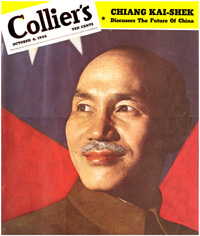
A 1945 Collier’s Magazine article about Yvonne De Carlo (a.k.a. Lilly Munster: 1922 – 2007) that appeared shortly after her first big break in Hollywood, Salome, Where She Danced. At the time of this interview the actress had well-over fifteen minor films on her resume but the journalist chose to claim that Salome was her first, just for the unbelievable glamor of it all; he also chose to shave three years off her age.
Yvonne De Carlo was born twenty years ago in Vancouver, British Columbia…She was a featured dancer at Earl Caroll’s and earned the undying respect of the producer by tipping the scales at a svelte 115 pounds, standing on the runway at a mere 5 feet four inches, and by displaying an 11 -/2 -inch neck, a 36 bust, a 24 waist, 32 hips a 7 1/2 -inch ankle, and 15 2/3 -inch wrist.
A magazine profile of RKO Studio Dance Director Hermes Pan (1909 – 1990); his work with Fred Astaire (1899 – 1987) and Ginger Rogers (1911 – 1995) and the lasting impression that African-American dance had made upon him. It is fascinating to learn what was involved in the making of an Astaire/Rogers musical and to further learn that even Bill Bojangles Robinson (1878 – 1949) was a fan of the dance team.
Astaire liked the youngster’s blunt answers. He realized the need of a critic who would talk back to a star.
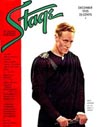
A fabulous three page article from STAGE MAGAZINE on the early career of Cary Grant:
Cary Grant appeared in six Broadway productions and twenty-seven Hollywood pictures before anybody took notice. Then he played a dead man.
Two months after James Dean’s fatal car crash, photographer Sanford Roth (1906 – 1962) penned this reminiscence of his unique friendship with this actor so many years his junior:
Dean was what Hollywood loosely labels a nonconformist, an individualist in the Brando stripe. He wasn’t easy to know.
Those were the days when the talkies had taken over from the silent films and movie executives began a wholesale raid on the New York stage for promising young talent. It was fertile territory. In a comparatively brief period they signed Clark Gable, George Brent, Jimmy Cagney, Joan Blondell, Spencer Tracy Ginger Rogers, Humphrey Bogart, Francis Tone and a score of others. While I was in Broken Dishes I had been screen tested by Samuel Goldwyn for a feminine lead opposite Ronald Coleman…I reached Hollywood with my mother on December 13, 1930.
Two million Americans have as their principal form of visual entertainment nomad movies, run by some 3000 road-showmen who present their motion pictures in tents, auditoriums or churches. Few city folks realize that this is the way in which entertainment is brought to about 5000 U.S. towns of less than 1000 population… Road-showmen say that the favorite shows are fast-action westerns and occasional comedies. Mushy love scenes are box-office poison among their clientele. During harvest seasons, when customers can best afford the ten to twenty-five cents admission charge, these showmen take in between $75.00 and $150.00 a week.
These were not the only traveling entertainers during the Thirties: the Federal Theater Project also sent hoards of players throughout the nation to amuse and beguile – you can read about that here
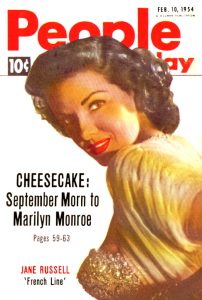
Click here to read about Marilyn Monroe and watch a terrific documentary about her life.
Back in the day, some wise old sage once remarked:
It’s Frank Sinatra’s world; we only live in it.
-in 1951, Nancy Sinatra certainly thought these words were double-dipped in truth; married to The Voice since 1939, she tended to their three children devotedly, yet she was served with divorce papers nonetheless in order that Ol’ Blue Eyes could go keep house with the twice-married starlet Ava Gardner (1922 – 1990). The attached article will tell you all about it; it’s a juicy one – filled hearsay, innuendo and the knowing words of a Vegas odds maker as to whether the marriage will last:
Will Frank turn out to be a better husband than Mickey Rooney or Artie Shaw? Will Ava have more luck with him than Nancy had?
(they divorced in 1957)
It was 1933 interviews like this one that made the studio executives at RKO go absolutely bonkers; what were they to do with Katharine Hepburn (1907 – 2003)? She simply refused to take all matters Hollywood with any degree of seriousness; although she hadn’t been a movie actress for very long at all, Katherine Hepburn was downright impious and goofy when reporter’s questions were put to her:
‘Is it true that you have three children?’ asked the interviewer.
‘I think it’s six,’ she answered.
Such responses served only to frustrate the members of the fourth estate to such a high degree and it seemed only natural that the fan magazine journalists would want to have the final word as to who Katherine Hepburn really was…
-But the Hollywood press did like her future co-star Carry Grant, click here to read it.
A Photoplay Magazine interview featuring British actor Ronald Colman (1891 – 1958) in which the journalist attempted to dispel all preconceived notions that the actor was some sort of male Garbo and was, in fact, a regular guy.
Our movies are becoming more blatantly obsessed with sex. Ten years ago it was unthinkable for a Hollywood picture to show a couple in bed together – even a husband and wife, since this violated an unwritten taboo of the industry’s self-regulating Productions Code. Today it is not surprising to see two people embracing, in varying stages of dishabille… As motion picture critic of The New York Times and as one who has watched American movies from the ‘silent’ days, I can truthfully say I have never seen them so unnecessarily loaded with stuff that is plainly meant to shock.
Click here to read more about the destruction of taboos in American pop-culture…
The attached magazine article is a profile of Veronica Lake (1922 – 1973) who was characterized in this column as an artist at making enemies.:
One of the most acute problems in Hollywood is Veronica Lake. Where, and at what precise moment her time-bomb mind will explode with some deviation from what studio bosses consider normal is an ever-present question. Hence, the grapevine of the movie industry always hums with rumors that unless Miss Lake ‘behaves’, she will no longer be tolerated, but cast into oblivion.
Her response was eloquent.
The attached article from 1938 heralded a new day in the fashion industry where fashion magazines would no longer be relied upon to set the trends in clothing; henceforth, that roll would only be played by movie actresses in far-off Hollywood.
It was Hollywood movie stars who introduced sunglasses to the world of fashion…
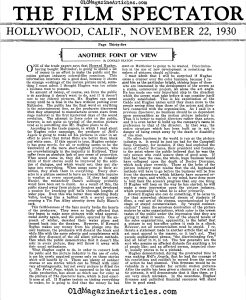
The Thrilling, romantic story of how Howard Hughes, the millionaire kid, who tossed fortunes into the making of Hell’s Angels
The editors of Photoplay, like many in the Hollywood community between the years 1927 through 1930, were extremely curious about wunderkind Howard Hughes (1905 – 1976) and the wildly expensive film he was directing that never seemed able to reach a state of completion, Hell’s Angels. This article, by Bogart Rogers, makes clear that by the time the film was released, production costs had soared beyond the four million dollar range (although some contemporary sources believe it was a few hundred thousand south of that number)- and most infamously, four aviators had been killed during the filming. This article sums-up the Hollywood career of Howard Hughes up to 1930 and seeks to separate some of the falsehoods that circulated about the boy-director.
A sly little grin must have come to the lips of the editors of Photoplay when they asked Hollywood’s reigning scandal-monger, Errol Flynn (1909 – 1959), to write a small treatise concerning Hollywood morals – and he accepted their offer. Flynn sharpened his pencil and scribbled the following lighthearted defense of Hollywood hedonism; contradicting himself at several points, he opined that Hollywood was not much different than any other neighborhood – and actors are always good because they’re too closely monitored to do bad – and if you don’t believe that, then you should know that the acting trade brings out in all who heed the call a certain character trait that makes any monogamy highly unlikely.
The attached article is a swell piece of journalism that truly catches the spirit of home front America. You will read about the war-weary Hollywood that existed between the years 1941-1945 and the movie shortages, the hair-pin rationing, the rise of the independent producers and the ascent of Van Johnson (4-F slacker) and Lauren Becall:
Lauren, a Warner Brothers property, is a blonde-haired chick with a tall, hippy figure, a voice that sounds like a sexy foghorn and a pair of so-what-are-you-going-to-do-about-it eyes