
Famine in the North-East
(Quick Magazine, 1950)
Quite often when Marxist economic theories are put into effect, tree bark becomes a sought-after delicacy…
|

|

|
|

|

|
|

|

|
|

|
|

|
|

|

|

|
|
|
|
|

|

|

|

|

|

|
|
|
|

|
|
|
|
|
|

|
|

|
|
|
|
|
|
|

|
|
|

|
|
Quite often when Marxist economic theories are put into effect, tree bark becomes a sought-after delicacy…
When this profile first appeared in 1950, the column’s subject, Mao Zedong (1893 – 1976), was generally seen as a tin-horn dictator and Stalinist dupe. It wouldn’t be long before he would be widely recognized as one of the greatest mass-murderers in world history.
For those who keep records of the harsh treatment dolled out to religious sects by the various assorted tyrannical governments of the world, China is the all-time champion. Since it’s inception, the People’s Republic of China has attempted to coerce or eradicate every religious faith within its borders. Here is an account by an eyewitness to the many assorted atrocities dished out to the Christians in China by the followers of Mao Zedong (1893 – 1976.
An article about Soviet persecution of religious adherents can be read here…
A magazine article about a political leader who is considered the founder of modern China: Sun Yat-sen (1866 – 1925):
The return of Sun Yat-sen to power in South China is much more than a mere personal triumph, who are assured by his adherents, who say that it is ‘a sign of the times which merits the thoughtful consideration of the Great Powers in their roles of guardians of the Far East.
An interview with Zhang Zuolin (1873 – 1928), the Chinese warlord who oversaw Manchuria and much of North China during the last fifteen years of his life. The article was written by the old China-based correspondent Randall Gould.
Marshall Zhang, drawn to Peking from his native Mukden ‘to cooperate with the foreign ministers in saving China from Bolshevism’, talks in terms of nations but continues to think in terms of provinces. Anyone who has spent half an hour with him knows this. The Strong Man of Mukden has improved his propaganda vocabulary but he is using the same old brain – shrewd, keen, but sharply limited.
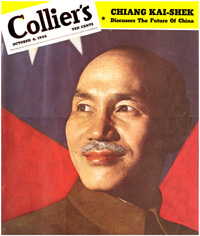
Generalissimo Chiang Kai-Shek stepped up to the plate and answered nine questions that were put to him by COLLIER’S editor Henry La Cossitt, concerning the future of democracy in China.
In December of 1949 Generalissimo Chiang Kai-Shek’s anti-communist forces retreated to the island of Formosa (Taiwan).
This is a single column that clearly lays out the Truman Administration’s diplomatic policies concerning Mao’s China – the summary is reduced to five bullet points.
Attached is a 1927 American magazine article that reported on the Soviet influence taking place in China. Attention is paid to the activities of a young Soviet named Karl Berngardovich Radek (born Karol Sobelsohn: 1885 – 1939):
Russia has been the only country to assist the Nationalist China movement to which they all hope to devote their lives. Men who believe in the ‘dictatorship of the proletariat’ have furnished much of the brain-power that has organized, directed and articulated the Chinese popular uprising in it’s successful Northern drive…As far as foreign culture is concerned, China is still much more deeply steeped in American and British idealism than in those of modern Russia
Washington’s growing impatience and distrust with both Chiang Kai-shek’s island nation and the communist thugs on the mainland was reaching the high-water mark during the earliest days of 1950 when President Truman’s Secretary of State Dean Acheson (1893 – 1971) presented that administration’s China policy:
No official military aid for Generalissimo Chiang Kai-shek’s Chinese Nationalist government, either on the island of Formosa [Taiwan] or anywhere else. No hasty recognition of the Communist Chinese government of Mao Zedong. No attempt to stop further Russian advances in Asia except through ‘friendly encouragement’ to India, French Indo-China, Siam, Burma and the new United States of Indonesia…
A 1941 magazine article by Delbert Johnson that reported on the unprecedented success of Chinese Industrial Cooperatives during the earliest period of the Japanese occupation:
Industrial cooperation in China, which was no more than a paper plan three years ago, today is a nation-wide movement that has cast a blight upon Japan’s economic aspirations in Asia and is providing the people of China a new means of salvation against aggression.
The plan for the Indusco movement came into being during the dark days of the spring and summer of of 1938…Seemingly, China was doomed to economic strangulation if not to military defeat. But a handful of Chinese and foreign visionaries’ thought otherwise. They knew that time, area and population all would work to China’s advantage in any prolonged struggle.
The years 1927 through 1947 has largely been remembered as a victorious era for the Chinese Nationalists in their struggle against the Communist rebels under Mao Zedong (1893 – 1976). However, following Mao’s 1947 retreat to Manchuria and the subsequent training and reforms that took place within his army, the Nationalist Chinese troops began to feel the humiliation of defeat until they made good their strategic withdrawal to Formosa (ie. Taiwan), where they have remained ever since.
This single page article goes into greater detain outlining the chronology of events.
Upon hearing that Stalin had died, the official Red Chinese radio spent hours talking of Stalin’s death, paid little heed to Malenkov’s elevation to Russia’s premiership.
Mao has considered himself second only to Stalin in communism.
The review of J.O.P. Bland’s China: The Pity of It which was written by Henry Kittredge Norton:
Mr. Bland (1863 – 1945) has known his China for a third of a century and he is convinced that if that unhappy country has moved at all in the last three decades, it has moved backwards…Without relieving the Chinese of their share of the responsibility in the premises, the half-baked liberalism of the west – by which is meant Great Britain and the United States for the most part -is found to be the chief cause of expanding disaster in China…
Available at Amazon: China – The Pity Of It
A dispatch from the old China watcher Lewis S. Gannett was printed in the left-leaning American magazine, THE NATION:
All China has been won to half the Nationalist program – that which is directed to the reestablishment of national independence. The fundamental conflict between ‘moderates’ and ‘extremists’ is, I think, between short-sighted men who think that the Nationalist passion can subside without causing fundamental changes in China’s social fabric, and those who recognize the inevitability of industrialization in China and are determined that their country shall not pass through all the miserable phases of capitalistic industrialism which created a disinherited proletariat in the West.
Seasoned Washington journalist Felix Morley (1894 – 1982) discussed the complicated issues involved in the diplomatic recognition of Communist China:
All the obvious arguments are against recognition. The Red regime in China has imprisoned our official representatives, confiscated American property, flouted and insulted us in a dozen different ways.
But in recent years we have mixed up diplomatic recognition and moral approval. The absurd result is that we recognize Russia and not Spain, and are at present opposed to recognizing China even though we fear that may be cutting off our nose to spite Stalin’s face.
An excerpt from a longer article written by an eyewitness concerning the atrocities that took place in 1927 Nanking as the victorious Nationalists forces entered the city. Reference is made to the bombarding of that city by both British and American gunboats.
Click here to read about the 1937 sacking of Nanking.
