











The New Republic Articles
Touchstone Magazine Articles
Sea Power Magazine Articles
The Smart Set Articles
Liberty Magazine Articles
Click Magazine Articles
Photoplay Magazine Articles
The Flapper Magazine Articles
The New York Times Articles
Rob Wagner's Script Magazine Articles
Harper's Bazaar Magazine Articles
Scribner's Magazine Articles
Ken Magazine Articles
The American Legion Weekly Articles
La Baionnette Articles
Current Literature Magazine Articles
Outing Magazine Articles
The American Legion Monthly Articles
The Film Spectator Magazine Articles
Stage Magazine Articles
Men's Wear Magazine Articles
The National Park Service Articles
The Saturday Review Articles
Vogue Magazine Articles
Collier's Magazine Articles
Hearst's Sunday American Articles
Direction Magazine Articles
Film Daily Magazine Articles
Outlook Magazine Articles
Pic Magazine Articles
Life Magazine Articles
Newsweek Articles
Confidential Magazine Articles
Leslie's Magazine Articles
People Today Magazine Articles
The Atlantic Monthly Articles
Punch Magazine Articles
The Dial Magazine Articles
Confederate Veteran Magazine Articles
G.I. Joe Magazine Articles
The Saturday Evening Post Articles
Trench Warfare Articles
Freedom's Triumph Articles
The North American Review Articles
PM Tabloid Articles
47 Magazine Articles
Harper's Weekly Articles
Vanity Fair Magazine Articles
Creative Art Magazine Articles
Theatre Arts Magazine Articles

Aviation History

Find archive articles on Aviation. Our site has great information from old magazine newspaper articles about Aviation history.

Air Force One – the First One
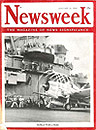
(Newsweek Magazine, 1945)

Two months after the death of President Roosevelt, and with W.W. II almost at an end, the censorship concerning FDR’s presidential aircraft was terminated. The reporters at Newsweek were not slow in reporting all that could be known about this comfy juggernaut that had spirited FDR to Malta, Yalta and Cairo. The plane was a Douglas C-54A, reconfigured to sleep five and was equipped with an inter-cabin telephone, radio, and a stateroom. The President had anticipated traveling hither and yon while planning the post-war world, but other plans got in the way.

Frank Coffyn
(Collier’s Magazine, 1934)

Frank Coffyn (1878 – 1960) was one of the earliest pioneer aviators in the United States. In this article he recalls those heady days when he regularly broke bread and talked shop with the likes of Orville Wright and other assorted fathers of aviation. Coffyn has long been remembered for being the first pilot to fly his camera-mounted Wright Flyer over Manhattan and under both Brooklyn and Williamsburg Bridges in 1912 – which he recalls herein.

Advertisement

Use shortcode [oma_ad position="summary_top"] (or other position) in your theme or widgets to display OMA Promotions here.

The First Ten Years of Passenger Air Travel
(Click Magazine, 1938)

In the wake of numerous air disasters involving the nascent passenger airlines, this article was produced to show readers that with each crash, steps were taken to make each flight safer. In 1938, the Federl Government stepped in and established the Civil Aeronautics Authority.

Wilbur Wright, R.I.P.
(Collier’s, 1912)

The Collier’s Magazine obituary for Wilbur Wright (1867 – 1912) was written by the aviator and journalist Henry Woodhouse (born Mario Terenzio Casalengo, 1884 – 1970).


The Brothers Wright gave flying instructions to a young boy who would later become one of the first U.S. Air Force generals – you can read about him here…


Click here to read about a much admired American aviator who was attracted to the fascist way of thinking…

Advertisement

Use shortcode [oma_ad position="summary_top"] (or other position) in your theme or widgets to display OMA Promotions here.

Two Parachute Pioneers
(Popular Mechanics, 1912)

Attached is a well illustrated article concerning two of the earliest parachute drops: one was quite fatal while the other had a jollier ending. The first leap documented in this column was made by a fellow known only as F. Rodman Law (dates?); he jumped 345 feet from the torch of the Statue of Liberty and landed 30 feet from the water’s edge. The next day, parachute enthuiast Franz Reichelt (1879 – 1912) jumped from the first platform of the Eiffel Tower with a parachute of his own design. The Popular Mechanics correspondent reported that:

His body was a shapeless mass when the police picked it up.

Advertisement

Use shortcode [oma_ad position="summary_top"] (or other position) in your theme or widgets to display OMA Promotions here.

Harry Hawker
(The Literary Digest, 1919)

An article on the pioneer aviator Harry Hawker (1889 – 1921), written on the heels of his his failed attempt to beat the Yankees in crossing the Atlantic. Australian by birth, Hawker came to Britain specifically to seek a career in the infant aviation industry. His wish was answered in 1912 when he was hired by Tommy Sopwith. Hawker saved his wages to afford flying lessons and acquired his flying permit in the September of that same year. The following month he won the British Michelin Cup with a grueling endurance flight of 8 hr, 23 min. Sopwith was impressed and Hawker was promoted to chief test pilot. The rest is told herein…


from Amazon: Hawker: Aviator, Designer, Test Pilotstyle=border:none

New York to Philadelphia in Record Time
(Popular Mechanics, 1910)

Pilot Charles Hamilton (1886 – 1914) made the first round-trip flight from Philadelphia to New York and back again flying a Curtis bi-plane in 1910:

He flew from New York to the Philadelphia in one hour and fifty minutes. His average speed on trips to the Quaker City was 46.92 miles per hour, but returning he averaged 51.36 miles per hour.


The NEW YORK TIMES paid Hamilton $5,000.00 for this achievement.

Advertisement

Use shortcode [oma_ad position="summary_top"] (or other position) in your theme or widgets to display OMA Promotions here.

Mouillard: Aviation Pioneer
(The Literary Digest, 1912)

The attached 1912 Literary Digest article addresses the debt that past and future aviators owe to Louis Pierre Mouillard (1834 – 1897); an aviation visionary whose relentless study of bird flight throughout the last half of the Nineteenth Century paved the way for aviators yet unborn.

The China Clipper
(Literary Digest, 1935)

When the twenty-five-ton Martin transport-plane successfully passed its preliminary tests at Baltimore a few days ago, preparatory to entering the regular service of Pan American Airways, it was an occasion of world significance. In all likelihood this new member of the famous Clipper series will be the first to establish regular passenger and mail service across the Pacific.

The Earliest Airline Stewardesses
(The Literary Digest, 1933)

By the time this article hit the newsstands, the airline stewardess job was no longer a novelty and there were twenty-five women working in relays on the trans-continental run between Chicago and Oakland. The woman who held the record as the first airline stewardess, Ellen Church (1904 – 1965), was hired two and a half years earlier.


In addition to other restrictions, the earliest flight attendants of the Thirties were all required to be no older than 26, weigh no more than 118 pounds, stand no taller than 54 and hold nursing degrees in order that they be prepared to soothe the frayed nerves of the flight-fearing passengers.


With the birth of passenger airlines came the need for those who had particular set of culinary skills: read about them here.

Advertisement

Use shortcode [oma_ad position="summary_top"] (or other position) in your theme or widgets to display OMA Promotions here.

Naval Aviation as a Concept
(Popular Mechanics, 1914)

As early as 1914, the dreamers who saw the possibilities in aviation began to envision non fixed-wing aircraft and ships that could carry them out to sea. The attached 1914 article concerns an unnamed ship being constructed at the Blyth Shipyard in England that is designed to transport flying boats at sea, picking-up and lowering to and from the sea by way of cranes. The article is illustrated.

Just Another Airborne Wedding Ceremony
(Literary Digest, 1922)

Another article on this site marks 1912 as being the year that saw the first airborne wedding ceremony; but this article reported on the first wedding to be performed in a Fokker Monoplane with the added benefit of a wireless radio transmitter that broadcast the event to numerous well-wishers down below. The wedding was officiated by non-other than the Flying Parson himself, Belvin W. Maynard. Maynard was a legend in early aviation and he died in a crash some four months later.

The number of in-flight nuptials that have been performed since the first in 1912 are too numerous to count; however the last high-profile event took place in the Fall of 2007, when Sir Richard Branson (b. 1950) of Virgin Airlines presided over an in-flight wedding ceremony at 35,000 feet en route from San Francisco to Las Vegas.

Early Aviation Safety Inventions
(The Literary Digest, 1912)

An overview of the technological advancements that had been introduced in the aviation community in 1912. References are made to the superiority of the Pneumatic Flying Helmet, and the installation of the W. I. Twombly Safety Harness, oil gauges, self-acting gas pumps, double-cables, self-starting motors and heavily re-enforced wheels.

References are also made to the 1910, twenty-two mile flight across the English Channel by a pilot named Bleriot.

Advertisement

Use shortcode [oma_ad position="summary_top"] (or other position) in your theme or widgets to display OMA Promotions here.

Scroll to Top