










World War Two

Find old World War 2 articles here. We have great newspaper articles from wwii check them out today!

Broadway Theater in Wartime
(Yank Magazine, 1945)

New York’s Broadway theater scene during World War II:

Show people will never forget the year 1944. Thousands of men and women from the legitimate theater were overseas in uniform -actors and actresses, writers, scene designers, stage hands – and all looked back in wonderment at what war had done to the business… Letters and newspapers from home told the story. On Broadway even bad shows were packing them in…


Click here to read a 1946 article about post-war Broadway.

The Women of the U.S. Coast Guard
(Think Magazine, 1946)

From the icy sweeps of Alaska to the tropical Hawaiian Islands, trimly clad girls in the dark blue of the Coast Guard SPARS have served since their organization was founded in 1942 to fill the shore posts of men at sea.

Communications and radio work were an important phase of their duty. Another field in which SPARS were exceptionally active was aviation, with young women in navy blue working in control towers, instructing fledgling fliers via the Link trainer, and parachute riggers…SPARS were also required to familiarize themselves with weapons.

Ranking woman officer is Captain Dorthy C. Stratton (1899 – 2006), Director of the Women’s Reserve, appointed on November 24, 1942).

The 9th Air Force on D-Day
(Yank Magazine, 1944)

An eye-witness account of the U.S. Army Ninth Air Force A-20 bombers as they made their runs on D-Day:

There was no time to lose on this mission. Hitler’s armies might well be driving over those crossroads toward the beachheads at this minute. This was not just an ordinary mission. It was the beginning of a mission that some day might end all combat missions.

‘There’s London.’ Rafalow announced, over the intercom.
I glanced down. The acres of buildings looked quiet and peaceful.
You’d almost think there wasn’t a war on.’
A few minutes later his voice came over the intercom again, but this time it was high-pitched with excitement. We were over the English Channel where it was quite obvious there was a war on.
‘By God, look at the ships!’ he yelled.

Advertisement

Use shortcode [oma_ad position="summary_top"] (or other position) in your theme or widgets to display OMA Promotions here.

D-Day-Plus-One
(Yank Magazine, 1944)

D-Day for my outfit was a long, dull 24-hour wait. We spent the whole day marooned in the middle of the English Channel, sunbathing, sleeping and watching the action miles away on the shore through binoculars. We could hear the quick roars and see the greenish-white flashes of light as Allied Battleships and cruisers shelled the pillboxes and other German installations on the beach.

On D-plus-one we took off for shore. Four Messerschmidtts dove down to strafe the landing crafts as we headed in, but a Navy gunner drove them off with a beautiful burst of ack-ack…

Assessing the Late-War German Soldier
(U.S. Dept. of War, 1945)

The German soldier is one of several different types depending on whether he is a veteran of 4 or 5 years, or a new recruit. The veteran of many fronts and many retreats is a prematurely aged, war weary cynic, either discouraged and disillusioned or too stupefied to have any thought of his own…The new recruit, except in some crack SS units, is either too young or too old and often in poor health.

Medal of Honor Recipient Robert D. Maxwell
(Collier’s, 1945)

This 1945 article by George Creel reported on the brave and selfless acts of Robert D. Maxwell (1920 – 2019):

COURAGE, like everything else, has its kinds of degrees. No one would detract a hair’s weight from the bravery of the firing line, but in battle there is the heartening touch of a comrade’s shoulder, the excitement of the charge, and the 50-50 chance of coming out alive. All these aids are lacking in those epic instances where men make death a deliberate choice…one example that stands out for sheer drama and sustained fortitude is that of Technician Fifth Grade Robert D. Maxwell, who covered a German hand grenade with his body, smothering the explosion that would have killed every member of his group.


Maxwell survived his wounds; seven months later he was awarded the Medal of Honor for his courage. He currently reside in Oregon.

Advertisement

Use shortcode [oma_ad position="summary_top"] (or other position) in your theme or widgets to display OMA Promotions here.

The DUKWs of W.W. II
(Yank Magazine, 1944)

The American Army’s amphibious vehicles called the DUKWs (Ducks) were first manufactured by General Motors in 1942 and were issued to both the U.S. Army and Marine Corps. 2,000 were shipped to the British, over five hundred found their way to the Australian military and 535 were passed along to the Soviet Army. They have earned their sea legs a thousand times over and have even ventured across the English Channel.

The attached YANK MAGAZINE article was one of the first articles to have ever been written about them, and quite ironically plays-down the revolutionary nature of the invention:

Japs realize the value of the DUCKs. They once issued a communique saying their bombers sank ‘one 5,000-ton ship and one amphibious truck.

A German Advantage in the War
(Yank Magazine, 1945)

The Chief of Staff’s 1945 report concerning the U.S. Army’s progress and set-backs during the course of the war mentioned one element:

in which the German Army held an advantage almost to the end of the war. The first was the triple-threat 88-mm [field gun] which our troops first encountered in North Africa…

Anticipating Germany’s Collapse
(United States News, 1944)

Taking into consideration the state of Germany’s military forces on land, air and sea, as well as the fragile state of the German populace after three years of steady bombardment, this 1944 NEWSWEEK MAGAZINE article concluded that Germany’s end was nigh – really, really nigh:

Thus on the face of it, Germany’s situation is desperate. She is encircled by powerful nations that are allied against her. Her chance of creating dissension to split those allies is gone. She is being beaten on every front and in every phase of the fighting. Her last chance to win has disappeared.


Germany would fight on for another sixteen months.

Advertisement

Use shortcode [oma_ad position="summary_top"] (or other position) in your theme or widgets to display OMA Promotions here.

‘About the Russians in Normandy”
(Yank Magazine, 1944)

About the Russians in Normandy…and they weren’t much help to Adolf, either. Here are two stories, one of which tells how Russians, captured and forced to fight for the enemy, turned the tables on Jerry; the other which tells what happened when the Americans liberated Russian prisoners from a concentration camp.

Marlene Dietrich Did Her Bit
(Yank Magazine, 1945)

A post-game interview with Hollywood star Marlene Dietrich (1901 – 1992) concerning all the many places throughout the European Theater of Operations that she performed before Allied audiences, at times performing very close to the German front line.


Marlene Dietrich’s only daughter, Maria Riva Dietrich (b. 1924), wrote that her mother, feeling a deep sense of pity and gratitude, made love to a very large number of front line soldiers.


Click here to read about the woman who entertained the U.S. troops during the First World War.

Advertisement

Use shortcode [oma_ad position="summary_top"] (or other position) in your theme or widgets to display OMA Promotions here.

Riding The Fox-Hole Circuit
(Newsweek Magazine, 1944)

Together [these entertainers] constitute the vast composite known as USO-Camp Shows, Inc. Organized in November, 1941 as this war’s answer to the last one’s mistakes (too little which came too late to too few), Camp Shows see to it that as much entertainment as possible reaches as many soldiers as possible – in contrast to the fact that the last war produced only an Elsie Janis (You can read about her here)… The money to run Camp Shows comes from the National War Fund; the authority to use its services rests with the Army and Navy.

Montgomery’s Quarrel with Eisenhower
(Collier’s Magazine, 1946)

One of the many now-it-can-be-told stories of the early post-war period had to be that friction that existed on the SHAEF staff between British General Bernard Law Montgomery and General Eisenhower. It is recalled herein by the noted English war correspondent Alan Moorehead (1910 — 1983).

When General Eisenhower Came Home
(Yank Magazine, 1945)

The General had seen welcomes in Paris and London and Washington and New York, but he got the warmest reception of all when he hit his boyhood home town, little Abilene, Kansas.

As soon as the Eisenhower party was seated a gun boomed and the parade began. It wasn’t a military parade. It told the story of a barefoot boy’s rise from fishing jaunts on nearby Mud Creek to command of the Allied expeditionary force that defeated Fascism in Western Europe.


In 1944, a class of sixth graders wrote General Eisenhower and asked him how they can help in the war effort; click here to read his response…

Advertisement

Use shortcode [oma_ad position="summary_top"] (or other position) in your theme or widgets to display OMA Promotions here.

Wartime Brooklyn
(Yank Magazine, 1945)

A four page article regarding the city of Brooklyn, New York during the Second World War – make no mistake about it: this is the Brooklyn that Senator Bernie Sanders inherited – it isn’t far from the N.Y. borough named Queens, where numerous Communists resided.


• Almost half the penicillin that was produced in the United States came out of Brooklyn

• Forty Five percent of of the Brooklyn war plants were awarded the Army and Navy E or the M from the Maritime Services

• Throughout the war, the ranks of the U.S. Armed Services were swollen with Brooklyn sons and daughters, 280,000 strong.


Click here to read an article about one of New York’s greatest mayors: Fiorello LaGuardia.

Los Angeles Nisei at Santa Anita Racetrack
(Rob Wagner’s Script, 1942)

Attached is a eye-witness account of the Los Angeles Issie and Nisei populations after having been removed from their homes and detained at Santa Anita racetrack prior to their transfer and subsequent incarceration at Manzanar, California.

There are more than 6,000 Japanese housed in the stables which once accommodated 2,000 horses…Each stall has had a room built on in front with doors and windows and the floors have been covered with a layer of asphaltum which seems to have killed the odors.

This article, laced throughout with subtle undertones of condemnation, was written by a Hollywood screenwriter named Alfred Cohn (1880 – 1951) who is largely remembered today for having written the adaptation for the Al Jolson movie The Jazz Singer (1929).

Paulette Goddard in Uniform
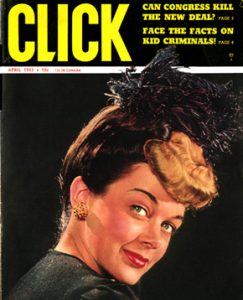
(Click Magazine, 1942)

Paulette Goddard (1910 – 1990) is pictured in color wearing an all-purpose uniform designed by the Hollywood stylist Irene (Irene Lentz, 1900 – 1962). The actress was a sporadic volunteer, having appeared in four films throughout 1942.

Advertisement

Use shortcode [oma_ad position="summary_top"] (or other position) in your theme or widgets to display OMA Promotions here.

Scroll to Top