





World War Two

Find old World War 2 articles here. We have great newspaper articles from wwii check them out today!

An American Tank in Tunisia
(American Magazine, 1943)

Here is first-person account of life in an M3 Stuart tank fighting in Tunisia:


“We were ordered to hold, and hold we did. But we took a terrible shellacking. We dodged around, spitting at the Germans with our little 37mm gun. Every now and then one of their heavy tank shells or high-velocity 88s would hit one of our light tanks and smash it. The wounded would crawl out, and those who could walk would carry or drag those who couldn’t… In the afternoon, when we were finally ordered to withdraw, we had only 9 of 18 tanks left, and some of those were damaged. We took what wounded we could into the tanks and held them in our arms.”

The Seabees
(Pageant Magazine, 1944)

In another article on this site, these words were quoted from the captured dispatches of a Japanese general writing to his superiors:


[The Yank] is a wizard at handling machinery and he can build airfields, roads and advance bases with uncanny speed.”


– he was, of course, referring to the famous Construction Battalions (Seabees) of the U.S. Navy. This article will tell you all about them.

Advertisement

Use shortcode [oma_ad position="summary_top"] (or other position) in your theme or widgets to display OMA Promotions here.

The Battle for the North Atlantic
(All Hands, 1945)

Throughout the course of World War II, there were three admirals who commanded to U.S. Atlantic Fleet: King, Ingersoll and Ingram. It was Admiral Jonas Ingram (1887 – 1952) who wrote the attached article about battle for the Atlantic:


“The Atlantic Fleet’s record speaks for itself. Since the declaration of war we have escorted 16,760 ships across the Atlantic. Of these, less than a score were sunk in convoy…We know definitely that we sunk 126 U-boats…”


Click here to read a related article.

Advertisement

Use shortcode [oma_ad position="summary_top"] (or other position) in your theme or widgets to display OMA Promotions here.

Planning an Assault
(Coronet Magazine, 1945)

Here is an interesting article from World War Two that goes into some detail explaining what is involved when a lieutenant colonel in an infantry regiment presents his plan of attack on a German town that is heavily defended. We hear him as he addresses the junior officers who will do the heavy lifting, and we get a sense of their concerns. Few reporters have ever paid any attention to this aspect of an assault.

Red Victory South of Kharkov
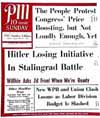
(PM Tabloid, 1943)

“The Russians today apparently had stopped the German advance beyond Kharkov and had even regained the initiative on some sectors of the Donets. The turn of the tide came in Chuguyev, a town on the Donets River some 20 miles southeast of Kharkov. Yesterday the German radio said that Russin forces ‘encircled’ there had failed in attempts to break out.”

British Offensive to be Launched in Tunisia
(PM Tabloid, 1943)

Three months into 1943, the Allied Command announced that the British 8th Army would soon be on the march alongside the newly arrived Americans:


“It will be a tough battle against the best of Hitler’s fighting men and weapons, but there is no doubt among Allied militarists of the outcome. Even pessimists agree that the Axis will be driven into the sea. There is reason to believe that the Nazi command itself is resigned to the loss of its last foothold on the south shore of the Mediterranean.”

Advertisement

Use shortcode [oma_ad position="summary_top"] (or other position) in your theme or widgets to display OMA Promotions here.

VJ-Day on New York City
(PM Tabloid, 1945)

“Seven million New Yorkers let down their hair last night in the wildest, loudest, gayest, drunkest kissingest, hell-for-leather celebration the big town has ever seen.”


Click here to read about VE-Day in New York City…

The Japanese Run Out of Ships
(PM Tabloid, 1944)

After the Battle of Leyte Gulf, the U.S. Navy believed that the Japanese had lost over half their original strength:


“Naval observers in Washington are exhilarated by the evident extent of the Japanese defeat but, in true Navy tradition, they are being canny about it. It isn’t what we have sunk or disabled [that matters], it’s what is left that can still fight.”

Advertisement

Use shortcode [oma_ad position="summary_top"] (or other position) in your theme or widgets to display OMA Promotions here.

Pearl Harbor and the Significance of Radio
(PM Tabloid, 1941

“The news of [the Pearl Harbor] attack broke out at a time on Sunday afternoon when a comparatively few newspapers in the U.S.A. were being published (there were no evening papers on sunday). The result was that the nation learned of the war and its immediate developments almost entirely by radio. The National Broadcasting system held the bulletin for a few minutes, and at 2:30 gave the news simultaneously to its Red and Blue networks, and subsequently to the whole world over its international short-wave system.”

Japanese Fleet Crossed the Sea While Kurusu Talked
(PM Tabloid, 1941)

“Don’t believe that the Japanese ordered their dawn assault only yesterday. The fact is that they ordered it not days ago but weeks ago. While Japan’s special envoy, Saburo Kurusu, was busy talking in Washington, the ships that were to attack us were already on their way. While he was staling and waiting ‘for instructions’, they were getting into position. More than that: they had their orders before Kurusu even started talking.”

Arrests
(PM Tabloid, 1941)

The mass arrests of Japanese Americans began the evening of the Pearl Harbor attack:

“As the arrests began last night, Attorney General Francis Biddle announced that FDR had authorized him to apprehend as ‘alien enemies’, Japanese aliens considered dangerous ‘to the peace and security of the U.S.A. He said that at least 1,000 Japanese nationals would be affected, but there would be ‘a fair hearing for all persons apprehended.’ “

Advertisement

Use shortcode [oma_ad position="summary_top"] (or other position) in your theme or widgets to display OMA Promotions here.

Looking for Spies on the Japanese Home Front
(Collier’s Magazine, 1941)

“The spy phobia possesses all inhabitants of Nippon. No one believes a foreigner can possibly be living in or visiting Japan for any simple reason such as business or pleasure. He must be in the pay of a foreign government. This entails a counterespionage system in which every Japanese joins with enthusiasm.”

Impressions of Tokyo
(Collier’s Magazine, 1945)

During the August of 1945, C.C. Beall (1892 – 1970), popular commercial illustrator of the Forties, was dispatched by Collier’s to illustrate the surrender of the Imperial Japanese Empire on the decks of the battleship Missouri – and to draw-up whatever else caught his fancy on mainland Japan. Much of his account concerns his search for food and suitable lodgings.

The Japanese Spy Problem
(American Legion Magazine, 1939)

“At the end of last year, our authorities discovered that there were nearly one hundred Japanese leg men in New England reporting to the Boston office. More than five hundred in Washington; something above two hundred in Chicago; twenty-five hundred were in the New York area; twenty-five in Cleveland; thirty-eight in Detroit; eighty-odd in Florida, and so on out to the West Coast where around three thousand Japanese are ‘on duty’ from San Diego to Port Washington.”

Advertisement

Use shortcode [oma_ad position="summary_top"] (or other position) in your theme or widgets to display OMA Promotions here.

Scroll to Top