


























World War Two

Find old World War 2 articles here. We have great newspaper articles from wwii check them out today!

”Impregnable Pearl Harbor”
(Collier’s Magazine, 1941)

Six months before Japan’s devastating assault on Pear Harbor came this article concerning how remarkable the Navy’s defensive measures were and how unlikely it would be if the installation was ever to be attacked. A large part of the article concerned how overwhelmingly Japanese the Oahu population was, and the many steps taken by the Army and Navy to keep them off-base. How terribly unimaginative of them to think that Japanese Naval Itelligence wouldn’t think to farm-out spying to an Englishman like Frederick Rutland – which they did.

POWs at Fort Dix
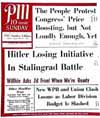
(PM Tabloid, 1945)

“German prisoners of war are not coddled at the Fort Dix camp. The PWs are not mistreated, but neither is any kindness shown them. The officers supervising them are not cruel or lenient; they adhere strictly to the letter of the Geneva Convention on the treatment of prisoners.”


PM reporter Jack Shafer knew all this to have been true, because he went to Fort Dix and saw for himself.

Advertisement

Use shortcode [oma_ad position="summary_top"] (or other position) in your theme or widgets to display OMA Promotions here.

Dr. Jung on Germany’s Hangover
(PM Tabloid, 1945)

Swiss psychiatrist Carl Jung (1875 – 1961) had much to say as to how the German people could come to terms with all the dreadful acts that were committed in their name during the previous 12 years.


“[The German] will try frantically to rehabilitate himself in the face of the world’s accusations and hate – but that is not the right way. The only right way is his unconditional acknowledgement of guilt… German penitence must come from within.”


Click here to read Jung’s thoughts on Hitler.

U.S. POWs Singled Out for Abuse
(PM Tabloid, 1945)

PM war correspondent Victor Bernstein filed this story three weeks before VE-Day concerning a 180-mile forced march that was the lot of assorted Allied prisoner of war in Germany. Numerous interviews with the survivors of the march revealed that the Nazis lording over as many as 4,000 POWs choosing to brutalize the U.S. prisoners in much the same way they abused Poles and Soviets. British POWs seemed not to attract their ire.

A Futile Defense Tactic
(PM Tabloid, 1945)

“The Japanese are making frenzied and costly attempts at Okinawa to stem our advance toward the home islands, but their efforts appear no more successful than they were in the Philippines and Iwo Jima.”

Advertisement

Use shortcode [oma_ad position="summary_top"] (or other position) in your theme or widgets to display OMA Promotions here.

London Under the Bombs
(Collier’s Magazine, 1941)

“A German plane dropped a flare. Then the inevitable stick bombs followed and the Savoy [Hotel] trembled. I looked and winced. Two large fires were reaching up into the night. This dwarfed any Blitz I have ever seen. Still both incendiaries and high-explosives screamed down. The night was filled with noise – all of it frightening noise. And above the planes still roared. It was so light that the balloons could be seen clearly. Now and then there would come the rattle of machine gun fire, hardly heard over the crackling of fires and the noise of the bombs. But it told us that the night fighters were up there.”

A Great Time to be Alive
(PM Tabloid, 1945)

It is our wish to successfully give utterance to the true feelings from each era that we are able to represent on this website; for this reason, we posted the attached column by Max Lerner (1902 – 1992), in which he expresses his excitement as to how great it was to be alive in one of the Allied nations at the time of Hitler’s demise.


“The two big fascist leaders in whose shadow our whole generation has lived – Mussolini and Hitler – are now lying dead amidst the ruins of their empires, one following the other in the space of a few days…We are not only the anvil. We are the hammer. To know that is to grow in stature in a great time.”

Advertisement

Use shortcode [oma_ad position="summary_top"] (or other position) in your theme or widgets to display OMA Promotions here.

The Drive on Berlin
(PM Tabloid, 1945)

“Flags of two new kinds are flying in the city – white flags displayed by the panic-stricken populace, and the first Soviet flags that, Reuters says, are hoisted over what tall buildings are left within the captured districts. Three Soviet guards carried a blood-soaked banner 2000 miles from Stalingrad to Berlin. Pravda says the soldiers kneeled and kissed the flag and then raised it over a ruined building.”

A Pen-Picture of the Devastated Soviet Union
(Collier’s Magazine, 1941)

After touring thousands of miles with a German press-pass throughout Nazi-occupied Russia, American journalist Hugo Speck (1905 – 1970) gave a thorough picture of the violence visited upon that land by both Armies:


“German-occupied Russia is in rags and ruins; huge sweeps of European Soviet territory have been systematically destroyed, partly by the Russians themselves and partly by the devastation of Stukas, panzers, guns and fire…”

Advertisement

Use shortcode [oma_ad position="summary_top"] (or other position) in your theme or widgets to display OMA Promotions here.

Longing to Meet the Reds
(PM Tabloid, 1945)

“The aspiration to be the first to meet the Red Army is aired all the way up and down the line, from division generals to the boys in the foxholes. And if the Yanks had their way, they’d hit the first road east and keep helling it eastward till they hit the vodka. As one soldier from an armored division put it:”


“‘This is what the hell we’ve been pushing across Europe for and I don’t want to lose the pie when I practically have it in my mouth.'”

Destroying Germany from Above
(Collier’s Magazine, 1943)

“The Reich is being methodically pulverized. The Eighth U.S. Air Force by day and the R.A.F. by night have only begun their deadly round-the-clock job. The coming months will see them unleash a fury that surpasses all the world’s earthquakes.”

Life on a B-17 Base in England
(Collier’s Magazine, 1943)

This is an amazing article that recalls the open-all-night cities that were the B-17 bases in Britain during World War Two. Such were the lives of the ground crews, who worked all night and then found sleep impossible – preferring to stay-up and stare at the skies in anticipation for their returning bombers.


“A crew chief stumbles past you on his way to the hangar. He’s been going seventy-two hours without taking his shoes off; his face is unshaven, and his eyes look like holes burned in a blanket.”

Advertisement

Use shortcode [oma_ad position="summary_top"] (or other position) in your theme or widgets to display OMA Promotions here.

Life on a B-17 Base in England
(Collier’s Magazine, 1943)

This is an amazing article that recalls the open-all-night cities that were the B-17 bases in Britain during World War Two. Such were the lives of the ground crews, who worked all night and then found sleep impossible – preferring to stay-up and stare at the skies in anticipation for their returning bombers.


“A crew chief stumbles past you on his way to the hangar. He’s been going seventy-two hours without taking his shoes off; his face is unshaven, and his eyes look like holes burned in a blanket.”

Soldiers Speak-Out About the Home Front
(Collier’s Magazine, 1943)

“There is no other country at war with such an enormous gulf in sacrifice between fighting men and civilians. There is no other country where the men at the front have given up everything, while the people at home have given up practically nothing. And the soldiers know it…‘A few bombs would do this country a lot of good.’ I heard that in San Francisco from a curly-headed sailor who had been sunk in the Pacific, and I heard it again in Washington from a corporal who had left his leg on Hill 609. Both added, rather anxiously, that, of course, they wouldn’t want anyone to get hurt.”

Advertisement

Use shortcode [oma_ad position="summary_top"] (or other position) in your theme or widgets to display OMA Promotions here.

Scroll to Top