

World War Two

Find old World War 2 articles here. We have great newspaper articles from wwii check them out today!

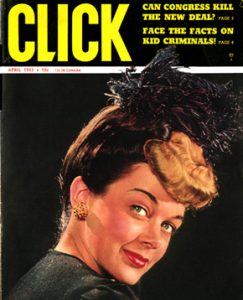
The Pin-On Hairdo: White Trash Triumph
(Click Mahazine, 1943)

In light of the fact that we are patriots, we like to think that these hairdos were not as wide-spread on the home front as the journalist implies.


Michel, of the Helena Rubinstein salons, has been fingered as the one responsible for the two-tone pin-On hairdo, a look that was entirely reliant upon the false hair industry in order to achieve the preferred look. Three color images are provided as well as six how-to images.


During the Second World War, hair dye was not simply used by women; click here to read about the men who needed it.


Click here to read a 1961 article about Jacqueline Kennedy’s influence on American fashion.

When Fashion and Uniforms Meet…(Click Magazine, 1942)

When the general appearance of women’s uniforms prescribed for voluntary war work by various charitable organizations were deemed unfashionable, uncomfortable or simply embarrassing, the well-known fashion stylist and costume designer Irene (Irene Lentz, 1900 – 1962) stepped up to the plate designing an all-purpose green wool suit, topped-off by a beret:

The noted Hollywood stylist, Irene, performed a real service for defense when she designed her all-around defense suit. Of sturdy gabardine, worn with long cotton service socks and plastic shoes, it is nevertheless as attractive as any civilian suit, and more practical than most. In this outfit, women war workers will not feel self-conscious and ill at ease.

Women, Fashion and Uniforms on the Home Front
(Rob Wagner’s Script Magazine, 1942)

Two short, gossipy paragraphs from a Hollywood literary magazine printed early in the American home front experience concerning women war-workers, fabric rationing and the long-standing debate between ready-made uniforms vs custom-made uniforms:

Feminine uniforms are causing great dismay. Women of small means complain that while they would like custom-made uniforms, they can’t afford them. Nevertheless, designers are doing a capacity business, turning out ultra-chic numbers for those in the money…

Click here to read an article about women’s uniforms during W.W. I.

Advertisement

Use shortcode [oma_ad position="summary_top"] (or other position) in your theme or widgets to display OMA Promotions here.

W.W. II Button Restrictions and Button Decorations
(Click Magazine, 1943)

A well-illustrated article from the home front fashion-filled pages of Click Magazine that served to document the contradictory days when wartime button-rationing coincided with a wide-spread yen for decorating with buttons:

In a frantic bid for individuality, fad-loving women are rediscovering the decorative button. Buttons are no longer just a practical devices for holding clothes together. They pep-up simplified silhouettes and restyle dated fashions.

John Frederics and the Hats for the Fall
(Click Magazine, 1942)

Here is a an Elizabeth Hawes (1903 – 1971) fashion review covering some of the hats for the autumn of 1942. They were all the creations of John-Frederics (1902 – 1993) – some are simply fantastical while others are a tad less dramatic, but not lacking in style.


Click here to read about the hats of 1947.

Advertisement

Use shortcode [oma_ad position="summary_top"] (or other position) in your theme or widgets to display OMA Promotions here.

That Slim Wartime Silhouette
(Click Magazine, 1943)

Five fashion photographs and a few words on the government-approved look for the autumn of 1943. The wartime fashion news for 1943 was apparel order L-85 that had been issued by the War Production Board in order to conserve material for victory.


To read another article about 1940s fashions and the hardships of fabric rationing, click here. Click here to read about the fashion silhouette of the early Fifties.

Fashion Symbolism in Wartime Attire
(Yank Magazine, 1945)

This was an unusual article for Yank to run with but it is a wonderful read nonetheless. The column concerns fashion as a reliable barometer of societal direction and starts out with a quote from Basil Liddell-Hart (1895 – 1970) on this issue. The writer then goes to the author and all-around fashion philosopher, Elizabeth Hawes (1903 – 1971) who proceeded to speak thoughtfully on the topic of fashion in wartime. Hawes remarked that the clothing of the leaders can be read as an indicator of forthcoming events.


CLICK HERE to read about the beautiful Blonde Battalions who spied for the Nazis…

Paris Fashion Liberated
(Tricolor Magazine, 1944)

New York fashion journalist Gertrude Bailey wasted no time in applying for her overseas press pass upon hearing the news that the Germans had been driven from the banks of the Seine in August of ’44. Although the fashion column she filed largely anticipated the glorious return of Paris chic, mention was also made of what Paris fashion was like during the German occupation – sitting ringside at one of the runways, Bailey found that

One found significance in the appearance of green as a color, and noted that the reason it had been absent for four years was because it was the color of the German uniform, which no Frenchwoman would wear until France was free.

Advertisement

Use shortcode [oma_ad position="summary_top"] (or other position) in your theme or widgets to display OMA Promotions here.

Home Front Lingerie
(Click Magazine, 1944)

Here is a small article, illustrated with five fashion images, about the types of intimate apparel and pajamas that were available to the home-sewing girls on the W.W. II American home front.


Click here to learn about the under garments that had to be worn to pull-off the New Look

Advertisement

Use shortcode [oma_ad position="summary_top"] (or other position) in your theme or widgets to display OMA Promotions here.

The Stewardship of General MacArthur
(Collier’s Magazine, 1948)

The attached article is about the governance of
General Douglas MacArthur (1880 – 1964) over conquered Japan following the close of World War II and was written half way through the American occupation period by the well-respected American journalist George Creel (1876 – 1953). The article clarifies what regime change meant for post-war Japan and the roll that MacArthur’s creed and character played in the process.


Click here to read about the 1918 portrait of General MacArthur painted by Joseph Cummings Chase.

The P-47N
(Collier’s Magazine, 1945)

A printable one page article that expounds on the evolution of the P-47 Thunderbolt through varying stages of development into the fuel-efficient juggernaut called the P-47N. Remembered in the World War II annals as the dependable escort of the B-29 Super fortresses that bedeviled the axis capitals during the closing months of the war.

No sacrifice was made in ammunition, guns or protective armor to provide the P-47N with this long range. It still carries eight 50.-caliber guns, four in each wing. It also can carry 10 five-inch rockets which pack the destructive power of five-inch artillery or naval shells.

Buzz-Bombs Over London
(Yank Magazine, 1944)

Launched by air or from catapults posted on the Northern coast of France, the German V-1 Buzz-Bomb was first deployed against the people of London on June 12, 1944. Before the V-1 campaign was over 1,280 would fall within the area of greater London and 1,241 were successfully destroyed in flight.

Accompanied by a diagram of the contraption, this is a brief article about London life during the Buzz-Bomb Blitz. Quoted at length are the Americans stationed in that city as well as the hardy Britons who had endured similar carnage during the Luftwaffe bombing campaigns earlier in the war.

Advertisement

Use shortcode [oma_ad position="summary_top"] (or other position) in your theme or widgets to display OMA Promotions here.

The Grumman Hellcat
(Collier’s Magazine, 1943)

An enthusiastic piece that informed the folks on the home front that the days of the Japanese Zero were numbered:

Hellcat, daughter of battle, answers all the prayers of Navy pilots. She’s a low-winged Navy fighter; F6F, the Navy’s newest and the world’s best…F6F is a ship that can fight the Jap Zero on the Zero’s own terms, a plane that can stand up and slug, that can bore in with those terrible body blows.

Joe Rosenthal on Iwo Jima
(Collier’s Magazine, 1955)

Associated Press combat photographer Joe Rosenthal (1911 – 2006) wrote the attached article ten years after snapping the world famous image of the four U.S. Marines and one Navy corpsman raising the American flag on Mount Suribachi during the battle of Iwo Jima. In five pages, he explains the remarkable impact that the photo had on the American psyche as well as the popular culture on the American home front, both during the war and afterward. Rosenthal was awarded a Pulitzer Prize for capturing on film one of the greatest events of W.W. II and briefly explains that the three surviving men who participated in the event were thrust into fame for years afterward.


Read our article about the treason of Ezra Pound.

Hollywood Stars in the USO
(Click Magazine, 1944)

Attached is a 1944 article from CLICK MAGAZINE about the touring performers of the U.S.O. during the Second World War. Illustrated with eight photographs picturing many of the most devoted and well-loved of the Hollywood entertainers (Bob Hope, Martha Raye, Al Jolson, Jack Benny, Wini Shaw) the article, by celebrated newspaper critic Leonard Lyons, goes into some detail as to the deep sense of gratitude these show people felt and how happy they were to give some measure of payback. It was estimated that the U.S.O. performed 293,738 shows by the time the war reached an end.

Advertisement

Use shortcode [oma_ad position="summary_top"] (or other position) in your theme or widgets to display OMA Promotions here.

Scroll to Top