


World War Two

Find old World War 2 articles here. We have great newspaper articles from wwii check them out today!

‘The Problem People”
(Collier’s Magazine, 1942)

These assorted color photographs of the Japanese-American internment camp at Manzanar, California helped to illustrate this 1942 COLLIER’S MAGAZINE article by Jim Marshall as to what Manzanar was and was not, who was there and how it operated:


All we can do here is prove that we are good sports and good Americans, and hope that people will respect us and our problems.

Ukrainian Partisan Witnessed to Nazi Murders at Babi Yar
(Collier’s Magazine, 1945)

The attached 1945 article from COLLIER’S by George Creel (1876 – 1953) was one of the very first pieces of wartime journalism to report on the Nazi atrocities committed in the forest of Babi Yar, just outside Kiev, Ukraine. Under the command of Reichskomissar Erich Koch (1896 – 1986) 33,000 Ukrainian Jews were slaughtered by German soldiers over a five day period during the month of September, 1941; this brief article tells the tale of Ukrainian partisan Yefim Vilkis, who resisted the Nazi occupation and witnessed the massacre.

An Observer on the Russian Front
(Collier’s Magazine, 1945)

During the late war period, leftist playwright Lillian Hellman (1905 – 1984), was twice denied permission to travel to war-torn Britain on the grounds that she had been recognized as an active communist. Yet, ironically, those same pencil-pushers in the State Department turned around a few months later and granted her a passport to visit the Soviet Union in August of 1944 – as a guest artist of VOKS, the Soviet agency that processed all international cultural exchanges. It was during this visit that she penned the attached eyewitness account of the Nazi retreat through Stalin’s Russia:

Five days of looking out of a train window into endless devastation makes you sad at first, and then numb. Here there is nothing left, and the eye gets unhappily accustomed to nothing and begins to accept it…


Click here to read a 1939 STAGE MAGAZINE profile of this writer.

Advertisement

Use shortcode [oma_ad position="summary_top"] (or other position) in your theme or widgets to display OMA Promotions here.

The Siege Of Leningrad
(Collier’s Magazine, 1944)

Reporting by radio from the city of Moscow, the celebrated Russian poet Vera Inber (1890 – 1972) gave an account of the difficult life lived by the civilians of Leningrad when the Nazi war machine laid siege to that city between September 8, 1941 through January 27, 1944:

I will never forget the winter of 1941 – 42, when the bread ration was 4.4 ounces daily – and nothing else but bread was issued. In those days, we would bury our dead in long ditches – common graves. To bury your dead in separate graves, you needed fourteen ounces of bread for the gravedigger and your own shovel. Otherwise, you would have to wait your turn for days and days. Children’s sleighs served as hearses to the cemetery.

The Segregated U.S. Army
(Coronet Magazine, 1960)

Here is a segment from a longer article that tells the sad story about racial segregation in the U.S. Armed Forces. The small portion that is attached here tells of a secret group of fifty army researchers who were dispatched to the European front and

interviewed thousands of [White] soldiers about their attitudes toward Negro platoons fighting experimentally within their divisions.

Their findings proved that to these front-line respondents, the experimental platoons were truly their equal. In 1948 this research was showed to President Truman, who signed Executive Order 9981, thus bringing to an end racial segregation within the ranks of the U.S. Military.

The U.S. Navy was the biggest offender

African-Americans in Hawaii
(Yank Magazine, 1943)

Colonel Chauncey Hooper was a World War I veteran; of African-American stock, he had served with the Harlem Hellfighters (the 369th Regiment, 93rd Division). When 1943 came along, he could be found as an army colonel in Hawaii, lording over a regiment of colored New Yorkers calling themselves Hooper’s Troopers. This article is by no means about Hooper as much as it concerns the high number of Harlem Jazz musicians who served under his command


Dorie Miller was an African-American hero during the Second World War, click here if you would like to read about him.

Advertisement

Use shortcode [oma_ad position="summary_top"] (or other position) in your theme or widgets to display OMA Promotions here.

African-Americans in the U.S. Army
(Yank Magazine, 1945)

Here are a few fast facts about the African-Americans who served in the U.S. Army during the Second World War (it should be noted that the record keeping in 1945 was not nearly as accurate as they had hoped; the number of Black servicemen and women was way off compared to what is known today. Pentagon figures today number W.W. II African-American service at 1.2 million).


Those councilors who advised FDR on all matters African-American were popularly known as the Black Brain Trust…

African-American Fighter Pilots
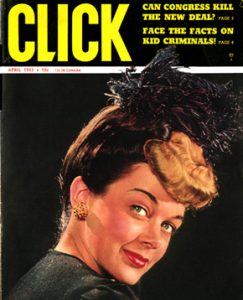
(Click Magazine, 1943)

A three page photo-essay found on the yellowing pages of a 1943 issue of Click Magazine introduced American readers to the flying Black Panthers of the U.S. Army Air Force; a fighter squadron composed entirely of African American pilots, trained at the new $2000,000 airfield in Tuskegee, Ala.. The four paragraphs that tell their story are accompanied by eight portraits of the pilots and snap-shots of the assorted ground crew, mechanics and orderlies – all Black.

They undoubtedly will reach a combat area this summer. One squadron, the 99th, has arrived overseas already. [These] pilots, whose insignia is a flame-spewing black panther, are rarin’ to join them. They want to roar a personal answer to the Axis ‘race superiority’ lies.

With The War Came New Opportunities
(United States News, 1942)

The government, endeavoring to meet the problem by raising the economic stature of the Negro, create committees, change regulations. The Army admits Negro candidates for officer training to the same schools as whites. It is training Negro pilots for the Air Corps. Negro officers will command Negro troops. The Navy opens new types of service for the Negro in the Marine Corps, the Coast Guard, inshore establishments, Navy yards and construction crews.

Advertisement

Use shortcode [oma_ad position="summary_top"] (or other position) in your theme or widgets to display OMA Promotions here.

Men’s Hats and Shoes
(Advertisements, 1942)

When the fops answered the call in 1942, these are the hats and shoes they walked away wearing.


You will be able to easily print the attached page of fashion images.


On another note: the legendary fashion designer Christian Dior had a good deal of trouble with people who would illegally copy his designs; click here to read about that part of fashion history.


The Hat Superstition that was Reliable…
(Pathfinder Magazine, 1945)

As far as superstitions and clothing are concerned, hats seem to be the one garment that has the most unfounded and irrational precepts attached to their existence. Plentiful are the dictates pertaining to where hats should never be placed or worn – these superstitions existed centuries before the Second World War, but for one citizen of San Angelo, Texas, he had his own beliefs where hats are concerned and some believed that, as a result, he was able to save the lives of 56 American servicemen…

Advertisement

Use shortcode [oma_ad position="summary_top"] (or other position) in your theme or widgets to display OMA Promotions here.

Stockings Go to War
(Office of War Information, 1943)

The attached article from 1943 appeared in a number of publications throughout the nation in order to impart to the women (and perhaps a handful of the men) how urgent was the need for their used silk stockings.


More about silk on the W.W. II home front can be read here…


Click here to read about the woman who dictated many of the fabric restriction rules on the home front.

1940’s Sportswear for Men
(Collier’s Magazine, 1945)

Halfway through 1944 American magazines began their individual count-downs until the war’s end; running with articles about the post-war world, the end of rationing, the demobilized military and the guaranteed boom that would come in the menswear industry. The attached fashion editorial appeared early in 1945 promotes the versatility of gabardine wool, it’s earliest appearance in the Middle ages, it’s use in uniforms and it’s newest application in sportswear.


The article is illustrated with five terrific color photographs.

Advertisement

Use shortcode [oma_ad position="summary_top"] (or other position) in your theme or widgets to display OMA Promotions here.

Color Trends in Men’s Suiting 1935 – 1950
(Men’s Wear Magazine, 1950)

Although there is black-out during the war years, the attached charts will give you a sense of the preferred suiting colors both before the war and upon it’s immediate conclusion. The pointy-headed soothsayers who attempt to predict which colors men will buy were very surprised to find that in the aftermath of World War II, American men were quite eager to buy browns and khaki-colored suiting after all.

Were Churchill and Stalin Hipsters?
(Click Magazine, 1942)

Illustrated with pictures of Winston Churchill’s weird zipper suit and Joseph Stalin’s all purpose costume, 1940s fashion critic Elizabeth Hawes (1903 – 1971) taunts the Great-American-Male and challenges him to respond in kind by wearing copies of these comfortable threads:

Today’s business clothes were worked out by the winners of the Industrial Revolution, whose descendants are the big tycoons of our day…Aspirants to leadership and success normally copy the clothes of existent leaders. Isn’t it about time the most of you changed your suits?

Elizabeth Hawes wrote more on the topic of W.W. II fashions…

The Hostess Gown Made a Splash on the Home Front
(Click Magazine, 1944)

There can be no doubt that the fashion-craving lasses of the Thirties and Forties had a tough time of it! Coming of age during the the Great Depression, they spent too much time window-shopping as a result of the all too widespread economic deprivations that were the order of the day – only to be greeted on the other end by the fabric rationing that accompanied the Second World War. They had some good news in the form of a swanky garment that was called Hostess Gowns which were seen as ultra-feminine and tailored in the finer fabrics of the day:

Top-notch fashion stores are finding a new wartime boom in luxury hostess gowns and pajamas; new styles for home reflect the latest dress fashion trends. Ruffles, waistline draping, beads, sequins and marabou add luxury; a number of dressy models might also be taken for dinner gowns…

Advertisement

Use shortcode [oma_ad position="summary_top"] (or other position) in your theme or widgets to display OMA Promotions here.

Scroll to Top