













The Dial Magazine Articles
The North American Review Articles
Touchstone Magazine Articles
The Saturday Evening Post Articles
Outlook Magazine Articles
The Smart Set Articles
Stage Magazine Articles
Hearst's Sunday American Articles
Newsweek Articles
People Today Magazine Articles
Current Literature Magazine Articles
Life Magazine Articles
The National Park Service Articles
Liberty Magazine Articles
Photoplay Magazine Articles
The Saturday Review Articles
Freedom's Triumph Articles
Scribner's Magazine Articles
Outing Magazine Articles
The American Legion Monthly Articles
Confederate Veteran Magazine Articles
Punch Magazine Articles
Ken Magazine Articles
G.I. Joe Magazine Articles
Vogue Magazine Articles
Rob Wagner's Script Magazine Articles
Harper's Bazaar Magazine Articles
Leslie's Magazine Articles
Confidential Magazine Articles
Harper's Weekly Articles
Click Magazine Articles
The Flapper Magazine Articles
The Atlantic Monthly Articles
Film Daily Magazine Articles
La Baionnette Articles
PM Tabloid Articles
The Film Spectator Magazine Articles
Trench Warfare Articles
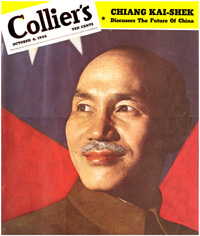
Collier's Magazine Articles
Men's Wear Magazine Articles
The New Republic Articles
Creative Art Magazine Articles
Sea Power Magazine Articles
The American Legion Weekly Articles
47 Magazine Articles
Direction Magazine Articles
Vanity Fair Magazine Articles
The New York Times Articles
Theatre Arts Magazine Articles
Pic Magazine Articles

World War Two

Find old World War 2 articles here. We have great newspaper articles from wwii check them out today!

Linda Darnell Downsizes
(Collier’s Magazine, 1943)

Everyone on the home front was used to making sacrifices, and Hollywood star Linda Darnell (1923 – 1965) was no exception:


“Allowances must be made for Linda Darnell who has been sorely tried. Instead of six servants, she now has two – and she hears strange sounds from the kitchen that convince her she will soon be alone. Her chauffer has been drafted; her butler is working at Lockheed. Her flower gardens are a wreck because the Japs who once tended them are in internment camps… ‘Why, this gas rationing… it’s worse than being bombed!'”

The Pampered Axis Prisoners
(United States News, 1945)

“There are reports that these prisoners are often pampered, that they are getting cigarettes when Americans civilians cannot get them, that they are being served by American soldiers, that they are often not working at a time when war workers are scarce. The general complaint is that the 46,000 American prisoners in Germany are not faring as well as the 300,000 Germans in this country.”

Advertisement

Use shortcode [oma_ad position="summary_top"] (or other position) in your theme or widgets to display OMA Promotions here.

The Home front Knuckles Under
(Collier’s Magazine, 1942)

Having heard from assorted armchair generals, radio oracles and ink-stained bums that the heart of the American home front was not in the fight, journalist Quentin Reynolds bought some train tickets to scour the country and see if it was true.


It wasn’t.


Click here to read about the rationing of makeup.

A Great Cheer from Coast to Coast
(PM Tabloid, 1945)

An anonymous reporter relays all that came across his desk in the way of wild victory celebrations on VJ Day. Spread out over 14 paragraphs are eyewitness accounts of the pandemonium that spread across the nation when the news arrived that the war was over.

Advertisement

Use shortcode [oma_ad position="summary_top"] (or other position) in your theme or widgets to display OMA Promotions here.

More Letters from the German Home Front
(American Magazine, 1942)

“The information in letters found on the German dead, intimate and personal as it is, leads to some striking deductions. The people inside Germany hate the war and want it to end. They are tired of hardships, sick of sacrifice. They lament the moral disintegration of their young women; they shudder at air raids; they weep over their dead. But nowhere do they betray the least suggestion of German guilt or regret for horrors which the German armies perpetrate on conquered countries. Hard as is their life, they know neither starvation nor desperation. Nor do they expect Germany to lose the war. To expect them at this time to revolt against Hitler is as futile and puerile to expect the Fuehrer to live up to his promises or the treatise he signs.”

Advertisement

Use shortcode [oma_ad position="summary_top"] (or other position) in your theme or widgets to display OMA Promotions here.

Opinions on the Early Home Front
(Newsweek Magazine, 1942)

Newsweek‘s Raymond Moley (1886 – 1975) took a serious look at the year that had just passed, 1941, and concluded that the American people, as a whole, had had embraced the war as their own personal problem. He was impressed with the gravity with which the home front solved the problems that war brought to their doorsteps:


“The pre-Pearl Harbor issue has been liquidated, not because of an act of national will power. It had faded before the immediate tasks of war. The new year brought so many jobs to do, so many problems to grapple with that there was no time to remember 1941… At no time in the year has there been a real failure on the part of Americans to appreciate the gravity of the war job.”

One Year of War
(Newsweek Magazine, 1942)

“In the twelve months since Pearl Harbor the American family has begun
to experience war on the home front. Almost a full year has passed before gasoline rationing was extended to the entire country. More than a year will have passed before meat rationing begins next month. The sugar pinch has been only a gentle nip. The full extent of the fuel shortage has yet to be measured against the severity of the weather. The sign ‘one per customer’ appears on more and more shelves in the corner grocery, but except for extra cups of coffee the average menu isn’t too far from prewar. Thanksgiving of 1942 was hardly less than the usual feast day.”

”The New Order” in Japan
(Collier’s Magazine, 1941)

After reading this 1941 article you will come away with a full understanding as to how misguided Imperial Japan was to enter into a war with the United States and the British Empire. At the time of the printing, Japan had been engaged in its second war with a very underdeveloped China; even though Japan had held the momentum in that war, it had still driven the Japanese into a life of highly uncomfortable rationing, which would only get worse as their new war expanded.

Advertisement

Use shortcode [oma_ad position="summary_top"] (or other position) in your theme or widgets to display OMA Promotions here.

The Nation’s Capital as ‘Boomtown’
(American Legion Magazine, 1943)

“Every day in Washington, and twice on Sundays, there will be parades. You love parades. You’ll never get tired of turning out for bands, even though they always stop playing just as they get opposite you…. Anyhow, there will always be the feel of parades in Washington, and the echoes of martial music, and the sight of waving flags. Where else, oh where elese, could they sing so fervently God Bless America?”

One Year of Military Expansion
(Newsweek Magazine, 1942)

When President Franklin Roosevelt declared war on December 8, 1941 – he was not the only one to do so; judging by the content of the attached article, and numerous others on this site, 100,000 other Americans did the same thing. This article is about the rapid growth of the United Sates military that took place between December of 1941 through December of 1942 – and boy, did it grow.

Advertisement

Use shortcode [oma_ad position="summary_top"] (or other position) in your theme or widgets to display OMA Promotions here.

The Sherman
(Newsweek Magazine, 1942)

“‘We’re so far ahead of that Heinie in tank design and production that he’s never going to catch us’ – that was the opinion expressed by Major General Levin H. Campbell (1886 – 1976), the War Department’s Ordnance Chief, in an interview in New York last week. He quoted a British officer as saying that the American M-4 General Sherman tank is the ‘answer to a tankman’s prayer.'”

Fort Des Moines
(Liberty Magazine, 1942)

“When recruits in the new Women’s Army Auxiliary Corps – commonly dubbed WAACS – reported for training at Fort Des Moines, Iowa, women for the first time in American history became members of Uncle Sam’s Army.”


(The title concerning “the first woman in the Uncle Sam’s Army” is believed to go to a lass named Deborah Sampson who served in George Washington’s army in 1781, under the name “Robert Shurtliff”.)

Berliners Under the Bombs
(Liberty Magazine, 1944)

A Turkish diplomat explains all that he saw in the war-weary Berlin of 1944:


“You see children wildly seeking for their mothers, wives wildly seeking for their husbands. Women carry dead children in their arms and children weep beside their dead mothers.

Advertisement

Use shortcode [oma_ad position="summary_top"] (or other position) in your theme or widgets to display OMA Promotions here.

Scroll to Top