
Crown Prince Rupprecht
(N.Y. Times Book Review, 1923)
NULL
|
|

|
|

|
|

|

|
|
|
|

|
|
|
|
|

|
|

|

|
|

|
|

|
|

|
|
|

|
|
|

|

|

|

|

|
|
|

|

|
|
|
|
|

|

|
|
|

|
|
“Hungary is reported to be on the brink of revolution…[Since the war’s end] The Government has never been popular with the majority of the people; it was only accepted by them as a temporary measure, pending the advent of King Otto – the late King Charles’ young son – to the throne of Hungary.”
In this interview the Kaiser’s son and fellow exile, Crown Prince Wilhelm (1882-1951, a.k.a. The Butcher of Verdun), catalogs his many discomforts as a refugee in Holland. At this point in his life the former heir apparent was dictating his memoir and following closely the goings-on at Versailles.
Click here to read what Kaiser Wilhelm II thought of Adolf Hitler.
With the revelation that Britain’s King George VI was left-handed came this column by an uncredited journalist listing all the various unseemly elements that are associated with with left hand usage (most importantly, Lucifer). In light of the fact that a British king is also assigned the title Defender of the Faith in the Anglican Church; steps had to be taken in his youth to train him how to use his right hand. These lessons came at a cost, and the result was his sad stuttering speech – which also involved additional lessons with a speech therapist.
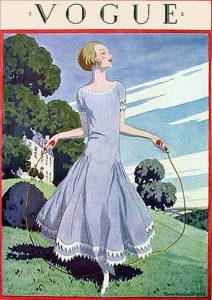
Luciene Murat (1876 – 1951?), a distinguished member of the French nobility wrote this Vogue article shortly after her return from Turkey in 1922. It is the sort of column that could only have been written by an over-indulged member of the post-war European high-society types, which makes it all the more enjoyable to read. Her reminiscences of her visit to the city of Pera are especially interesting for the observations made regarding the recently displaced White Russians of her acquaintance who reluctantly resided there in some discomfort.
An article by Rebecca West (1892 – 1983) in which she listed an enormous number of reasons as to why May 12, 1937 (the coronation date for George VI) will not be a good day to be in London. From time to time throughout the article she throws-in some bon mots:
This is a crucifixion as well as a coronation. The best kings we have ever had have been Queens, and every year Kingship becomes less and less suitable for a man. A constitutional monarch has constantly to behave as if he were a mindless puppet in circumstances which would prove fatal to everybody, including himself, if he really were a mindless puppet.
The King’s Speech
This two and a quarter page article discusses the probable effect [that] the change of sovereigns will have upon the present so-called constitutional crises. The writer also concentrates on the subject of Edward VII as diplomat, his thoughts on the entente, his popularity and his unique relationship with the French. The character of the incoming George V is examined as it relates to the constitutional controversy of 1910.
This is a brief English translation of an article that appeared in Deutsch Review by Lord Esher entitled, King Edward VII and Germany. Published during the last year of Edward’s reign, it is plea to prolong that long Indian summer before the war and a declaration of his affection for Germany, the German people and his lasting support for all disarmament treaties.
Attached is a news report from a 1917 issue of THE ATLANTA GEORGIAN announcing:
Czar Nicholas decided to abdicate the Russian throne only after he had been held up by soldiers and the necessity for such action impressed upon him, according to a dispatch printed in DIE FRANKFURTER ZEITUNG…
Also included in the report were the text of a speech delivered by the Czar which called for national unity.
This snippet is about a major crisis (and a colossal media event) that took place in the life of Queen Elizabeth’s sister, Princess Margaret Rose (1930 – 2002) – when she was told in 1955 that the man she loved, Captain Peter Townsend, was not suitable for marriage.
This well-illustrated article presents a thumbnail history of some of the household units that guard the British royal family.
By the time this item appeared in print, the Balkan War (1912-1913), was over however some of the swells of Europe put their crowned heads together and collectively came up with the best Medeival plan they could think of in order to insure the promise of peace. The plan was to have:
• the Czar’s daughter, Grand Duchess Olga (1895 – 1918), would wed Serbia’s Crown Prince Alexander
• the Czar’s second daughter, Grand Duchess Tatiana (1897 – 1918), was promised to Rumania’s Crown Prince Charles (1893 – 1959)
• All concerned agreed that Rumania’s Pricess Elizabeth (1894 – 1956) and Crown Prince George of Greece (1890 – 1947) would make a simply splendid couple (they divorced in 1935).
Relations between Emperor William (Kaiser Wilhelm II, 1859-1941)and his son and heir, the German Crown Prince (Wilhelm III, 1882-1951), have now become so strained as to be a source of embarrassment to the whole court of Berlin. Vienna, a sort of clearing house for gossip of this sort, is filled with sensational stories…
Click here to read what the Kaiser thought of Adolf Hitler.
Alfonso XIII of Spain (1886 – 1941) is remembered as a pretty level-headed guy, but non the less, it was news items like this one that made Karl Marx first dip his nib in the inkwell…
A beautifully illustrated page from VOGUE MAGAZINE reporting from Belgrade on the the royal wedding of Alexander I of Yugoslavia (1888 – 1934) and Marie of Romania (Marie of Hohenzollern-Sigmaringen: 1900 – 1961). An earlier posting on this site indicated that the groom had been promised in 1913 to wed Grand Duchess Olga of Russia (1895 – 1918), but there were complications.
Following Alexander’s 1934 assassination, their oldest son, Peter II (1923 – 1970) assumed the throne and presided as the last king of Yugoslavia.
Younger brother Alexander hated dashing, erratic Crown Prince George (1887 – 1972), darling of the Serbian people, so he framed him as a loony, got him exiled, and in due course became King instead. George made the mistake of writing an insulting letter and going back home on the heels of it. Now, in a remote Yugoslavian villa, surrounded by trees, hedges, and mustachioed detectives, the Serbian Bad Boy lives in solitary confinement, doing mathematical problems to keep from getting bored.
A 1938 article which gave a brief account of the incarcerated Crown Prince George of Serbia. As the above makes clear, he was judged insane and locked up between the years 1925 through 1939. He was set free by the Nazis during their brief occupation of that country.
Click here to read about the 1922 discovery of King Tut’s tomb.
Will Any of These Pictures be Turned to the Wall? asked the editors of VANITY FAIR shortly after the outbreak of the W.W. I. On the attached pages are photographic portraits of the potentates representing the assorted combatant nations; French President Raymond Poincare was the only elected official to be included among the royals. Pictured are Austria’s Emperor Franz Joseph, Britain’s King George V, Germany’s Willhem II, Victor Emmanuel II of Italy, Peter of Serbia and Albert, King of the Belgians.
Attached is a page from VANITY FAIR MAGAZINE depicting the ten European princesses from 1914, having benefited from full hair and make-up, posing bemedaled and amused in full military dress before the society magazine cameras.
The Royals pictured on this page were all granted the ceremonial rank of ‘Colonel’ in the household cavalry units within their respective principalities, as well as a few of the cavalry regiments outside their domains.
Several of the Royal and Imperial women in Europe, who are possessed of military rank, have lost their colonelcies in foreign regiments by the World War. Thus, the Czarina and the Russian Grand Duchess, as well as Queen Mary of England, have been deprived of their commands in the Kaiser’s army.
