Author name: editor

Failure of General Marshall | Pearl Harbor Attack and General George Marshall | General Marshall at 1945 Pearl Harbor Hearings
1945, Newsweek, Pearl Harbor

What Might Have Been
(Newsweek Magazine, 1945)

Into the records of the Pearl Harbor investigating committee last week went a little-noticed document that added new mystery to the disaster of December 7, 1941:


Four months before the enemy struck, the Army and Navy air command at Pearl Harbor drew up a joint defense plan which correctly forecast the hour, the direction, the size of the force and the strategy by which the Japs actually attacked.

American Tank Destroyers Battle of the Bulge 1944 | US Army Tank Destroyers 1944 |
1945, Battle of the Bulge, Newsweek

Killing Tiger Tanks in the Ardennes
(Newsweek Magazine, 1945)

This article follows the efforts of the Tank Destroyers (TD) in the Ardennes during the Battle of the Bulge:

This TD work is among the most dangerous of the war. One of the chief reasons is that TDs are constantly up against superior enemy weapons. For example, none of our TDs (except possibly the M-36) can penetrate the 8-inch frontal armor of the King Tiger, whereas the German 88-millimeter anti-tank gun has been able to penetrate any American tank. And to kill the tiger, TDs must shoot for the tracks, then assault the disabled monster with high explosive, setting it afire.


Click here to read about the equipment and training of American tank destroyers during the Second World War.

Advertisement

Use shortcode [oma_ad position="summary_top"] (or other position) in your theme or widgets to display OMA Promotions here.

American Tank Destroyers (America's Alertmen, 1942)
1942, America's Alertmen, Combat Training

American Tank Destroyers
(America’s Alertmen, 1942)

Another look at the M-2 Half Track and the training of their five-man crews at Fort Hood, Texas. We got a kick learning that these men were not simply trained to fire their 37 and 75 mm. mounted guns, but also instructed in all other manner of tank fighting methods:

Another little trick they master is the construction of a sticky grenade; a white sock filled with TNT, soaked in heavy axle grease to triple it’s detonating power. This sticks like glue; and if it explodes near the tank’s ventilators — that’s all, brother.


Click here to read about the TD units that fought at the Battle of the Bulge.

The Ill Fated One (Creative Art Magazine, 1932)
1932, Creative Art Magazine, Modigliani Articles

The Ill Fated One
(Creative Art Magazine, 1932)

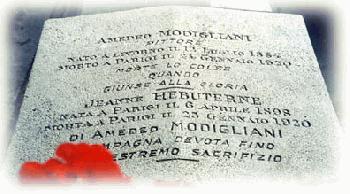
There is much that can be said about those unfortunate men whom life does not treat properly and to whom only death gives the glory they had so wanted to know…One finds them on thrones, in society, among artists, among bourgeoisie, and in the lower classes. Modigliani has his place on this list of grief. His name follows hard upon those tragic ones, Van Gogh and Gauguin.

A convergence of unhappy circumstances compelled Modigliani to live poorly and to die miserably.

Grant Wood: Iowa as Muse (Art Digest, 1936)
1936, Modern Art, The Art Digest

Grant Wood: Iowa as Muse
(Art Digest, 1936)

An art review of the American painter, Grant Wood (1891 – 1942), and his efforts to illustrate a 1935 children’s book titled Farm on the Hillstyle=border:none.

Wood, a reigning member of the Regionalism School in American art, had come into the public eye some six years earlier with the creation of his painting, American Gothic, is quoted in this article concerning his creative process and the importance his vision of Iowa plays while painting:

…Mr Wood seceded from the neo-meditationists of Paris because when he began to meditate he realized that ‘all the really good ideas I’d ever had came to me while I was milking a cow.’

Click here to read a 1942 article by Rockwell Kent on the proper roll of American artists during wartime.

Advertisement

Use shortcode [oma_ad position="summary_top"] (or other position) in your theme or widgets to display OMA Promotions here.

Advertisement

Use shortcode [oma_ad position="summary_top"] (or other position) in your theme or widgets to display OMA Promotions here.

Hermann Goering Named as 'Economic Dictator' (Literary Digest, 1936)
1936, Hermann Goering, The Literary Digest

Hermann Goering Named as ‘Economic Dictator’
(Literary Digest, 1936)

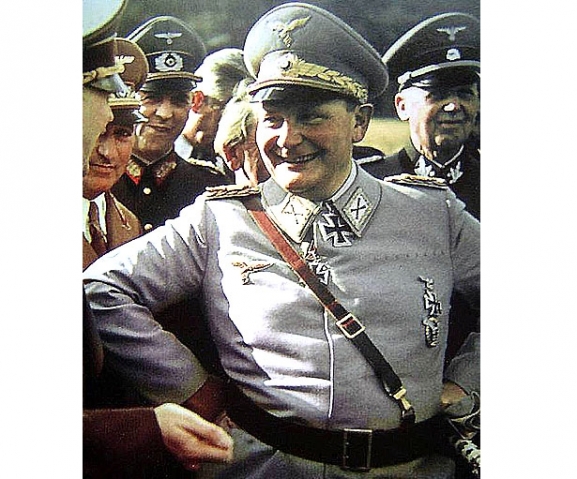
Uncle’ Hermann to the masses, ‘Our’ Hermann to the army and big business, Col. Gen. Hermann Wilhelm Goering (1893 – 1946) last week became economic dictator and virtual Vice-Chancellor of the Third Reich.

Adolf Hitler dropped into his brawny, outstretched arms full power to carry out the gigantic plan which aims at making the Nazi State economically self-sufficient [in four years].

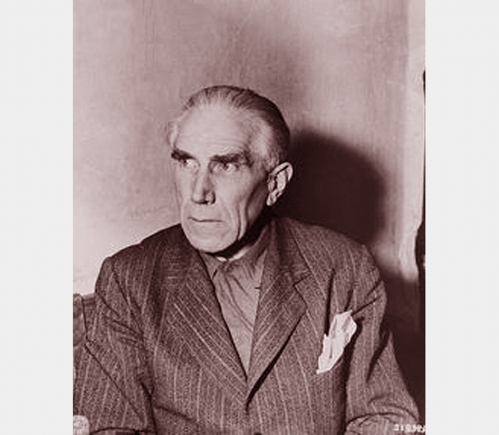
1947 Trial of Trial of Franz von Papen | Capture of Franz von Papen 1945 | Vice Chancellor von Papen in Captivity
1947, Aftermath (WWII), Pathfinder Magazine

The Trial of Franz von Papen
(Pathfinder Magazine, 1947)

Franz von Papen (1879 – 1969) was born into the German nobility; he worked as a diplomat, a politician and during both World Wars he served as an intelligence officer in his nation’s army. During the Third Reich von Papen was appointed Vice Chancellor under Adolf Hitler. This article concerns the period in von Papen’s life when, after having been acquitted earlier by the international tribunal, he found himself once more on the docket for another misdeed.


Franz von Papen had an IQ that measured 134 – click here to read about the strangely high IQs of the other lunatics in Nazi leadership…

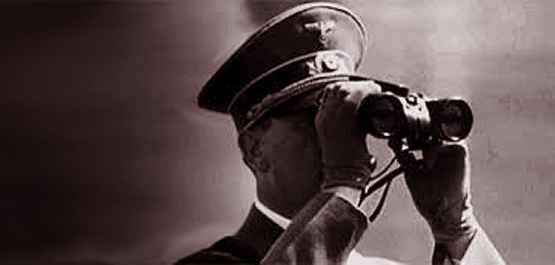
Hitler's Military Options in 1940 (Click Magazine, 1940)
1940, Adolf Hitler, Click Magazine

Hitler’s Military Options in 1940
(Click Magazine, 1940)

A Phony War magazine article by Major General George Ared White (1880 – 1941) in which he muses wistfully (as Oregon men are wont to do) as to all the various, dreadful choices that were spread before Herr Hitler in the early months of 1940.


As varied as Hitler’s military options were, the General believed that France’s Maginot Line was impregnable and he did not think that Hitler would commit to such an undertaking. General White believed Hitler had six options before him which are all illustrated on the attached cartoon map.

Advertisement

Use shortcode [oma_ad position="summary_top"] (or other position) in your theme or widgets to display OMA Promotions here.

Hitler's Final Days (Pageant Magazine, 1960)
1960, Adolf Hitler, Pageant Magazine

Hitler’s Final Days
(Pageant Magazine, 1960)

This article pieces together the last few days of Hitler’s bunker experiences – who was there, how did he pass his time and the subjects he addressed. All the matters discussed herein was gleaned from the intelligence agencies of the three victorious armies that marched into Berlin during the Spring of 1945. The author goes into some detail as to whether he and his entourage could have escaped on foot plane or tank and rules each one out categorically. He further examines the possibility as to how this same group could have escaped to Argentina by submarine or air – and rules these possibilities out as well (the author, however, omits the possibility that they could have escaped through the elaborate tunnel system below the streets of Berlin).

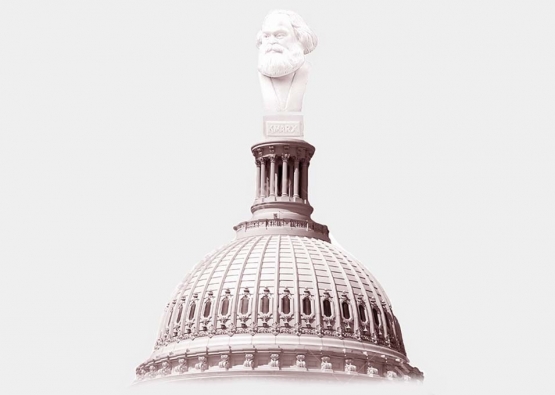
1950s Spies in U.S. Government | Soviet Infiltration of the U.S. Government
1953, The Cold War, Weekly News Review

Reds in the Government
(Weekly News Review, 1953)

This article makes a passing reference to a Soviet defector who jumped ship in 1937 in order to escape Stalin’s seemingly random purges, his name was General Alexander Barmine (1899 – 1987). In his READER’S DIGEST piece from October, 1944 (the article can be read here) Barmine declared that Soviet spies were rapidly filling up positions within the U.S. Government. His more alarming proclamation was when he wrote that FDR’s administration was protecting them – this implied that Red agents were already perched in the highest positions. When W.W. II ended (along with the Soviet alliance) both political parties in Washington agreed to weed out these moles – but they couldn’t agree as to how deep the infiltration was. The Democrats believed that by 1953 most of the Communists had been found, the Republicans felt otherwise.

Advertisement

Use shortcode [oma_ad position="summary_top"] (or other position) in your theme or widgets to display OMA Promotions here.

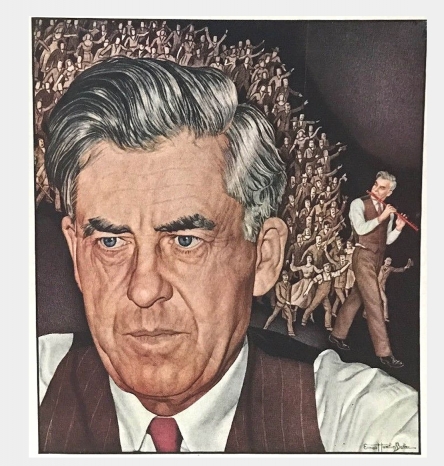
Henry Wallace: Was He Red? (Collier's Magazine, 1948)
1948, Collier's Magazine, The Cold War

Henry Wallace: Was He Red?
(Collier’s Magazine, 1948)

Henry Wallace (1888 – 1965) was FDR’s second Vice President (1941 – 1945) and as a seasoned Washington politician he must have known that his political career was coming to an end when the attached editorial hit the newsstands in early October of 1948. Written by William L. Chenery, publisher of COLLIER’S MAGAZINE, one of the most staid, middle class news and fiction organs around – it was not the sort of organization that looked upon libel lightly; Chenery meant what he wrote when he slandered the former vice president as the spokesman of Russia.


Wallace, who at the time was taking a licking as the Progressive Party nominee for president in the 1948 race, left politics shortly afterward. In 1952 he wrote a book in which he admitted how wrong he was to have ever trusted Joseph Stalin.

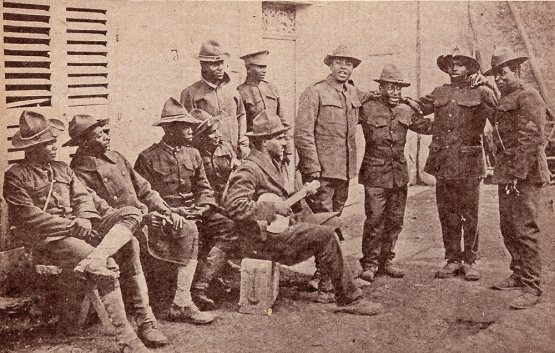
'Soldier Man Blues from Somewhere in France'' (Literary Digest, 1927)
1927, Entertainment, The Literary Digest

‘Soldier Man Blues from Somewhere in France”
(Literary Digest, 1927)

This article is essentially a collection of lyrics from an assortment of songs sung by the Black Doughboys who were charged with the task of loading and unloading trucks far behind the front line trenches. It was written in 1927 to serve as a review for Singing Soldiersstyle=border:none by John J. Niles, who compiled the labor songs while stationed in France as a fighter pilot:


All dese colored soldiers comin’ over to France

All dese soldiers an’ me

Goin’ to help de Whites make de Kaiser dance

All dese soldiers an’ me…

1945, Pathfinder Magazine, Pearl Harbor

Pearl Harbor’s Two Fall Guys
(Pathfinder Magazine, 1945

Recognizing that responsible commanders must always assume the blame for the failings within their respective domains, former U.S. General George C. Marshall and General Leonard T. Gerow stood up and claimed responsibility for leaving Pearl Harbor vulnerable to Japanese attack. Marshall had been FDR’s Army Chief-of-Staff since the Autumn of 1939 and Gerow had been serving as executive officer of the War Plans Division at the time of the sneak attack – however, To read this article is to understand that these men were responsible for Pearl Harbor’s lack of preparedness…

Advertisement

Use shortcode [oma_ad position="summary_top"] (or other position) in your theme or widgets to display OMA Promotions here.

Scroll to Top