Author name: editor

Natalie Curtis Burlin and First Nation Music 1913
1913, First Nations, The Literary Digest

The Influence of the Natives on Rag Time Music
(The Literary Digest, 1913)

A foremost scholar in the field of Native American Music insisted that the American Indian had a guiding roll in the development of Rag Time:

Most people instinctively assign it to the Negro; but the Indian also, according to Natalie Curtis Burlin (1875-1921), is to be credited with a hand in it. The syncopation, which is a predominant feature of all Rag Time,as she observes in ‘The Craftsman’, is an absolutely essential element in the songs of our North American Indians of many tribes.

Also discussed are the efforts of Geoffrey O’Hara to make the earliest recordings of Native American Music on behalf of the U.S. Library of Congress.

Alice Cunningham Fletcher Study of Native American Music | National Bureau of Ethnology Study of Native American Music 1908
1908, First Nations, The Literary Digest

Unsuspected Qualities of Indian Music
(Literary Digest, 1908)

A short article on the topic Native American music and the studies of Alice Cunningham Fletcher (1838 – 1923), who had overseen a number of Native American archival recording sessions around the time this article appeared in print. Fletcher once wrote:

We find more or less of it in Beethoven and Schubert, still more in Schumann and Chopin, most of all in Wagner and Liszt.

Advertisement

Use shortcode [oma_ad position="summary_top"] (or other position) in your theme or widgets to display OMA Promotions here.

Alfred Von Wegerer Questioned German War Guilt Clause Versailles Treaty | Was Germany Guilty of Causing WW I
1927, Pamphlet Produced by the National Park Service, War Guilt

Questioning German War Guilt
(The Nation, 1927)

This article from THE NATION was written by Alfred Von Wegerer in the interest of refuting Versailles Treaty article 231, which reads:

The Allied and Associated Governments affirm, and Germany accepts, the responsibility of Germany and her allies for causing all the loss and damage to which the Allied and Associated Governments and their nationals have been subjected as a consequence of the war imposed upon them by the aggression of Germany and her allies.


Von Wegerer, like most Germans at that time, got mighty hot under the collar when he stopped to consider that Germany was blamed entirely for the start of the First World War. This article was written nine years after the close of the war when a number scholars on the allied side had already stepped forward to question, what has come to be called, the war guilt clause.


Read about the total lack of war guilt that existed in 1950 Germany…

A GI View of Japan (Newsweek Magazine, 1945)
1945, Newsweek, Post-War Japan

A GI View of Japan
(Newsweek Magazine, 1945)

Reporter Robert Shaplen (1917 – 1988) filed this account of how the GIs have reacted to the strangest country they have ever encountered:

Looking at the Japanese, the average GI wonders how they ever managed to prosecute a war in the first place. Everything in Japan, even broken and blasted cities and factories, has a miniature toy-like appearance. Automobiles, the ones that are left, don’t work; trains bear little resemblance to the Twentieth Century Limited or a fast freight back home. The short, slight people are dressed poorly and drably.

Advertisement

Use shortcode [oma_ad position="summary_top"] (or other position) in your theme or widgets to display OMA Promotions here.

Western Customs in Japan | Japanese People Adopt Western Customs | American Influence in Post-War Japan
1954, Post-War Japan, Weekly News Review

‘The Japanese Try Western Ways”
(Weekly News Review, 1954)

There’s a ‘New Look‘ in Japan. It’s come about in the years since World War II and is largely due the result of Western influence brought about by the presence of American soldiers…More and more women are dressing in American-style clothing, although they still prefer the kimono as evening dress. Girls now are given the same education as boys. There is a new school system with grade schools, high schools and colleges modeled somewhat on the American pattern…


Some of the allure attached to the West was a result of theses guys…

WW I Eyewitness to the Death of Hay Enright and Gresham 1917 | First Americans to Die in World War I
1922, The American Legion Weekly, World War One

First Blood
(American Legion Weekly, 1922)

A veteran of the U.S. First Division, Sixteenth Infantry, tells the chilling story of that rainy night in November, 1917, when the first German raid upon the American trenches took place:

It was on that night that Company F took over its first front line position, received its baptism of fire, bore the brunt of the first German raid and lost the first American troops killed and captured in the World War.

…two hundred and forty Bavarians, the widely advertised cut-throats of the German Army, hopped down on us. The first raid on American troops was in full swing. They had crawled up to our wire under cover of their artillery barrage and the moment it lifted were right on top of us.


The U.S. Army would not launch their own trench raid for another four months.

Japanese Nationalist Masaharu Kageyama | Japanese Nationalism in Occupied Japan | Japanese Patriots in Occupied Japan 1949
1949, Pathfinder Magazine, Post-War Japan

Japanese Nationalists
(Pathfinder Magazine, 1949)

This article tells the tale of the Japanese Nationalist Masaharu Kageyama (1910 – 1979), a fellow who, in the political landscape of U.S.-occupied Japan, seemed rather like the late Mussolini of Italy: always remembering the storied past of a Japan that no longer existed. Kageyama was something a flat-Earther, choosing the road of the Japanese Nationalist, he held that Emperor Hirohito was indeed divine and that the Fascist vision of an East-Asia Co-Prosperity Sphere was achievable, even in 1949.

Advertisement

Use shortcode [oma_ad position="summary_top"] (or other position) in your theme or widgets to display OMA Promotions here.

Disappearance of Latin from American Schools | American Schools No Longer Teach Latin | Why Don't American Schools Teach Latin Anymore
1952, Education, Pathfinder Magazine

Whither Latin?
(Pathfinder Magazine, 1952)

This article charts the decline of Latin as an academic study in American schools. The disappearance of Latin began in the Thirties and steadily snowballed to such a point that by 1952 its absence was finally noticed.

Is Latin on its way out in high schools? The answer is a confident ‘NO.’
It’s hard to see how it can go any lower,’ declares Dr. John F. Latimer, head of Latin studies
at George Washington University.

Axis POWs Who Escaped US Prison Camps | WW II Prisoner of War Camp Escapees
1953, Collier's Magazine, POWs

The German Who Escaped
(Collier’s Magazine, 1953)

Read this unbelievable adventure by a former Afrika Korps Panzer Grenadier who, having been captured and subsequently shipped to the U.S., made good his escape from an Illinois prisoner-of-war camp – whereupon he assumed a fake identity and easily acquired a Social Security number. After having rented an apartment and worked several jobs in Chicago, he started a successful business just two years after his escape, married an American woman, sired a daughter – and he might very well have eluded the FBI entirely if he hadn’t insisted all the while on sending foodstuffs to his mother in war-ravaged Germany.

Post-War Japan Sex Workers
1952, Pic Magazine, Post-War Japan

GI Joe and the Women of Japan…
(Pic Magazine, 1952)

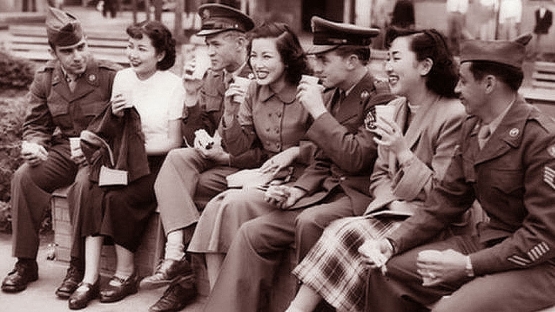
Although this article is illustrated with imagery depicting American men and Japanese women appearing to genuinely be enjoying one another’s company, the accompanying text says something quite different. The article centers on the observations of the woman who heads the YWCA in Japan who insists that the vulgar Americans stationed in that country are coercing Japanese women to become prostitutes. The journalist then goes into some detail as to what a big business prostitution in Japan has become and how many illegitimate births have resulted.

Advertisement

Use shortcode [oma_ad position="summary_top"] (or other position) in your theme or widgets to display OMA Promotions here.

Martha Gellhorn Over Germany (Collier's Magazine, 1945)
1945, Collier's Magazine, World War Two

Martha Gellhorn Over Germany
(Collier’s Magazine, 1945)

An article by the W.W. II war correspondent Martha Gellhorn (1908 – 1998) who rode with the crew of a P-61C Black Widow Night Fighter one evening as they made their rounds over what remained of Hitler’s Germany:

COLLIER’S girl correspondent sat on a wobbly crate and flew over Germany looking for enemy planes at night. Her nose ran, her oxygen mask slipped off, her stomach got mad, she was scared and she froze. They didn’t down any Germans, but otherwise that’s routine for the Black Widow pilots.

Click here to read additional articles about the war correspondents of the Second World War.


Click here to read Martha Gellhorn’s article about what she saw at Dachau.


Click here to read about the 1943 bombing campaign against Germany.

USMC Pilot Richard C Mangrum | USMC Pilots at Henderson Field | USMC General Richard C Mangrum Article
1943, The American Magazine, World War Two

‘Guadalcanal Diary”
(The American Magazine, 1943)

Lieutenant Colonel Richard Mangrum, USMC, was a seasoned veteran in the Cactus Air Force that fought the good fight at Henderson Field from Guadalcanal in 1942:

For eight weeks the author and his fellow pilots shared the primitive life of the other Marines at Henderson Field. Some portion of his squadron was almost constantly in the air, attacking enemy reinforcements.

Advertisement

Use shortcode [oma_ad position="summary_top"] (or other position) in your theme or widgets to display OMA Promotions here.

Japan and the Road to War (Literary Digest, 1933)
1933, The Literary Digest

Japan and the Road to War
(Literary Digest, 1933)

A collection of opinions gathered from the newspapers of the world concerning the belligerency of Imperial Japan and its poor standing in the eyes of the League of Nations:

Feeling grows among the Japanese that events are shaping toward a second world war, with Japan in the position that Germany occupied in 1914…A Canadian Press dispatch from London, in THE NEW YORK TIMES, estimated war supplies sent from England to China and Japan. According to statistics of the British Government for 1932, the largest individual items were 7,735,000 small-arms cartridges for China and 5,361,450 for Japan…Japan also purchased 740 machine guns.


Four years after the Pearl Harbor attack, a Japanese newspaper editorial expressed deep regret for Japan’s aggressiveness in the Second World War, click here to read about it…

Click here to read about a 1925 novel that anticipated the war with Imperial Japan.

What's in that Brooklyn Water? (Quick Magazine, 1952)
1952, Hollywood History, Quick Magazine

What’s in that Brooklyn Water?
(Quick Magazine, 1952)

2013 marked the 100th year since the first film was made in Hollywood, and in that time one American neighborhood more than any other has consistently supplied the film and television industry with a seemingly inexhaustible pool of talent: Brooklyn, New York. From Clara Bow in the era of silent film to Gabby Sidibe in the digital – the talented sons and daughters of Brooklyn have made their way West and we have all been the beneficiaries.

Advertisement

Use shortcode [oma_ad position="summary_top"] (or other position) in your theme or widgets to display OMA Promotions here.

Scroll to Top