Author name: editor

Men's Fashions for the Summer of 1932 (Magazine Advertisement)
1930s Fashion

Men’s Fashions for the Summer of 1932
(Magazine Advertisement)

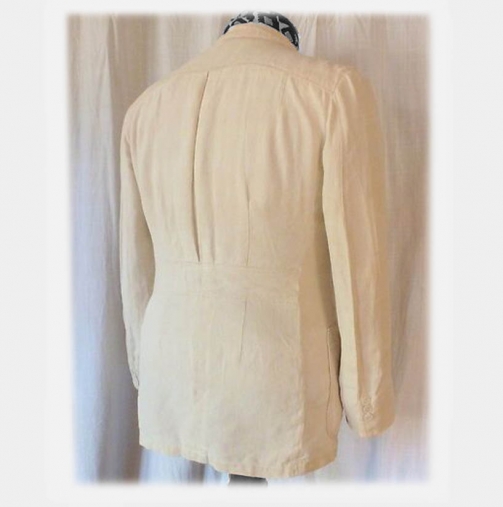
These two 1932 magazine advertisements had a tremendous amount of relevance in the lives of those fellows lucky enough to still enjoy summer vacations, just two and a half years into the greatest economic down-turn in American history.


These two pages appeared in the swankiest of New York society rags during the era: STAGE, TOWN & COUNTRY and VANITY FAIR, promoting the white summer suits and linen leisurewear of the Palm Beachtailors.

Life in Paris After WW2 | Coal Shortages in Post-WW2 Europe | French Rationing After WW2
1945, France, Newsweek

Dreading the Winter
(Newsweek Magazine, 1945)

When this article was published the war was over and Paris had experienced her second German-free autumn – but life was still difficult in the city. Coal was still rationed, the lines in the shops were long and the average French child was drastically underweight. NEWSWEEK dispatched two gumshoe reporters to get the full picture for the folks at home (where, happily, rationing had ended the the previous August).

Advertisement

Use shortcode [oma_ad position="summary_top"] (or other position) in your theme or widgets to display OMA Promotions here.

Patou Fashion 1945 | Lavin Fashion 1945 | Winter 1945 Fashion Collections Paris
1940s Fashion, 1945, Newsweek

The Paris Winter Collection
(Newsweek Magazine, 1945)

After years of material shortage, the accent is definitely on the feminine, with all of its flounces… A look at all the collections shows that black is the outstanding color for afternoon and dinner. Drapings, wrappings and swathings that girdle the hips are the outstanding line. The favored fabrics are velvet , velveteen, corduroy (used horizontally, as are other striped materials) monotone tweeds, Kashas (a twill-weave fabric of wool mixed with Cashmere), and some Scotch plaids.

Advertisement

Use shortcode [oma_ad position="summary_top"] (or other position) in your theme or widgets to display OMA Promotions here.

Another Addition to Man's Incomprehension of Woman... (The Saturday Review of Literature, 1932)
1932, Miscellaneous, The Saturday Review of Literature

Another Addition to Man’s Incomprehension of Woman…
(The Saturday Review of Literature, 1932)

Attached is the 1932 review of Woman: Theme and Variations by Major A. Corbett-Smith:

There is no mystery about women, he announces…she is never quite sure of herself in comparison with other women; but she is well aware of her superiority to man…


Click here to read about feminine conversations overheard in the best New York nightclubs of 1937.

Paris Is Back! (Collier's Magazine, 1946)
1940s Fashion, 1946, Collier's Magazine

Paris Is Back!
(Collier’s Magazine, 1946)

Having no foresight as to the fashion juggernaut that would commence in one year with the appearance of Christian Dior’s New Look, the journalist puts all her credibility in one basket by declaring that all eyes are on the French fashion designer Madame Marcelle Dormoy. Much ink is spilled concerning the bleakness that clouded fashionable Paris during the occupation and the difficulty all fashion houses experienced in 1946 securing suitable fabric for their creations (at black-market prices).
The writer recovered some of her street-cred anticipating the meteoric career return of the well-loved French film actress Edwige Feuillère (1907 – 1998), who is personified herein as the epitome of French Glamour returned.

Click here to read a 1946 article about Le Corbusier.

The Boeing Collaboration (Ken Magazine, 1939)
1939, Ken Magazine, The Nazis

The Boeing Collaboration
(Ken Magazine, 1939)

A 1939 article that concerned the rapid growth of the German Air Force, but also referred to the scandalous business dealings of American manufacturers Boeing and Douglas Aircraft had in this expansion.

It has taken Field Marshall Hermann Wilhelm Goering a little over six years to build the German Air Armada, one of the world’s most formidable offensive forces, out of a magnificent bluff.


A similar article can be read here…

Advertisement

Use shortcode [oma_ad position="summary_top"] (or other position) in your theme or widgets to display OMA Promotions here.

FDR Favored the Navy Over The Army
1945, F.D.R., Newsweek

The Navy Mourned
(Newsweek, 1945)

It was no secret around Washington that President Franklin Roosevelt was partial to the U.S. Navy. The admirals and other senior officers of the navy certainly knew – and loved it. The attached essay was an appreciative salute to FDR composed shortly after his death by Admiral William Pratt (1869 – 1957):

Other men, military in training and veterans of successful land campaigns, have sat in the White House, but never before in the history of our country has any man ever sat there whose instincts at heart were essentially those of a sailor.

1930s Fashion Stylist | 1937 DELINEATOR MAGAZINE FASHION ARTICLE
1930s Fashion, 1937, The Delineator Magazine

Was Tobé the First Fashion Stylist?
(Delineator Magazine, 1937)

Here is a 1937 magazine article from the long forgotten pages of DELINEATOR MAGAZINE insisted that they found the very first fashion stylist -some lass named Tobé (born Taubé Coller, a.k.a. Mrs Herbert Davis, 1890 – 1962). They were very insistent on the matter, although they failed to explain the sources used to reach this conclusion:

This woman is the first official stylist…Now she is head of Tobé Incorporated, through which she does for more than a hundred stores in America and some in Canada, England, Australia, Norway and Sweden.

Things Were Not Right in Korea ('48 Magazine, 1948)
1948, 48 Magazine, The Korean War

Things Were Not Right in Korea
(’48 Magazine, 1948)

Written two years prior to the Korean War, this article is about the joint occupation of Korea – the Soviets in the industrialized North, the Americans in the agrarian South, and how poorly both regions were being served before the 1950 war:

The issue in Korea is not Communism vs. Americanism, but occupation-trusteeship vs. freedom. On that issue, both Russia and the United States would lose after a free vote of the people, because the two powers have, each in their own way, failed Korea.


The Soviet Army moved into northern Korea during the August of 1945, click here to read about it…

Advertisement

Use shortcode [oma_ad position="summary_top"] (or other position) in your theme or widgets to display OMA Promotions here.

1930s Latin American Literature | 1930s Trends in Latin American Art by Andrés Iduarte | Andrés Iduarte Essay on Latin American Art
1941, Direction Magazine, First Nations

Native Contributions to Latin American Arts
(Direction Magazine, 1941)

This column by Andrés Iduarte (1907 – 1984) addressed the popularity of Los Indios in the arts of Latin America throughout the 1930s. What came to be known as the pro-Indian movement in the U.S. of the 1960s was a political development in the counter-culture of that era, but thirty years earlier it was a trend in the arts of Latin America. Andrés Iduarte covered the contributions of painters, poets, novelists and sculptors who were all of Native descent south of the Rio Grande (FYI: Brazil is not mentioned in this article).

Natalie Curtis Burlin and First Nation Music 1913
1913, First Nations, The Literary Digest

The Influence of the Natives on Rag Time Music
(The Literary Digest, 1913)

A foremost scholar in the field of Native American Music insisted that the American Indian had a guiding roll in the development of Rag Time:

Most people instinctively assign it to the Negro; but the Indian also, according to Natalie Curtis Burlin (1875-1921), is to be credited with a hand in it. The syncopation, which is a predominant feature of all Rag Time,as she observes in ‘The Craftsman’, is an absolutely essential element in the songs of our North American Indians of many tribes.

Also discussed are the efforts of Geoffrey O’Hara to make the earliest recordings of Native American Music on behalf of the U.S. Library of Congress.

Advertisement

Use shortcode [oma_ad position="summary_top"] (or other position) in your theme or widgets to display OMA Promotions here.

Alice Cunningham Fletcher Study of Native American Music | National Bureau of Ethnology Study of Native American Music 1908
1908, First Nations, The Literary Digest

Unsuspected Qualities of Indian Music
(Literary Digest, 1908)

A short article on the topic Native American music and the studies of Alice Cunningham Fletcher (1838 – 1923), who had overseen a number of Native American archival recording sessions around the time this article appeared in print. Fletcher once wrote:

We find more or less of it in Beethoven and Schubert, still more in Schumann and Chopin, most of all in Wagner and Liszt.

Alfred Von Wegerer Questioned German War Guilt Clause Versailles Treaty | Was Germany Guilty of Causing WW I
1927, Pamphlet Produced by the National Park Service, War Guilt

Questioning German War Guilt
(The Nation, 1927)

This article from THE NATION was written by Alfred Von Wegerer in the interest of refuting Versailles Treaty article 231, which reads:

The Allied and Associated Governments affirm, and Germany accepts, the responsibility of Germany and her allies for causing all the loss and damage to which the Allied and Associated Governments and their nationals have been subjected as a consequence of the war imposed upon them by the aggression of Germany and her allies.


Von Wegerer, like most Germans at that time, got mighty hot under the collar when he stopped to consider that Germany was blamed entirely for the start of the First World War. This article was written nine years after the close of the war when a number scholars on the allied side had already stepped forward to question, what has come to be called, the war guilt clause.


Read about the total lack of war guilt that existed in 1950 Germany…

Advertisement

Use shortcode [oma_ad position="summary_top"] (or other position) in your theme or widgets to display OMA Promotions here.

Scroll to Top