







World War Two

Find old World War 2 articles here. We have great newspaper articles from wwii check them out today!

American Losses at Normandy
(Yank Magazine, 1944)

In the July 22,1944 issue of YANK the editors saw fit to release the numbers of American casualties that were racked-up during the first eleven days of the allied Normandy Invasion. In the fullness of time, the numbers were adjusted to be considerably lower than the 1944 accounting; Pentagon records now indicate 1,465 were killed, 3,184 were wounded, 1,928 were registered as missing, 26 were taken prisoner.
It is interesting to note that YANK did not sugar coat the report.


Of the total US figure, 2499 casualties were from the US airborne troops (238 of them being deaths). The casualties at Utah Beach were relatively light: 197, including 60 missing. However, the US 1st and 29th Divisions together suffered around 2,000 casualties at Omaha Beach.

FDR’s D-Day prayer can be read here

Additional facts and figures about the U.S. Army casualties in June of ’44 can be read in this article.

General Patton’s Prayer for Battle Weather
(Faith Is Power For You, 1950)

The attached paragraphs tell the story of General Patton’s famous prayer for battle weather – who authored it and how many men recited it.

That prayer [and the accompanying Christmas] greeting were typically Patton. They [read as if they] were [pulled] from the Old Testament rather than the New and had the ring of Joshua and David at their militant best.They were not written for a soft time but for their occasion; they were words to make men strong – and they did.


FDR’s D-Day prayer can be read here

Advertisement

Use shortcode [oma_ad position="summary_top"] (or other position) in your theme or widgets to display OMA Promotions here.

Home Front Spy-Hunters
(Coronet Magazine, 1944)

Appearing in 1944, this article listed numerous reports relayed to the FBI by amateur spy-hunters of all the imagined foreign agents who they stumbled upon daily. Some of the accounts ended up being true and lead to actual confessions, but most were just plain silly – either way, the G-men had to investigate each account.

The Last Three Months
(Newsweek Magazine, 1945)

From inside Germany last week emerged the picture of a state that by all normal standards was in the last stages of dissolution… All signs indicated a physical breakdown perhaps as great as that of France in 1940… Refugees, mostly women and children with blankets around their bodies and shawls on their heads to protect them from the sub-zero weather, queue up for hours outside bakeries to get a loaf of bread. Draftees ride tanks in never-ending columns.

The Women of the U.S. Navy
(Think Magazine, 1946)

The attached is a short article from THINK MAGAZINE that sums up the contributions made by the 87,000 American women of the U.S. Navy during World War II. These women were organized into a body called WAVES (Women Accepted for Volunteer Emergency Service):

In 500 shore establishments of the United States Fleet, women in navy blue released enough men from non-combatant duty to man all of America’s landing crafts in two important operations: the Normandy landings on D-Day and the invasion of Saipan.

Created July 30, 1942, the Corps completed more than three years of service while the nation was engaged in war. The director was Captain Mildred H. McAfee (1900 – 1994), former president of Wellseley College.

Advertisement

Use shortcode [oma_ad position="summary_top"] (or other position) in your theme or widgets to display OMA Promotions here.

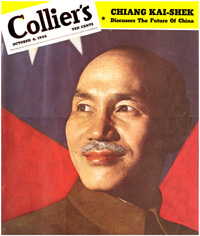
Eleanor Roosevelt on Japanese-American Internment
(Collier’s Magazine, 1943)

In this article, First Lady Eleanor Roosevelt (1884 – 1962) attempted to play (very politically) both sides of the street, implying on the one hand that the creation of the Japanese-American internment camps seemed a reasonable measure in wartime; but the reader doesn’t have to have a degree in psychology to recognize that she believed otherwise.

An Interview with a Kamikaze Pilot
(Yank Magazine, 1945)

With the fall of imperial Japan, YANK correspondent Robert MacMillan was
one of the very first journalists to interview the Japanese Kamikaze pilot Norio Okamoto, which allowed his readers to gain some understanding as
to how the Kamikaze Corps operated:

Okomoto’s story took all the wind -the Divine Wind – out of the Kamikaze sails. Even the interpreter, a Japanese civilian, was surprised. He had worked for radio Tokyo and while he knew a lot of the propaganda stories were ridiculous, he had believed the Kamikaze legend.


Click here to read articles about post-war Japan.

He Represented Four Million POWs
(The American Magazine, 1943)

Here is a petite profile of Tracy Strong (1887 – 1968), who, as Director of the YMCA War Prisoners Aid Committee, had license to enter every combatant nation in order to see to the health and welfare of all POWs. Much of his work involved procuring books, sporting equipment and musical instruments to the incarcerated.

Advertisement

Use shortcode [oma_ad position="summary_top"] (or other position) in your theme or widgets to display OMA Promotions here.

John Steinbeck of The N.Y. Herald Tribune
(Newsweek Magazine, 1943)

An odor rises from the men, the characteristic odor of an army. It is the smell of of wool and the bitter smell of fatigue and the smell of gun oil and leather. Troops always have this odor. The men lie sprawled, some with their mouths open, but they do not snore. Perhaps they are too tired to snore, but their breathing is an inaudible, pulsing thing.


Click here to read a movie review of The Grapes of Wrath.

The VT Radio Fuse
(Yank Magazine, 1945)

Its been said that World War Two was the first high-tech war, and a passing look at many of the military tools used between 1939 and 1945 will bare that out to be true. It was not only th the first war in which jet engines and atomic bombs were used, but also the first war to deploy walkie-talkie radios, rockets, and radar. This article concerns what the U.S. Department of War classified as a weapons system just as revolutionary as the atomic bomb: the VT fuse artillery shell (a.k.a. the time proximity fuse). It was used with great success in various theaters: anti-Kamikaze in the Pacific, anti-personnel in the Ardennes and anti V-1 in defense of Britain.

This is a short article that goes into greater detail outlining the successes listed above and explains how the system worked; it also is accompanied by a diagram of the shell.


Click here to learn about the timing fuses designed for W.W. I shrapnel shells.

The American 4.5 Multiple Rocket Launcher
(Yank Magazine, 1945)

To the American G.I.s serving along the Italian Front, the presence of rockets was like a page out of a Buck Rogers comic book. They had grown accustomed to seeing them mounted on the wings of quickly speeding American fighter aircraft, but to see and hear them up close and personal when fixed to the turret of a Sherman tank (pictured) seemed altogether too bizarre. This article, Rockets in Italy, will allow you to learn about the use and deployment of the U.S. Army’s ground rocket-gun and how it amazed all the men who ever came near enough to see one.


Click here to read about one of the greatest innovations by 20th Century chemists: plastic.

Advertisement

Use shortcode [oma_ad position="summary_top"] (or other position) in your theme or widgets to display OMA Promotions here.

‘Sand Diego – A Woman’s Town”
(Click Magazine, 1944)

Sand Diego wanted women for its war industries. Since the beginning of the war boom San Diego has cajoled, bribed and appealed publicly for women. And San Diego got women, not only for the war industries, but for every other conceivable job. They became letter carriers, bus drivers, high-altitude window washers, milk deliverers, office workers.

With the Brazilians in Italy
(Newsweek & Yank Magazines, 1944)

The attached YANK MAGAZINE article was written from the perspective of the American G.I.; it lays out a few peculiar facts about life in the World War Two Brazilian Army:

Every type of South American racial strain is represented. This gives a squad the appearance of a capsule League of Nations, except that there are no blonds.


Read about the day Brazil declared war on Nazi Germany…


Mexico preferred not to participate in the war, but they did kick all the Fascist spies out of their country, click here to read about it…

Mexico: American Ally
(Coronet Magazine, 1943)

When Manuel Avila Camacho (1897 – 1955) came to power as the president of Mexico (1940 – 1946) he immediately went to work kicking out the Fascist spies from Japan and Germany

He banned Nazi newspapers and cut Nazis off the air. He squashed the anti-Semitic Gold Shirts of Monterey and purged fifth columnists in key positions. He washed his hands of the Nazis and extended a hearty handclasp to Roosevelt.

Advertisement

Use shortcode [oma_ad position="summary_top"] (or other position) in your theme or widgets to display OMA Promotions here.

S/Sgt. Henry E. Erwin Off the Coast of Japan
(Collier’s Magazine, 1945)

War correspondents see and hear about many courageous acts that serve as a testimony to the level of personal commitment held high by many (but not all) of the American soldiers, sailors, airmen and Marines who served in the Second World War, and when I read the opening paragraphs about this hero, I knew it was going to be unique:

His name is Staff Sergeant Henry E. Erwin of Bessemer, Alabama. He was the radio operator on a B-29, and what he did, we think, was the bravest thing we ever heard of.

The War-Babies of Occupied Japan
(People Today Magazine, 1954)

There was one thing the Japanese hated more than being defeated and occupied by the Gai-jin (the Japanese slur for Whites) and that was when their daughters, sisters and nieces began bedding their tormentors and baring their young. Tremendous shame was brought on these women, and their families. This article is about the Amerasian babies who were isolated in a special orphanage designed just for them.


How did all of this come to pass? Click here to find out…

American Advantages During World War II
(Yank Magazine, 1945)

General Marshall listed a number of clear advantages that the American G.I. had over his German and Japanese counterpart: the M-1 Garand semi-automatic rifle, the jeep and the two-and-a-half ton truck (Deuce and a half):


It is interesting to trace the planning and decisions that gave us the Garand rifle and the tremendous small arms fire-power that went with it, noting especially that the War Department was strenuously opposed.

Advertisement

Use shortcode [oma_ad position="summary_top"] (or other position) in your theme or widgets to display OMA Promotions here.

Scroll to Top