Author name: editor

Architect Rudolf Schindler (Direction Magazine, 1945)
1945, Design, Direction Magazine

Architect Rudolf Schindler
(Direction Magazine, 1945)

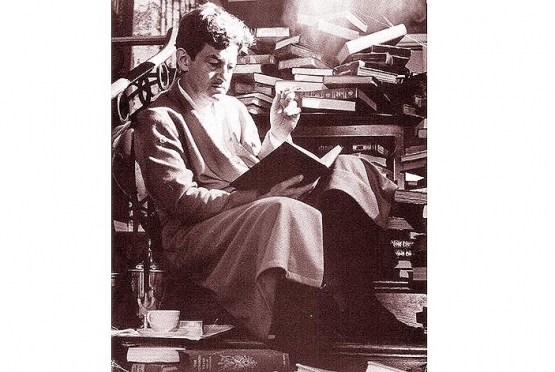
Esther McCoy (1904 – 1989) was one of the few voices in Forties journalism to champion modern architecture in the city Los Angeles. Sadly, the common thinking among too many critics and editors at the time held that Gomorrah-Sur-la-Mer could only to be relied upon for innovations like Cobb Salad and valet parking – but McCoy recognized that the city’s dramatic quality of light and odd lunar landscape combined to create fertile ground for modern architecture. Unlike other like-minded critics and historians who discovered the city in later decades, such as Reyner Banham, McCoy came to know the Viena-trained architect Rudolph Schindler, who is the subject of this 1945 article.

The Princess Colonels of 1914 (Vanity Fair, 1914)
1914, European Royalty, Vanity Fair Hall of Fame

The Princess Colonels of 1914
(Vanity Fair, 1914)

Attached is a page from VANITY FAIR MAGAZINE depicting the ten European princesses from 1914, having benefited from full hair and make-up, posing bemedaled and amused in full military dress before the society magazine cameras.


The Royals pictured on this page were all granted the ceremonial rank of ‘Colonel’ in the household cavalry units within their respective principalities, as well as a few of the cavalry regiments outside their domains.


Several of the Royal and Imperial women in Europe, who are possessed of military rank, have lost their colonelcies in foreign regiments by the World War. Thus, the Czarina and the Russian Grand Duchess, as well as Queen Mary of England, have been deprived of their commands in the Kaiser’s army.

W.W. I and the Royal Families of Europe (Vanity Fair, 1915)
1915, European Royalty, Vanity Fair Hall of Fame

W.W. I and the Royal Families of Europe
(Vanity Fair, 1915)

In five short paragraphs, this writer (Ard Choille), nicely sums up the chumminess that made up the royal families of old Europe and the vital role Queen Victoria played in the creation and maintenance of that bond:

Until the outbreak of the war the royal families of the various nations made up a wonderful club, the like of which had never been known before. Judging from the society papers, most of Europe existed for their convenience, and even the variety of military uniforms was kept up in order that royalty, while at home or abroad, might have the opportunity to change its clothes as often as possible

Advertisement

Use shortcode [oma_ad position="summary_top"] (or other position) in your theme or widgets to display OMA Promotions here.

Rockwell Kent: Artists of Democracy (Rob Wagner's Script Magazine, 1942)
1942, Modern Art, Rob Wagner's Script Magazine

Rockwell Kent: Artists of Democracy
(Rob Wagner’s Script Magazine, 1942)

The U.S. had only been actively engaged in World War II for five months when the American artist Rockwell Kent (1882 – 1971) felt the impulse to write about the unique roll an artist must play when a democracy goes to war:

The art of a democracy must be, like democracy itself, of and by and for the people. It must and will reflect the public mood and public interest…Awareness of America, of its infinitely varied beauties and of its sometimes sordid ugliness; awareness of the life of America, of its fulfillments and its failures; awareness, if you like, of God, the landscape architect supreme – and political failure: of the promise of America and of its problems, art has been, or has aimed to be, a revelation. It is for the right to solve these problems our way that we are now at war.

Resourceful Robert Motherwell (Quick Magazine, 1951)
1951, Modern Art, Quick Magazine

Resourceful Robert Motherwell
(Quick Magazine, 1951)

The ink-stained editors at QUICK MAGAZINE rarely ever concerned themselves with the Bohemian-happenings of the New York art world, but when the abstract expressionist painter Robert Motherwell (1915 – 1991) strayed from the standard-issue art supply tools and used a reflective fabric called Scotchlite in the creation of a 12 foot, three-paneled mural – the editors thought it was news.

Robert Henri (Vanity Fair, 1916)
1916, Modern Art, Vanity Fair Hall of Fame

Robert Henri
(Vanity Fair, 1916)

A VANITY FAIR MAGAZINE profile of the American painter Robert Henri (1865 – 1929):

Robert Henri does not sympathize with the artists who throw their work in the face of the public with a ‘There, take it or leave it.’ Indeed, he has an almost hieratic belief in the power of the fine arts, not merely to delight, but to improve, to uplift and to educate the masses.

Click here to read further about the 1913 Armory show.

Advertisement

Use shortcode [oma_ad position="summary_top"] (or other position) in your theme or widgets to display OMA Promotions here.

Irwin Shaw Recalled Combat PhotographerRobert Capa ('47 Magazine, 1947)
1947, 47 Magazine, Miscellaneous

Irwin Shaw Recalled Combat PhotographerRobert Capa
(’47 Magazine, 1947)

American novelist Irwin Shaw (1913 – 1984) was quick to reminisce about the bad old days of World War II and Robert Capa (1913 – 1954), who fit it like a round peg fits a round hole:

Capa is a dangerous influence because he has perfected the trick of making life among the bombed cities and the stinking battlefields of our time seem gay and dashing and glamorous…


Click here to read an anecdote about Robert Capa during the Spanish Civil War.

William Orpen and the Portrait of Mrs. Oscar Lewisohn (Vanity Fair, 1915)
1915, Modern Art, Vanity Fair Hall of Fame

William Orpen and the Portrait of Mrs. Oscar Lewisohn
(Vanity Fair, 1915)

Here is a petite notice that appeared in a 1915 issue of VANITY FAIR heralding a new portrait by the British painter William Orpen (1878 – 1931), which depicted the likeness of a popular American stage actress Mrs. Oscar Lewisohn (Edna May Pettie 1878 – 1948). The anonymous reviewer compared the portrait styles of Orpen with that of London’s reigning portrait painter, John Singer Sargent:

Sargent had a way of showing his sitters as they didn’t think they looked. On the other hand, Orpen has a trick of making his sitters look like what they would like to be.

Advertisement

Use shortcode [oma_ad position="summary_top"] (or other position) in your theme or widgets to display OMA Promotions here.

Four Photgraphs of the Extended Royal Family (Vanity Fair, 1915)
1915, European Royalty, Vanity Fair Hall of Fame

Four Photgraphs of the Extended Royal Family
(Vanity Fair, 1915)

Assorted photographs of the assembled German, Spanish, Belgian, Russian, Norwegian and British royal families, posed as they gathered to attend the the 1894 and 1896 Royal weddings at Coburg; also pictured is the group photo snapped at the 1898 shooting party at Sandingham. Queen Victoria appears in two of the pictures, while Kaiser Wilhelm II can be seen in all of them.
Clothing the Camper and Yachtsman (Vanity Fair Magazine, 1917)
1917, Men's Fashion, Vanity Fair Magazine

Clothing the Camper and Yachtsman
(Vanity Fair Magazine, 1917)

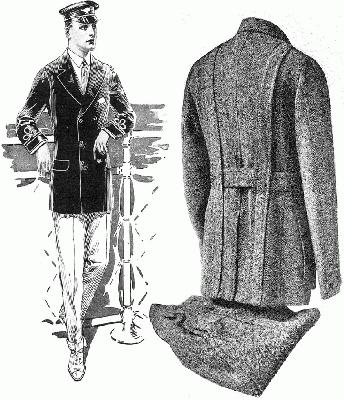
For all too few it is understood that fashion need not end in the wilderness: for it is more than likely that that was where the need for fashion was first recognized and it was there, among the toads and the dung, that the Well-Dressed man first crawled out of the muck and civilizationstyle=border:none

was born. With all this in mind, Robert Lloyd Trevor reviewed the fashions for the enjoyment of camp-life in this 1917 Vanity Fair review. Another vital concern touched upon by the journalist was the clothing available to the yachtsmen at that time:

Yachting is one of the things that begin at the bottom. That is to say, at the shoes. They are the foundation, as it were, for the rest of life on the rolling deep.

Advertisement

Use shortcode [oma_ad position="summary_top"] (or other position) in your theme or widgets to display OMA Promotions here.

The Fifth Avenue Soldier (Advertisement, 1918)
1918, Magazine Advertisement, U.S. Army Uniforms of World War One

The Fifth Avenue Soldier
(Advertisement, 1918)

The haberdashers of the Franklin Simon Company of Fifth Avenue, New York City, simply must not have been reading the many news reports regarding the horrors of industrial warfare. Indeed, their concept of coping with such carnage involved offering such sale items as silk handkerchiefs, cashmere socks and a dashing bathrobe for tooling around the barracks.

Click here to see what Brooks Brothers was selling During World War One.

The Well-Born Officer (Vanity Fair, 1918)
1918, U.S. Army Uniforms of World War One, Vanity Fair Hall of Fame

The Well-Born Officer
(Vanity Fair, 1918)

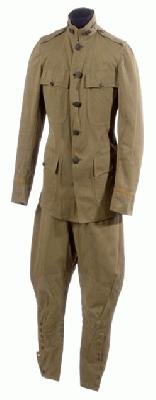
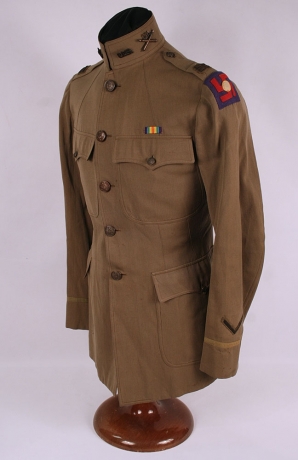
For it’s October issue, the editors of VANITY FAIR magazine stepped up to the plate and did their bit with this splendid review of all the finest uniform apparel that New York City offered it’s silk stocking officers. The article is nicely illustrated with photographs of a double-breasted mackinaw coat, two officer blouses (one of a wool-silk blend), a classic silk knit service tie as well as a very fine trench boot.


New From Amazon: Doughboys on the Great War:
How American Soldiers Viewed Their Military Experience
style=border:none

Advertisement

Use shortcode [oma_ad position="summary_top"] (or other position) in your theme or widgets to display OMA Promotions here.

1922, Confederate Veteran Magazine, Miscellaneous

Civil War Reunion Clothing
(Confederate Veteran Magazine, 1922)

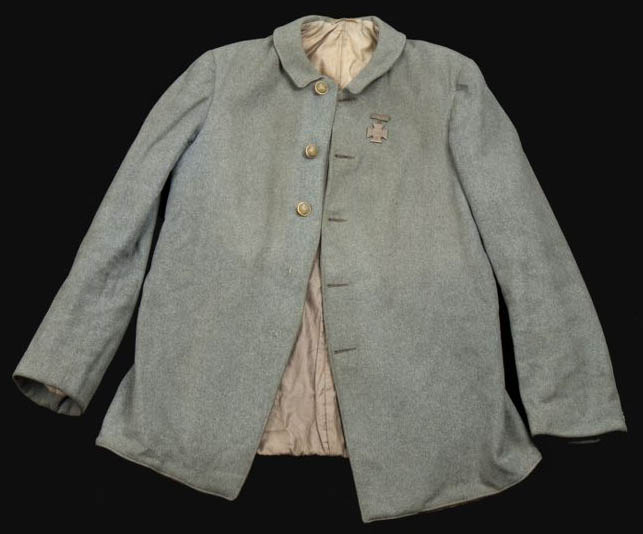
What did the smart, re-constructed Confederate soldier wear to the reunions, you ask? Why an eight buttoned sack coat with matching trousers composed of Dixie Gray wool, of course! It was all the rage among the apple-sauce crowd of 1922 – and by clicking the link below you will see a black and white ad from Confederate Veteran Magazine which pictured the togs.

Advertisement

Use shortcode [oma_ad position="summary_top"] (or other position) in your theme or widgets to display OMA Promotions here.

Scroll to Top