Author name: editor

20th Century Malaise | 20th Century Cynicism
1923, The Atlantic Monthly, Writing

The Pessimism That Followed W.W. I
(Atlantic Monthly, 1923)

A few years after the Great War reached it’s bloody conclusion, literary critic Helen McAfee discovered that a careful reading of the prominent authors and poets writing between 1918 and 1923 revealed that each of them shared a newfound sense of malaise – a despairing, pessimistic voice that was not found in their pre-war predecessors.

Certainly the most striking dramatization of this depth of confusion and bitterness is Mr. Eliot’s The Waste Land. As if by flashes of lightening it reveals the wreck of the storm… The poem is written in the Expressionist manner – a manner peculiarly adapted to the present temper… It is mood more than idea that gives the poem its unity. And the mood is black. It is bitter as gall; not only with a personal bitterness, but also with the bitterness of a man facing a world devastated by a war for a peace without ideals.


If you would like to read another 1920s article about the disillusioned post-war spirit, click here.

Mad Magazine (Coronet Magazine, 1960)
1960, Coronet Magazine, Magazines

Mad Magazine
(Coronet Magazine, 1960)

When Mad Magazine first appeared on newsstands in 1952 it was immediately recognized as something quite new in so far as American satirical magazine humor was concerned. The earliest issues were produced in comic book format with almost all content produced by its founding editor, Harvey Kurtzman (1924 – 1993); by 1955 the magazine’s lay-out was altered to its current form. From its earliest days, Kurtzman and his publisher, William Gaines (1922 – 1992), began receiving unsolicited gags from many of the finest writers and performers on radio and TV. This article lists some of the scandals (both foreign and domestic) that the magazine inadvertently generated.

Charles Lindbergh: American Hero (Literary Digest, 1927)
1927, Charles Lindbergh, The Literary Digest

Charles Lindbergh: American Hero
(Literary Digest, 1927)

Truth is stranger than fiction’ is an old writer’s saw that the pen plodders know and the general reader doubts. But that truth and fiction may be one and the same thing in comes to light in the story of Charles Lindbergh’s flight. No fiction writer could have contrived a story more perfect and right in it’s details…In a few short days an unknown lad has become the hero of the world. His name is on the lips of more people than any under the sun. His face etched in more minds than any living human. The narrative question of the story, ‘Will he make it?’ is on everybody’s lips, from President to beggars.

Advertisement

Use shortcode [oma_ad position="summary_top"] (or other position) in your theme or widgets to display OMA Promotions here.

The Plot to Assassinate Eisenhower Foiled by Cartoons...(Lion's Roar, 1946)
1946, General Eisenhower, The Lion's Roar

The Plot to Assassinate Eisenhower Foiled by Cartoons…(Lion’s Roar, 1946)

An interesting W.W. II story was passed along by actor, announcer, producer and screenwriter John Nesbitt (1910 – 1960), who is best remembered as the narrator for the MGM radio series Passing Parade. Five months after the end of the war, Nesbitt relayed to his audience that during the Battle of the Bulge, U.S.-born Nazi agents, having been ordered to kill General Eisenhower, did not even come close to fulfilling their mission, suffered incarceration among other humiliations – all due to a lack of knowledge where American comic strips were concerned. Read on…


Here is another Now it Can be Told article…

Advertisement

Use shortcode [oma_ad position="summary_top"] (or other position) in your theme or widgets to display OMA Promotions here.

A Child's Interview With Dickens (The Literary Digest, 1912)
1912, Miscellaneous, The Literary Digest

A Child’s Interview With Dickens
(The Literary Digest, 1912)

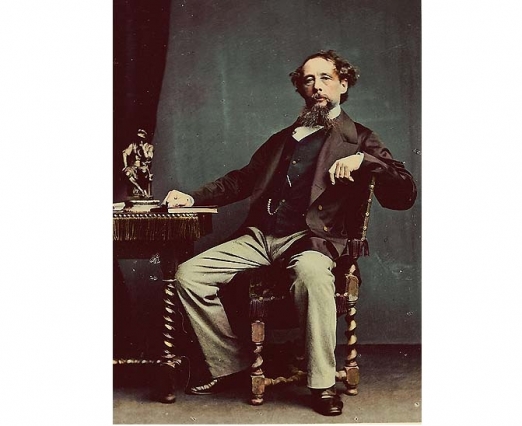
Kate Douglas Wiggin recalled her childhood train ride in the 1840’s in which she was able to have a chat with one of her favorite authors, Charles Dickens (1812 – 1870), as he traveled the United States on a reading tour.

‘Of course, I do skip some of the very dull parts once and a while; not the short dull parts but the long ones.’ He laughed heartily. ‘Now that is something that I hear very little about’ he said.

Advertisement

Use shortcode [oma_ad position="summary_top"] (or other position) in your theme or widgets to display OMA Promotions here.

Mark Twain's Unkind Portrait of Bret Harte (Current Opinion, 1922)
1922, Current Opinion Magazine, Miscellaneous

Mark Twain’s Unkind Portrait of Bret Harte
(Current Opinion, 1922)

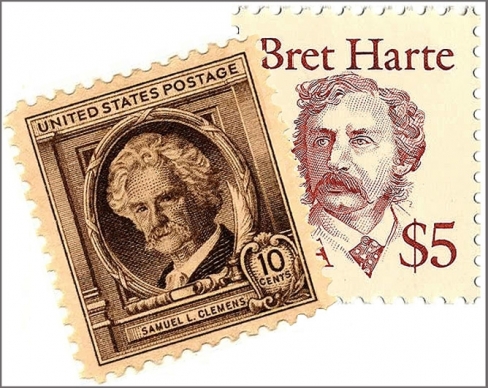
Nasty adjectives fly in this nifty essay concerning the friendship that soured between American writers Mark Twain (1835 – 1910) and Bret Harte (1836 – 1902). The two men were quite close during their younger days as journalists in San Francisco; in 1877 the bond between them was so strong that the two agreed to collaborate on a play, which they titled, Ah, Sin. However, Twain insisted that it was notoriety that killed his friend and it might have been better …if Harte had died in the first flush of his fame:

There was a happy Bret Harte, a contented Bret Harte, an ambitious Bret Harte, a bright, cheerful, easy-laughing Bret Harte to whom it was a bubbling effervescent joy to be alive. That Bret Harte died in San Francisco. It was the corpse of that Bret Harte that swept in splendor across the continent…

Advertisement

Use shortcode [oma_ad position="summary_top"] (or other position) in your theme or widgets to display OMA Promotions here.

The House of Lucile (Hearst's Sunday American, 1917)
1917, Fashion, Hearst's Sunday American

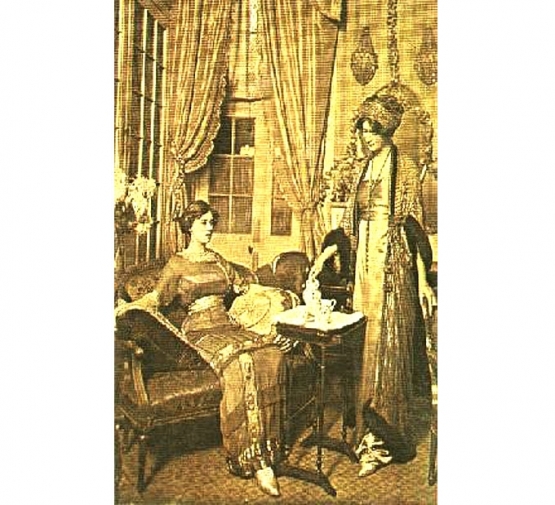
The House of Lucile
(Hearst’s Sunday American, 1917)

Fashion and Hollywood costume designer Howard Greerstyle=border:none
wrote of Lady Duff Gordonstyle=border:none
(born Lucy Sutherland, 1863 – 1935):

…she was the first to introduce the French word chic into the English language, particularly in relation to fashion. She was the first dressmaker to employ mannequin parades (ie. models) in the showing of clothes…She was responsible for many fads and her clothes made many people famous. She was the most expensive dressmaker of her time, and the most aloof.


Lucile was one of the few souls to survive the TITANIC sinking; click here to read her account of that sad night.

•Read about the 1943 crochet revival•

Fritz Kuhn at Camp Nordland 1938 | Amerikadeutscher Volksbund 1937 | Salvatore Caridi American Fascist
1937, American Fascism, The Literary Digest

‘Fascism in America”
(Literary Digest, 1937)

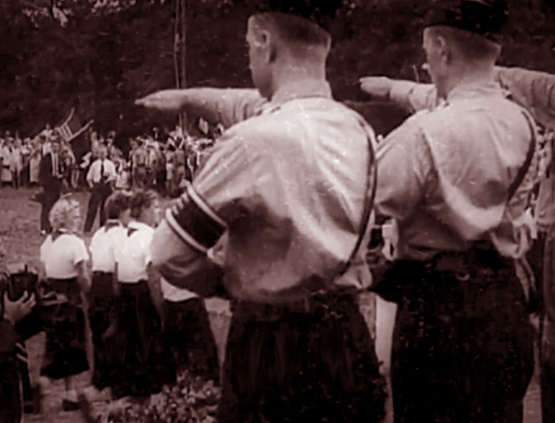
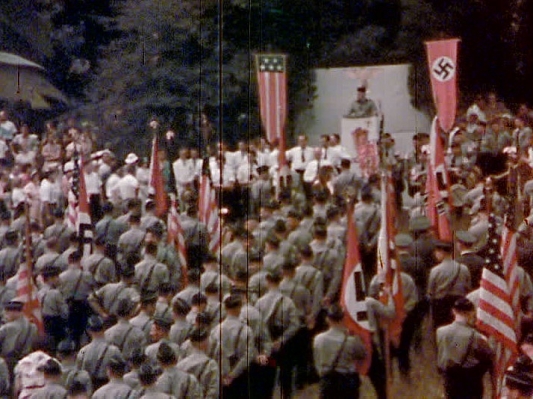
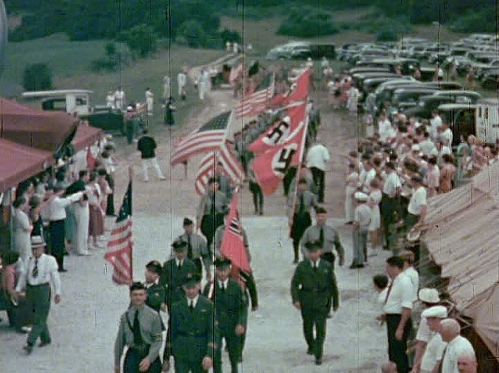
With the opening of Camp Nordland (Dorkland?) in Andover, New Jersey, the two streams of American fascism saw fit to convene there and join hands. The Italian side was lead by the American Duce Salvatore Caridi and Yankee Fuhrer Fritz Kuhn stood at the head of the American Bundists.

Amidst much heiling, drinking of imported beer and assorted flag-waving, was celebrated the cementing of the twenty-first link in a chain of camps which has been gradually growing. By car they came and by train, until the countryside was increased by ten thousand inhabitants.

Anastase Andreivitch Vonsiatsky Newspaper Article 1942 | A.A. Vonsyatsky Bundist Ally | Russian Fascist Party in America
1944, American Fascism, Newsweek

The White Russian Fascist In America
(Newsweek Magazine, 1944)

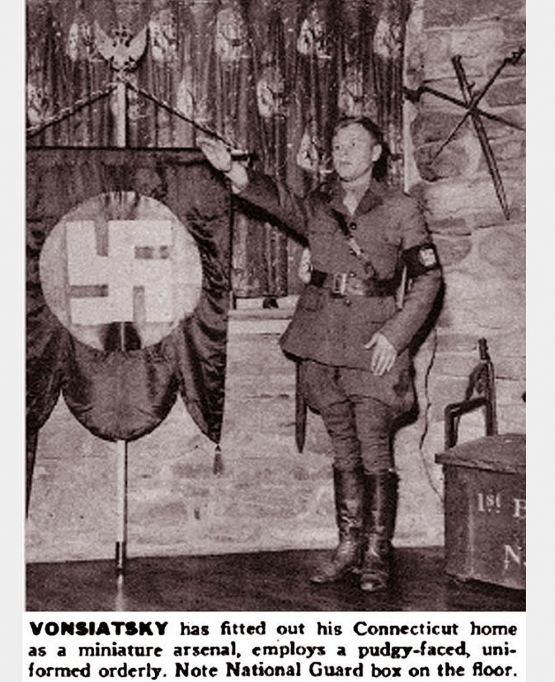
One of the loyal confederates of the American Bund was Anastasy Vonsyatsky (1898 – 1965). It was his sincere belief that Fascism was the only force capable of defeating international communism – and once he conceived of this idea, he was all in: Fascism could do no wrong. Although he worked closely with the American Bund, his true allegiance stood with the Russian Fascist Party in far-off Manchukuo, China
(you can read about Manchukuo here). Vonsyatsky was arrested by the FBI five months after Pearl Harbor and released in 1946.

Advertisement

Use shortcode [oma_ad position="summary_top"] (or other position) in your theme or widgets to display OMA Promotions here.

Fritz Kuhn American Nazi | American Nazis at Camp Nordland New Jersey 1938 | German-American Bund
1938, American Fascism, Click Magazine

American Nazis
(Click Magazine, 1938)

As you can see by glancing at some of the other articles on this page, the Italians and Germans were not the only nations to cultivate a taste for fascism; a franchise office was opened in the United States in the mid-Thirties. This article is essentially a photo-essay consisting of twenty-six images and a brief explanation regarding the American Nazi movement that once existed in New Jersey:


The pictures on these pages were not made in Germany. They may look like accurate shots of a foreign political movement, which they are, but they were made right here in these United States. Almost coincidentally with Hitler’s assumption of power in the Reich, our free democracy began to feel the long paw of Nazi propaganda…


Read about the American reporter who became a Nazi…

Click here to read about an admired American hero who was also attracted to fascist theology.

Who Was Mussolini | Career of Benito Mussolini
1937, Benito Mussolini, Pathfinder Magazine

Who Was Mussolini?
(Pathfinder Magazine, 1937)

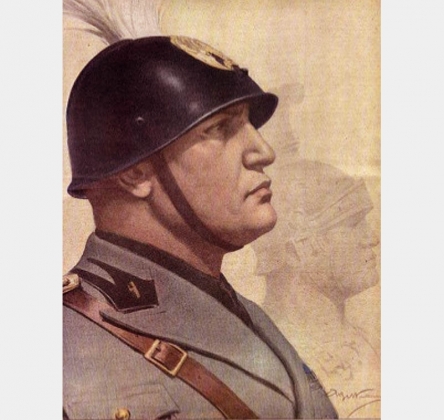
A semi-flattering profile of Benito Mussolini that explains his difficult childhood and the periodic beatings he suffered at the hands of his Marxist father. No references are made to his favorite pastimes – beating up editors and closing newspapers:

Significantly, his god is Nietzsche, the German philosopher who wrote: ‘Might makes right.’


You can read about his violent death here…


Fascist Rome fell to the Allies in June of 1944, click here to read about it…

Advertisement

Use shortcode [oma_ad position="summary_top"] (or other position) in your theme or widgets to display OMA Promotions here.

Scroll to Top