




World War Two

Find old World War 2 articles here. We have great newspaper articles from wwii check them out today!

The German JU-88 Heinkel Fighter Bomber
(Alertman, 1943)

From the pages of a 1943 issue of America’s Alertman was this page that presented some information about the German JU 88 twin engine bomber, which was the primary offensive aircraft in the Luftwaffe’s arsenal during the Second World War. It was the successor to the Ju-87 and saw service as a night fighter and torpedo bomber in addition to serving as reconnaissance aircraft. The earliest prototype first flew in December of 1936 with a civilian registration of D-AQEN; it managed a top speed of 360 mph. Throughout the course of the war there were 15,000 JU 88’s constructed.

The attached article from 1943 goes into greater detail and can easily be printed.

The American A-36 Fighter Bomber
(Yank Magazine, 1943)

This article page from a 1943 YANK MAGAZINE concerns the American A-36 fighter-bomber of World War II. The article is accompanied by photographs and testimonial accounts as to how well the fighter aircraft performed in combat over North Africa and Sicily.

Built by North American Aviation, this ship is a dive-bomber version of that company’s P-51 Mustang fighter. The A-36 can climb at the rate of nearly half a mile a minute, with a ceiling of 30,000 feet. Powered by a 12-cylinder Allison engine, it has a flying speed in excess of 400 miles an hour…

The R.A.F. Mosquito-Bomber
(Click Magazine, 1944)

Almost entirely [composed] of wood, Britain’s Mosquito Bomber can sting the enemy out of proportion to its size and appearance. Thirty odd German cities already have felt the devastating, impressive bite of Mosquitoes in more than 150 bombing raids on the Reich.

Advertisement

Use shortcode [oma_ad position="summary_top"] (or other position) in your theme or widgets to display OMA Promotions here.

The B-17
(Coronet Magazine, 1959)

The B-17 Flying Fortress was the most fabulous combat plane ever built. Like Douglas’ unretireable DC-3 airliner, the B-17 is history written in metal, a pivot of progress which helped influence an entire generation.

Perhaps more than any other plane, the B-17 beat Hitler. Its 640,036 tons of bombs on Europe, nearly the total dropped by all other U.S. planes combined, knocked out much of his industry, oil and railroads… The B-17 unveiled the era of strategic air power and turned man’s eye to the stratosphere and beyond.


Click here to read about the P-47 fighter plane.

Enter Napalm
(Collier’s Magazine, 1945)

The first use of napalm in the Second World War was by the U.S. Army Air Corps flying over Germany. This article reported that it was used by Navy over Saipan, the Army over Tinian and the Marines over Peleliu:

Now it is possible to tell one of the more dramatic fire-bomb stories: [During an eight day period] last October, on a section of Peleliu no bigger than a city block, the Death Dealer Squadron of the Second Marine Air Wing dropped more than 32,000 gallons of flaming gasoline on Jap cave positions and wiped them out.


Click here to read about one of the greatest innovations by 20th Century chemists: plastic.

The Undeveloped Weapons of the Nazi Scientists
(Yank Magazine, 1945)

The war was over when the U.S. Army Ordnance Department began snooping around all the assorted ÜBER-secret weapons labs and work shops where the pointiest headed Nazis were developing some truly far-seeing weaponry, inventions that they were never able to perfect (thankfully).

One of the most striking aspects of the attached article is the part when you recognize that it was the Nazi scientists who first conceived of such space-based weaponry as the Star Wars technology that was ushered in during the Reagan presidency (i.e.: the Strategic Defense Initiative). While in pursuit of their nefarious tasks, these same scientists also conceived of harnessing the powers of the sun in order to advance Hitler’s queer vision of the perfect world.


Click here to read about the firm belief held by the German Army concerning the use of motorcycles in modern war.

Advertisement

Use shortcode [oma_ad position="summary_top"] (or other position) in your theme or widgets to display OMA Promotions here.

When W.W. II Came to Hollywood
(Photoplay Magazine, 1948)

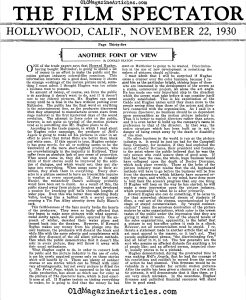
The attached article is but a small segment addressing the history of Hollywood during the war W.W. II years; clipped from a longer Photoplay Magazine piece that recounted the illustrious past of Hollywood some thirty-five years earlier.

After Pearl Harbor, the men really began leaving town. David Niven was gone now. So too, was Flight Officer Laurence Olivier. And more and more from the Hollywood ranks kept leaving. Gable, Fonda, Reagan, the well-knowns and the lesser-knowns. Power, Taylor, Payne, Skelton and many others…More Hollywood regulars went away, so other, newer newcomers had to be found to replace them because the box office was booming.

The Battle of Stalingrad
(Newsweek Magazine, 1942)

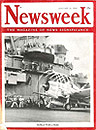
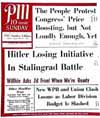
The Newsweek report on the under-supplied Red Army counter-offensive at Stalingrad.

Russia’s hope was Hitler’s despair. His schedule for the year had already been irreparably disrupted and none of his major objectives – Stalingrad, the Caspian Sea, the oil of the Caucasus – had yet been attained. And already the Nazi soldiers could feel the cold breath of winter through their summer uniforms…

‘What Kind of Women are the WAACs?”
(Click Magazine, 1942)

They’re career women, housewives, professionals, factory hands, debutantes. They’ve taught school, modeled, supported themselves, as secretaries, salesgirls, mechanics. Single and married, white and colored, between the ages of 21 and 45, they’re corresponding with a beau, in Ireland, a husband Australia, or the ‘folks back home’ in Flatbush. But varied as their background may be, they’ve enlisted in the Women’s Army Auxiliary Corps (WAAC) with a common purpose: to get behind America’s fighting men and help win a lasting peace.

When well-versed in army-administrative methods, the WAAC will cause the transfer of 450 enlisted men to combat areas each week. It realizes full-well its responsibility and has dedicated itself to the idea that the Women’s Army Auxiliary Corps will prove itself equal to the opportunity.

Advertisement

Use shortcode [oma_ad position="summary_top"] (or other position) in your theme or widgets to display OMA Promotions here.

The Women of the U.S. Marine Corps
(Think Magazine, 1946)

Lady Leathernecks’, as the trimly-clad members were affectionately dubbed, responded to their country’s call some 19,000 strong, accomplishing more than 150 different jobs at more than fifty Marine bases and stations throughout the United States.

Organized February 13, 1943 the Women’s Reserve was directed by Lt. Colonel Ruth Cheney Streeter (1895 – 1990). Women in the Marine Corps were authorized to hold the same jobs, ranks and pay as Marines.

The American Way of War
(American Magazine, 1945)

The Yank is not expert at deception, but he can change his plans rapidly. He is a wizard at handling machinery and he can build airfields, roads and advance bases with uncanny speed.


– so wrote one of the bewildered Japanese Army generals concerning his experiences with the American military in the Pacific.

The German Draft and Manpower Supply
(U.S. Dept. of War, 1945)

A U.S. Government study regarding the conscription policies of the German Army during World War II. Attention is paid to the development of this policy from it’s earliest days in 1935, when the draft was introduced, to the total mobilization scheme that followed the battle of Stalingrad.

Advertisement

Use shortcode [oma_ad position="summary_top"] (or other position) in your theme or widgets to display OMA Promotions here.

A Pat on the Back for the GIs
(Coronet Magazine, 1945)

So they’ve given up.

They’re finally done in, and the rat is dead in an alley back of the the Wilhelmstrasse.

Take a Bow, GI – take a bow, little guy.

Far-flung ordinary men, unspectacular but free, rousing out of their habits and their homes – got up early one morning, flexed their muscles, learned the manual of arms (as amateurs) and set out across perilous oceans to whop the bejeepers out of the professionals.

And they did.

Fashion Police
(American Magazine, 1943)

Who was it who deprived men of their suit vests and trouser cuffs? Who banned silk stockings? Who outlawed the flow in flowing skirts? Why, it was the War Production Board of course – click the title link if you want a name and a face…

Why France Fell
(Omnibooks Magazine, 1942)

On assignment for the Hearst papers, H.R. Knickerbocker (1898 – 1949) witnessed the total collapse of the French Army. He made his observations and conclusions available to American readers in his 1941 book Is Tomorrow Hitler’s?, which hit the bookshops shortly after Pearl Harbor.

If [The French] had ignored their low birth rate, been willing to spend lives, had retained the old offensive spirit traditional in the French Army, had known that they had to win or perish, had a Churchill to inspire and lead them, and had no traitors in their ranks, their comparative lack of weapons would not have mattered; they would still be fighting the Germans in France.


Click here to read the observations of U.S. Army Lieutenant Louis L’Amour concerning 1946 Paris.


Another article about a French general who collaborated with the Nazis can be read here…

Advertisement

Use shortcode [oma_ad position="summary_top"] (or other position) in your theme or widgets to display OMA Promotions here.

Ireland Bows Out of the War
(Collier’s Magazine, 1942)

This article discusses the various complications and contradictions inherent with Irish neutrality in the face of the Nazi march on Europe. Even though it was clear to see that an Allied victory would certainly be an Irish benefit and the Germans had already fire-bombed Irish cities twice, the Irish leader Eamon De Valera (1882 – 1975) was hellbent on seeing to it that Ireland never played favorites.

The Australian Soldier
(Yank Magazine, 1944)

Attached is a two page article concerning the basic lot of the World War Two Australian soldier: his pay, his kit, his battles and the general reputation of the Australian Imperial Forces (A.I.F.):

…the Australian Imperial Forces who have – and are seeing action all over the world…has fought in every theater in which British forces have been engaged…They have especially distinguished themselves at El Alamein in the North African campaign and in the Papuan and New Guinea campaigns.


Four years after the Pearl Harbor attack, a Japanese newspaper editorial expressed deep regret for Japan’s aggressiveness in the Second World War, click here to read about it…

The Aussies Pull It Together
(The American Magazine, 1942)

The attached 1942 article tells the remarkable story of Prime Minister John Curtin (1885 – 1945) and his amazing Australians – together they redefined themselves as a wool-producing agrarian nation and began producing the necessary tools of war.

Advertisement

Use shortcode [oma_ad position="summary_top"] (or other position) in your theme or widgets to display OMA Promotions here.

Scroll to Top