Author name: editor

A Visit to the Grave of Rupert Brooke (The London Mercury, 1920)
1920, The London Mercury, Writing

A Visit to the Grave of Rupert Brooke
(The London Mercury, 1920)

Attached is an account by a learned traveler who journeyed to that one piece of ground on the isle of Skyros that will forever be England – the grave of the English poet Rupert Brooke (1887 – 1915). The literati who wrote the attached article went to great lengths imparting the significance of Skyros throughout all antiquity and it’s meaning to the world of letters – credited only as S. Casson, he informed his readers that he arrived on the island five years after the 1915 internment in order to erect the headstone that is currently in place, describing the shepherds and other assorted rustics in some detail while alluding tirelessly to the works of Homer.

Broadway Costume Design for the Fall (Stage Magazine, 1933)
1930s Fashion, 1933, Stage Magazine

Broadway Costume Design for the Fall
(Stage Magazine, 1933)

In his review of contemporary Broadway costume design for the Autumn of 1933, the fashion journalist asked the pressing question:

What is the well-dressed play wearing these days?

There was much talk of Chanel, Schiaparelli and the House of (Elizabeth) Hawes as he heaped the praises high and deep for the the rag-pickers who clothed the ungrateful actresses for such productions as Men in White, Undesirable Lady, Her Master’s Voice and Heat Lightning.

The fashions in the plays are vivid, authentic, and wearable. They have sprung from the gifted brains and fingers of the cream of the crop of designers, Schiaparelli and Chanel in Paris, and our own industrious Americans who, themselves, are becoming hardy annuals. The silhouette is lengthening into slim height but even in sports clothes corners are rounded and curves are accentuated…

Advertisement

Use shortcode [oma_ad position="summary_top"] (or other position) in your theme or widgets to display OMA Promotions here.

A Diagram of Germany's Only World War I Tank (Almanach Hachette, 1919)
1919, Almanach Hachette, Inventions and Weapons

A Diagram of Germany’s Only World War I Tank
(Almanach Hachette, 1919)

A black and white diagram depicting the interior and exterior of the German A7V heavy tank. Manufactured in the spring of 1918, only twenty were ever known to have existed. Although the illustration depicts only two men, it is said that the tank had a crew of 18 and measured 26 feet, three inches in length and 10.5 feet in width. The A7V had two heavy Maxim machine guns placed within it’s turret, while the tank’s primary weapon was a 57mm gun mounted at the very front (these guns were believed to have been of Russian or Belgian origin). The tank could travel an estimated fifty miles at the top speed of 6 mph; it weighed 32 tons and sported armor plating that was 30mm thick at the bow and 20mm thick all around. The tank’s two 150 horse-power, 4-cylinder water cooled engines were made by Daimler.

The Talent for Sniping: Native Americans on the Western Front (The Stars and Stripes, 1919)
1919, Snipers, The Stars and Stripes

The Talent for Sniping: Native Americans on the Western Front
(The Stars and Stripes, 1919)

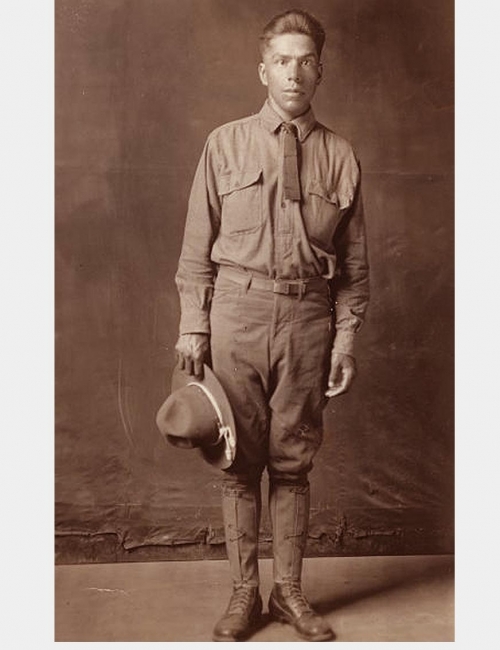
It was not beyond the editors of THE STARS and STRIPES to indulge in ethnic stereotyping from time to time and, no doubt, they exercised that privilege here as well, however the performance of the American Indian soldier got high marks for a number of valued skills from many Allied officers on the Western Front. It was not simply their ability to shoot well which invited these compliments, but also their instincts while patrolling No-Man’s Land in the dark in addition to a common sense of bravery shared by all. The article is rich with a number of factoids that the Western Front reader will no doubt enjoy; among them, mention is made of German women serving in combat.

Read some magazine articles about one of the great failed inventions of the Twentieth Century: the Soviet Union.


1940, Pathfinder Magazine, The Great Depression

Children in Need
(Pathfinder Magazine, 1940)

In respect to their economic status, it has been estimated that one-half to two-thirds of the city children of America are in homes where annual income is too low to permit the family to buy items called for in an ordinary ‘maintenance’ budget – a budget of about $1,261 to meet the normal needs of living in a family of four.


CLICK HERE to read about African-Americans during the Great Depression.

Advertisement

Use shortcode [oma_ad position="summary_top"] (or other position) in your theme or widgets to display OMA Promotions here.

1941 Film Reviews | DIRECTION MAGAZINE Reviews |
1941, Direction Magazine, Hollywood History

Thoughts on the American Films of 1941
(Direction Magazine, 1941)

Here is a film review from DIRECTION MAGAZINE that discussed many of the forthcoming movies of 1941 and how they so rarely depict American culture in an accurate light:

In bringing back the usual revelations from a trip through the Middle West, I want to repeat the oft-declared amazement that American films… reflect the barest minimum of the American scene in these United States. The rare attempts of the Grapes of Wrath and Primrose Path to seek and show new dramatic settings, are the exceptions that prove the rule of formula.
Many of the American films of 1941 are listed herein and the article can be printed.

Advertisement

Use shortcode [oma_ad position="summary_top"] (or other position) in your theme or widgets to display OMA Promotions here.

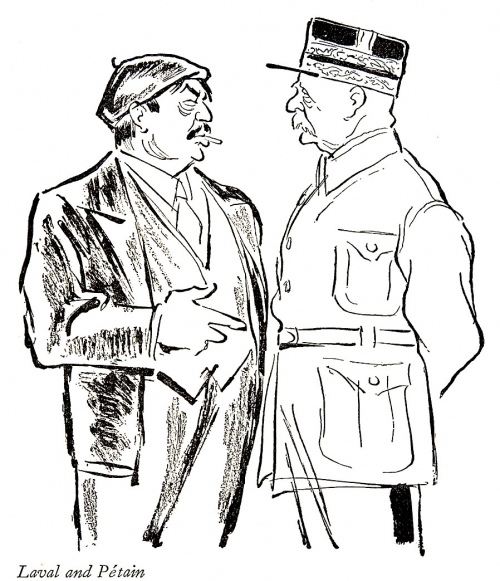
Jews in Occupied France | French Jews Betrayed by Petain | Laval Betrays French Jews
1942, France, Newsweek

The Betrayal of French Jewry
(Newsweek Magazine, 1942)

The Nazis quickly extended the dread Nuremberg laws to the occupied territory. Jews lost jobs, businesses, property, liberty, even their lives. They were flung into primitive concentration camps and deported to Polish ghettos. And with them the Nazis brought the usual wave of Jewish suicides.

ISAMU NOGUCHI (Creative Art Magazine, 1933)
1933, Creative Art Magazine, Design

ISAMU NOGUCHI
(Creative Art Magazine, 1933)

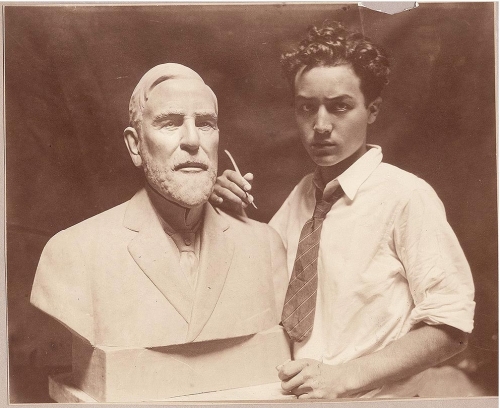
This is an early Thirties profile of a young American sculptor named Isamu Noguchi (1904 – 1988). In the years to come, Noguchi would become well known for his innovative designs for lamps and furniture; but when this article first appeared he was admired for simply having served as an apprentice to Constantin Brancussi.

Click here to read a 1946 art review concerning the paintings of French architect Le-Corbusier.

Advertisement

Use shortcode [oma_ad position="summary_top"] (or other position) in your theme or widgets to display OMA Promotions here.

Assimilation of Immigrants in the 1920s | Maurice G Hindus Immigration Article 1923 | 1920s Immigration
1923, Immigration History

Free Enterprise and the Assimilation of Immigrants
(Readers Digest, 1923)

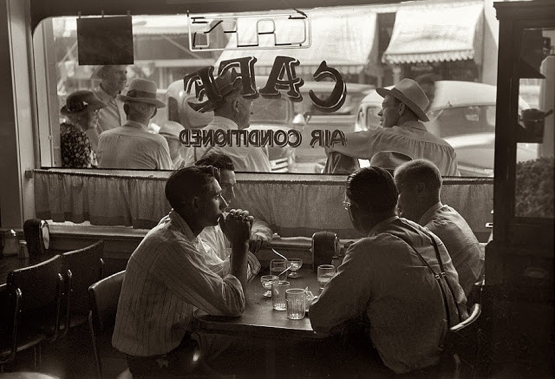
The testimony given in this column from the early Twenties is as true today as it was then. It was written by a 1905 immigrant who observed that the first word immigrants learn when arriving in America is BUY. When presented at every corner with products they’d never seen before in tandem with the smiling and encouraging face of the sales staff, the immigrant can’t help but feel an inner drive to join the American society:

And when he succumbs, why wonder that he grows more aggressive, demanding higher wages and striking when the demand is denied?

Soviet Hypocrisy | Politburo Members Enjoyed Pampered Lives | Stalin Lived in Luxury
1947, Joseph Stalin, Pageant Magazine

Stalin and His Cronies
(Pageant Magazine, 1947)

Here is an expose that revealed the hypocrisy of Stalin and the Soviet party members – who spoke of the inherit nobility of the laboring classes and the triumph of the worker’s paradise while they lived like the czars of old:

The children of the country’s rulers already regard themselves as the hereditary aristocracy… The absence of a free press and consequently, of public criticism, allows them to retain this psychology even beyond their adolescence.

Advertisement

Use shortcode [oma_ad position="summary_top"] (or other position) in your theme or widgets to display OMA Promotions here.

Cardinal Francis Spellman Article 1946 | Anti-Americanism Explained by Cardinal Francis Joseph Spellman
1946, The American Magazine, The Cold War

Un-Americanism
(The American Magazine, 1946)

New York’s Cardinal Francis Joseph Spellman (1889 – 1967) wrote the attached editorial explaining why Marxism was the polar opposite of everything Americans holds dear:

My sole objective in writing is to help save America from the godless governings of totalitarianism…if you believe with me that freedom is the birthright of the great and the small, the strong and the weak, the poor and the afflicted, then you would be convicted as I that [Socialism] is the antithesis of American Democracy.


Click here to read another argument opposed to socialism.

Dale Carnegie on Winning Friends and Influencing People (Collier's Magazine, 1949)
1949, Collier's Magazine, Interviews: 1912 - 1960

Dale Carnegie on Winning Friends and Influencing People
(Collier’s Magazine, 1949)

Dale Carnegie (1888 – 1955) was a phenomenon unique to American shores; he was a publishing marvel whose book How To Win Friends and Influence People has sold over fifty million copies since it’s first appearance in 1937.
Similar to his contemporary Napoleon Hillstyle=border:none
(1883 – 1970), Carnegie was one the preeminent self-help authors of the last century who recognized that success can be found within all of us if we simply know how to harness those elements properly. He had a strong belief that the powers of self-determination can be mastered in one’s ability to communicate clearly, and his followers are legion.


This article coincided with the printing of his second book, How to Stop Worrying and Start Living (1948), and explains the author’s philosophy –


… be a good listener, talk in terms of the other man’s interests, and make the other person feel important.

Advertisement

Use shortcode [oma_ad position="summary_top"] (or other position) in your theme or widgets to display OMA Promotions here.

Scroll to Top