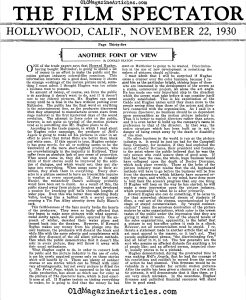
In 1930 a seasoned diplomat and respected attorney by the name of James Watson Gerard (1867 – 1951) created quite a dust-up in Depression-era Washington when he took it upon himself to release his list of those Americans who he believed to have the most power on Capitol Hill. The reason his compilation turned as many heads as it did was because there wasn’t the name of a single elected official to be found on the list – not even President Hoover (although his treasury secretary was, the millionaire industrialist Andrew Mellon).
When asked to clarify his reasoning as to why he felt that a man such as the Hollywood movie producer Adolf Zukor, to name one of the men on his list – has more power than Secretary of War Patrick J. Hurley, Gerard simply explained “that the men named are too busy to hold public office yet rule by virtue of wealth and business position.”
Years later, when the Ambassador was asked how his list would have read for the late Thirties-early Forties, he responded by saying, “It would have shrunk to one man – Roosevelt.”
Click here if you wish to read more on this subject and see Gerard’s list of the most powerful men in Cold War Washington.
CLICK HERE to read about African-Americans during the Great Depression.
CLICK HERE to read additional primary source articles about the Great Depression…
From Amazon:
The Little Girl Who Fought the Great Depression: Shirley Temple and 1930s America

old newspaper article about corporate power in WashingtonWashington power brokers The Most Powerful Men in Washington DC1930s era Washington DCpolitical power in Washington DCJames Watson Gerard 1930 list of Washington powerWashington power brokers 1930corporations run US governmentbusiness interests run US governmentlame duck president Hoover 1930President Hoover 1930political power of William Randolph Hearstpolitical power of Henry Fordpolitical power of JP Morganpolitical power of George F Bakerpolitical power of HM Warnerpolitical power of Walter C Teaglepolitical power of Charles Schwabpolitical power of Adolph Zukorpolitical power of Adolph Ochspolitical power of American businesspolitical power of Andrew Mellonpolitical power of Eugene G Grace
![The 64 Most Powerful Men [BR] in Washington](https://oldmagazinearticles.com/pdf/64-most-powerfull_0001.jpg)
![The 64 Most Powerful Men [BR] in Washington](https://oldmagazinearticles.com/pdf/64-most-powerfull_0002.jpg)
![The 64 Most Powerful Men [BR] in Washington](https://oldmagazinearticles.com/pdf/64-most-powerfull_0003.jpg)
old newspaper article about corporate power in WashingtonWashington power brokers The Most Powerful Men in Washington DC1930s era Washington DCpolitical power in Washington DCJames Watson Gerard 1930 list of Washington powerWashington power brokers 1930corporations run US governmentbusiness interests run US governmentlame duck president Hoover 1930President Hoover 1930political power of William Randolph Hearstpolitical power of Henry Fordpolitical power of JP Morganpolitical power of George F Bakerpolitical power of HM Warnerpolitical power of Walter C Teaglepolitical power of Charles Schwabpolitical power of Adolph Zukorpolitical power of Adolph Ochspolitical power of American businesspolitical power of Andrew Mellonpolitical power of Eugene G Grace