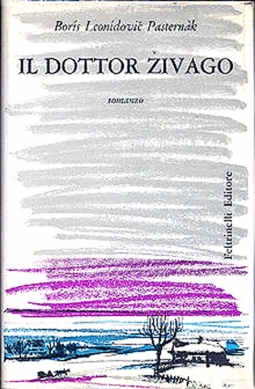
The manner in which Boris Pasternak’s Russian novel, Doctor Zhivago (1957), came to be published was not your standard bourgeois affair involving manuscripts sent by certified mail to charming book agents who host long, wet lunches; quite the contrary. As the journalist noted in the attached article:
“The circumstances under which Doctor Zhivago came to the West have evoked almost as much controversy as the book itself.”
It is an intriguing story involving the duplicity of one Italian communist who deceived oodles of Soviet functionaries favoring that the work be buried forever:
“That this forceful statement of faith in the human spirit came out of Communist Russia was a miracle. That it has helped readers to find themselves is another. That it raised doubts among the Communist faithful that may never be stilled is perhaps the greatest miracle of all.”
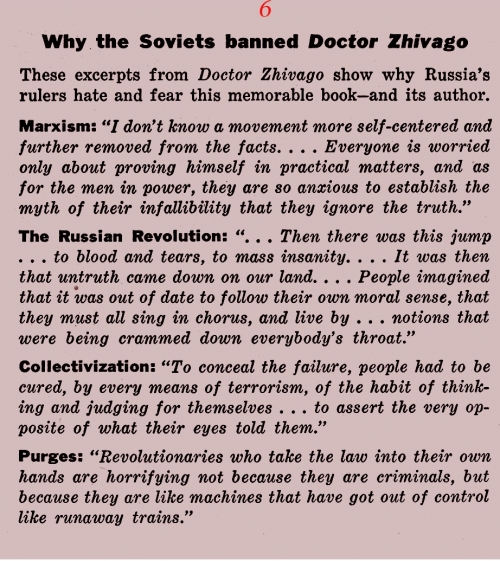
The censorious Soviet bureaucrats referred to the books as “a squalid, malicious work full of hatred for socialism.”

Boris Pasternak magazine articleBoris Pasternak newspaper articleДо́ктор Жива́гоanti-Soviet Writer Boris Pasternak articleAlexi Surkov secretary general of of Union of Soviet Writerssoviet censorship articlecensorship of soviet writersno freedom for writers in USSR 1959censorship of soviet historiansno freedom for Russian historians in USSR 1959russian historical fiction 1959
![The Book that [BR]Shook the Kremlin](https://oldmagazinearticles.com/pdf/PASTERNAK_0001.jpg)
![The Book that [BR]Shook the Kremlin](https://oldmagazinearticles.com/pdf/PASTERNAK_0002.jpg)
![The Book that [BR]Shook the Kremlin](https://oldmagazinearticles.com/pdf/PASTERNAK_0003.jpg)
![The Book that [BR]Shook the Kremlin](https://oldmagazinearticles.com/pdf/PASTERNAK_0004.jpg)
![The Book that [BR]Shook the Kremlin](https://oldmagazinearticles.com/pdf/PASTERNAK_0005.jpg)
![The Book that [BR]Shook the Kremlin](https://oldmagazinearticles.com/pdf/PASTERNAK_0006.jpg)
![The Book that [BR]Shook the Kremlin](https://oldmagazinearticles.com/pdf/PASTERNAK_0007.jpg)
![The Book that [BR]Shook the Kremlin](https://oldmagazinearticles.com/pdf/PASTERNAK_0008.jpg)
![The Book that [BR]Shook the Kremlin](https://oldmagazinearticles.com/pdf/PASTERNAK_0009.jpg)
![The Book that [BR]Shook the Kremlin](https://oldmagazinearticles.com/pdf/PASTERNAK_0010.jpg)
Boris Pasternak magazine articleBoris Pasternak newspaper articleДо́ктор Жива́гоanti-Soviet Writer Boris Pasternak articleAlexi Surkov secretary general of of Union of Soviet Writerssoviet censorship articlecensorship of soviet writersno freedom for writers in USSR 1959censorship of soviet historiansno freedom for Russian historians in USSR 1959russian historical fiction 1959