





















World War Two

Find old World War 2 articles here. We have great newspaper articles from wwii check them out today!

A New Kind of Fanaticism
(Newsweek Magazine, 1945)

“American troops on Okinawa thought they knew all there was to know about Jap fanaticism. But last week the Japs served it up with a new twist. The evening of May 24 started out like any other on the battle-torn island. The enemy sent its usual flight of Kamikaze suicide planes to strafe American airfields and dive into shipping offshore… At the height of the earsplitting air battle, the Japs played their trump card” – from the fuselage of a twin-engine bomber that had belly-landed on an American airfield, emerged Japanese infantry.

A Smaller War on the Home Front
(Brooklyn Eagle, 1942)

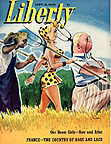
In 1942, the reasons for despising Global Fascism were many and myriad but the woman who penned this editorial hated Hitler, Mussolini and Tojo for a reason all her own: Gertie McAllister hated them because they put women in pants.

The Importance of Detroit
(Liberty Magazine, 1942)

Throughout a good deal of the Great Depression (1929 – 1940), FDR liked to think he was cozying-up to the voters when he insulted the great captains of industry with mean names like “selfish” and “stubborn”. All that ended when the war started, and the President had to make common cause with these men in order gain their cooperation in meeting the military needs of the nation. This article concerns the importance of the industrial might of Detroit.

Advertisement

Use shortcode [oma_ad position="summary_top"] (or other position) in your theme or widgets to display OMA Promotions here.

Miracle at 20,000 Feet
(Collier’s Magazine, 1943)

Flying home after bombing Tunis, the B-17 All-American with a full crew of ten onboard was sliced open at the rear by a nazi fighter plane that nearly severed her tail. How the craft stayed up in the air was anybody’s guess.

The Success of the Ploesti Raid
(Collier’s Magazine, 1943)

Here is an article from 1943, the year everything changed for the Axis. The article explains all that was involved with the stout-hearted raid on the Ploesti oil fields in Rumania. 177 American bombers were sent to do the job.


“From Ploesti, the Nazis extracted oil and oil products which maintained the entire German and Italian fleets, and third of the whole German air force in Russia. Around the Ploesti installations, the Germans had raised a forest of antiaircraft guns of large and small calibers. They had built blast walls around plants’ vital parts and spotted airdromes from which fighters could rise to intercept our bombers.”

”Eighth Over Berlin”
(Newsweek Magazine, 1944)

“Comparing the American [daylight] raids with the RAF [nighttime] incursions, it was certainly a great shock to Berliners to find their city now open to round-the-clock bombing.”


“We don’t mind the Yanks who come when the sun shines and it’s warm. It’s the Tommies sneaking in at night that we don’t like so much.”


Click here to read about the harried everyday life on a U.S. bomber base in England…

Advertisement

Use shortcode [oma_ad position="summary_top"] (or other position) in your theme or widgets to display OMA Promotions here.

We Want to Fight
(PM Tabloid, 1944)

On the very first day of America’s participation in World War II, an African American sailor at Pearl Harbor named Dorrie Miller shot down four enemy planes and saved 12 men from drowning. One would think that this would make the gang on capitol Hill sit up and realize that the war would be shorter if other men of a similar hue could be released upon our enemies, but this was not the case. Very few American blacks were permitted to fight and this article serves as a testimony to their frustration.

The Bombed-Out Germans
(Collier’s Magazine, 1944)

A report by a Swiss journalist as to what becomes of the Germans who are left homeless after the bombings:

“In most cities they immediately get 200 marks cash payment. The money is fresh and clean from the press… With cup in hand, the bombed-outers wait in the streets for the army goulash truck to drive up and give them a feed. Sometimes they wait for as much forty-eight hours. People who don’t like or cannot get the army goulash build themselves a fire and cook the horses, dogs and cats that lie around the street…”

He was One of a Kind
(Collier’s Magazine, 1943)

Here is an article by George Creel (1876 – 1953) regarding the life and career of General George Marshall (1880 – 1959) and all the unique elements within him that made him an ideal Chief of Staff for his time:

“He can not only talk with civilians in their own language, but he can also see things from the civilian point of view. Even during the years when Congress denied adequate appropriations for the Army, no one ever heard him snarl at rotten politicians. He saw the unwillingness to prepare for war as a democracy’s hatred of war, and even while regretting it, he understood.”


Click here to read about the Marshall Plan.

Advertisement

Use shortcode [oma_ad position="summary_top"] (or other position) in your theme or widgets to display OMA Promotions here.

”With Eisenhower in Sicily”
(Collier’s Magazine, 1943)

“On the first day of operations, I heard him say, ‘By golly, we’ve done it again! By golly, I wouldn’t have believed it1’ Meaning the surprise landings really turned out to be a surprise. And [turning to the press corps] he added, ‘This is the period when you fellows want to know everything, but military folks are scared to death just now. Darn it, I can’t tell you anything! After all, I’m the man responsible.”

Hunger in Axis Lands
(United States News, 1942)

American diplomats caught in Germany, Austria, Italy and other occupied lands at the time of FDR’s declaration of war were subject to five months of incarceration before they were repatriated. The attached article tells of the hardships and hunger experienced by the citizens of those nations as the war entered its third year. Also seen was the tremendous distrust that was developing between the Italians and the Germans.

Hollywood Feels the Actor Shortages
(Collier’s Magazine, 1943)

“What Hollywood is saying secretly and can’t say publicly is: The Armed Forces are taking away all our actors, all our technical men. Things are serious now; in six months they will be desperate. But if anybody in Hollywood got up and said that unless a great change in public policy is made, the movies might be out of business in six months…”


“[Movie stars have] a duty and Hollywood has a duty and they should be made to stick to it.”

Advertisement

Use shortcode [oma_ad position="summary_top"] (or other position) in your theme or widgets to display OMA Promotions here.

Amphibian Engineers
(Collier’s Magazine, 1943)

“The motto of the Engineer Amphibian Command is “Put’em Across”, and its principle is aptly put by Brigadier General Daniel Noce (1894−1976) , chief of the U.S. Army’s amphibious operations in the European theater, who built this force from scratch. ‘Water between us and the enemy is an avenue, not an obstacle’ he says.”

Fair Treatment
(Collier’s Magazine, 1943)

To us, the most interesting part of this 1943 editorial is in the opening sentence, where an accounting is given as to the number of prisoners acquired after a full year and a half of war. The U.S. military had amassed 22,000 Germans, 14,000 Italians – yet only 62 (sixty-two) Japanese prisoners of war! This is famously due to the instructions given to the Emperor’s combatants to not be taken prisoner – but we certainly expected there to be more than that. The writer goes on speaking in favor of just treatment for Axis prisoners – but please don’t pamper our Nisei in Arizona.

Advertisement

Use shortcode [oma_ad position="summary_top"] (or other position) in your theme or widgets to display OMA Promotions here.

Allied Air Power Succeeded
(Collier’s Magazine, 1942)

“[If not for the Allied air forces] Rommel might have reached his objectives – Alexandria, Cairo and Suez – had he not been able to plow through to the Nile Delta where he could resume his favorite kind of military football. He might have reached the flat, broad, green cool plains of the Delta had he been able to bring up water, food, fuel and reinforcements in men and weapons. It was precisely that which air power prevented…”

The Strategist
(Collier’s Magazine, 1944)

Here is a Collier’s profile of U.S. Admiral Raymond Spruance (1886 – 1969):


“Outside Navy circles, very few know much about the man who bosses our task forces in the Pacific and has never lost an engagement. But Admiral Nagano knows of Spruance; so does Tojo – because, if it weren’t for Spruance at Midway, Japanese carriers might now be based at Pearl Harbor.”

Advertisement

Use shortcode [oma_ad position="summary_top"] (or other position) in your theme or widgets to display OMA Promotions here.

Scroll to Top