



World War Two

Find old World War 2 articles here. We have great newspaper articles from wwii check them out today!

The First Nazi Prisoners
(Spot Magazine, 1941)

The first Nazi prisoners to be incarcerated by the U.S. were not from North Africa or Atlantic U-boats, they were the officers and men of the German passenger liner Columbus in 1939.

Kamikazes: The Naked Truth
(All Hands Magazine, 1946)

This unnamed journalist wished to discern fact from fiction as to what was expected from Kamikaze pilots. After spending almost an entire year in Occupied Tokyo, he read numerous reports on the topic, both military and civil. The PR blather fed to the Japanese public did state that a willing death was expected of them, but was surprised to find that many (not all) of the pilots were given parachutes (rarely used). His research revealed that the Kamikaze corps was hastily assembled and was composed of the lousiest pilots they could find.

Advertisement

Use shortcode [oma_ad position="summary_top"] (or other position) in your theme or widgets to display OMA Promotions here.

Race Riots
(Newsweek Magazine, 1943)

“It is a singular fact that [the] supposedly civilized Americans in these times deny the Negroes the opportunity to engage in respectable jobs, the right of access to the restaurants, theaters, or the same train accommodations as themselves and periodically will run amuck to lynch Negroes individually or to slaughter them wholesale – old men, women, and children alike in race wars like the present one.”


What Radio Tokyo was referring to were the multiple race riots that broke out in Detroit and seven other municipalities during the Summer of 1943.

The Radio Facsimile Transmitter
(Spot Magazine, 1941)

Throughout the course of the Second World War the Radio Facsimile Transmitter (Radio Fax) was used by the Allied Armies to transmit maps, orders and weather charts across God’s vast oceans. War correspondents used the technology to transmit articles and images to their editors.

Advertisement

Use shortcode [oma_ad position="summary_top"] (or other position) in your theme or widgets to display OMA Promotions here.

Explaining the Need for the USO
(Spot Magazine, 1941)

This article said it all honestly and without flowery metaphors – plainly stating the facts that if American military personnel were not provided some wholesome distractions, they would simply loiter around barrooms and whorehouses during their leisure time and become a drag on society.

An Anti-Discrimination Law on the Home Front
(Collier’s Magazine, 1941)

Inasmuch as the Roosevelt administration believed that the integration the armed forces was far too risky a proposition during wartime, it did take steps to insure that fair hiring practices were observed by all industries that held defense contracts with the Federal government; during the summer of 1941 a law was passed making such discrimination a crime.


The attached editorial from Collier’s Magazine applauded the President for doing the right thing.

The Jeep
(Coronet & Yank Magazines, 1945)

When General Marshall listed the numerous advantages that the U.S. Army enjoyed during the war (you can read it here), he included on his list the Willys Jeep. The Jeep and the Two and Half-Ton truck, he believed, contributed mightily to the mobility of American Forces in most theaters. The two articles attached herein go into some detail about the strengths of the Jeep, but concentrated primarily on the improvements made in the vehicle as Jeep prepared for its launch in the civilian market place.

Advertisement

Use shortcode [oma_ad position="summary_top"] (or other position) in your theme or widgets to display OMA Promotions here.

Tommy Gun
(Coronet Magazine, 1945)

“Soldiers respect for this weapon traces to two things. It fires .45 caliber slugs as a cyclical rate of 600 to 700 per minute. An enemy struck by a carbine or riffle bullet can keep coming – as Japs have shown. A man struck by a Tommy Gun slug is stopped dead in his tracks. A burst of fire can cut a man in two.”

Tommy Gun
(Coronet Magazine, 1945)

“Soldiers respect for this weapon traces to two things. It fires .45 caliber slugs as a cyclical rate of 600 to 700 per minute. An enemy struck by a carbine or riffle bullet can keep coming – as Japs have shown. A man struck by a Tommy Gun slug is stopped dead in his tracks. A burst of fire can cut a man in two.”

The Reporter was a WAAC
(Newsweek Magazine, 1943)

Newsweek reporter Vera Clay was not slow in accepting the U.S. Army’s invitation to don the khaki uniform and learn what goes into the training of a WAAC. In the company of fourteen other women reporters, she took the train to Fort Oglethorpe, Georgia, and for the next six days, the group began to learn about all things WAAC.

Advertisement

Use shortcode [oma_ad position="summary_top"] (or other position) in your theme or widgets to display OMA Promotions here.

The Government Film Business During WW II
(Pathfinder Magazine, 1944)

“Government movies are now having their greatest boom in history. The boom is tied to the war, but many capital observers believe that it will continue into the post war era, and that the large-scale production of films by the Government telling the people what’s what and how to do it is here to stay.”

Weeding-Out the Nuts from the Draft Pool
(Collier’s Magazine, 1941)

As America was gearing up to fight another world war, the brass caps were reminded how incapable they were at identifying and isolating the mental incompetents during the last war, and they swore this war would be different. Numerous military and civilian psychiatrists were convened, and it was concluded that of the millions of men called, at least 15 percent would likely be off-their-rockers.

The Coast Guard Fired the First Shot
(Philadelphia Record, 1945)

“Philadelphia Coast Guardsmen yesterday observed the surrender of Germany by recalling that their branch of service fired the first American shot in the war against Germany, capturing the first enemy ship and taking the first Nazi prisoner… It was in September, 1941, that the Coast Guard cutter Northland captured the Norwegian freighter Busko, loaded with equipment for a German weather station to be established in Greenland.”

Advertisement

Use shortcode [oma_ad position="summary_top"] (or other position) in your theme or widgets to display OMA Promotions here.

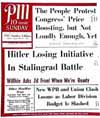
Increased U-Boat Activity
(PM Tabloid, 1943)

“Informed London sources said Saturday that the number of U-boats operating against Allied shipping is increasing despite the improved defense record of the last six months.”

First Election Planned for Post-Fascist Japan
(Philadelphia Record, 1945)

“The Japanese Cabinet decided yesterday a general election will be held January 20 to 31 [1946], and the Tokyo newspaper Yomuri Hochi urged ‘spontaneous and vigorous action’ toward forming a democratic government.”

Wanting the Japanese Cabinet to know who was in charge, General MacArthur moved the date up to December seventeenth [1945]. It was the first time Japanese women had ever voted.

Advertisement

Use shortcode [oma_ad position="summary_top"] (or other position) in your theme or widgets to display OMA Promotions here.

Scroll to Top