Author name: editor

The Sinking of the C.S.S. Alabama (Famous Events Magazine, 1913)
1913, Civil War History, Famous Events Magazine

The Sinking of the C.S.S. Alabama
(Famous Events Magazine, 1913)

This short article from The Famous Events of the World was written at a time when the Civil War was still fresh in the American memory; and although their lines were thinning, the veterans of that war were still walking the streets. One of the important events of the American Civil War during the year 1864 was the sinking of the Confederate pirate ship, C.S.S. Alabamastyle=border:none, commanded by Raphael Semmesstyle=border:none(1809-1877):

After a long course of capturing and destroying Northern merchant ships, the Aabama was caught in a French harbor by the United States frigate Kearsarge. The Kearsarge defied the ALABAMA to battle; and the Confederate ship, accepting the challenge, steamed confidently forth amid salvos of applause from the French and English spectators. The Kearsarge completely outfought her, and sank her.

Click here to read an article about the captain of the ALABAMA, Raphael Semmes.

When Grant Captured Richmond (The Atlantic Monthly, 1865)
1865, Civil War History, The Atlantic Monthly

When Grant Captured Richmond
(The Atlantic Monthly, 1865)

A moving account of the fall of Richmond, pieced together from various eyewitness accounts:

The whole Rebel Government was on the move, and all Richmond desired to be. No thoughts of taking Washington now, or of the flag of the Confederacy flaunting in the breeze over the old capitol! Hundreds of officials were at the depot, to get away from the doomed city. Public documents, the archives of the Confederacy, were hastily gathered up, tumbled into boxes and barrels, and taken to the trains, or carried into the streets and set on fire.

General Grant's March on Richmond (The Atlantic Monthly, 1865)
1865, Civil War History, The Atlantic Monthly

General Grant’s March on Richmond
(The Atlantic Monthly, 1865)

The Atlantic Monthly who witnessed Grant’s maneuvering outside the city of Richmond filed this article:

General Grant’s entire force could not have been less than a hundred and thirty thousand, including Sheridan’s cavalry, the force at City Point, and the provisional brigade at Fort Powhatan. Lee’s whole force was not far from seventy thousand, – or seventy-five thousand, including the militia of Richmond and Petersburg…


Click here to learn why Richmond was chosen as the capitol of the Confederacy

Advertisement

Use shortcode [oma_ad position="summary_top"] (or other position) in your theme or widgets to display OMA Promotions here.

General Lee's Unique Bond with his Army (Atlantic Monthly, 1911)
1911, Civil War History, The Atlantic Monthly

General Lee’s Unique Bond with his Army
(Atlantic Monthly, 1911)

Confederate General Robert E. Lee (1807 – 1870) is the topic of this psycho-graphic essay from Confederate Portraits (1914) by the celebrated biographer, Gamaliel Bradford (1863 – 1932).


…Lee won the hearts of his soldiers by living as they did. He managed the business of his position with as little fuss and parade as possible. Foreign officers were struck with the absolute simplicity of his arrangements. There were no guards or sentries around his headquarters, no idle aids-de-camp loitering about…

Civil War Pirate Raphael Semmes (Atlantic Monthly, 1913)
1913, Civil War History, The Atlantic Monthly

Civil War Pirate Raphael Semmes
(Atlantic Monthly, 1913)

Attached is a psychographic essay from Confederate Portraits (1914) by the noted biographer, Gamaliel Bradford (1863 – 1932). It must have been written in order to expose to the reading public that softer, more sensitive Raphael Semmes (1809 – 1877) that no historian ever seems to consider. This vision of the American Civil War pirate comes off as a quiet, pious Renaissance man, with a flare for the dramatic.

Semmes was not only a wide reader in his profession and in lines connected with it, but he loved literature proper, read much poetry and quoted it aptly. He was a singularly sensitive to beauty in any form.

Advertisement

Use shortcode [oma_ad position="summary_top"] (or other position) in your theme or widgets to display OMA Promotions here.

A Union Snoop (A Spy of the Rebelion, 1883)
1883, Civil War History

A Union Snoop
(A Spy of the Rebelion, 1883)

When the Civil War broke out, Alan Pinkerton (1819 – 1884) was given charge of the Union Intelligence Service, having previously gained tremendous credibility as a detective in Chicago. It was at this post, early in the war, that he was assigned a task by General George McClellan (1826 – 1885) to proceed south of the Ohio River in order to gain a more thorough understand as to the loyalties of those people. Pinkerton first wrote about this mission in his Civil War memoir, A Spy of the Rebellion.


Click here to read another account of Civil War spying.

Advertisement

Use shortcode [oma_ad position="summary_top"] (or other position) in your theme or widgets to display OMA Promotions here.

Lincoln and Lee in 1918 (The Nation, 1918)
1918, Civil War History, Pamphlet Produced by the National Park Service

Lincoln and Lee in 1918
(The Nation, 1918)

On the first anniversary marking the American intervention into the First World War Charles Payne of Grenell College, Iowa, wrote to the editors at The Nation and cautioned his fellow-Americans to remember the conduct and humility of Civil War General Robert E. Lee.


Click here to read about the heavy influence religion had in the Rebel states during the American Civil War.

Union General James Harrison Wilson (The Dial Magazine, 1912)
1912, Civil War History, The Dial Magazine

Union General James Harrison Wilson
(The Dial Magazine, 1912)

Attached is the review from a respected literary journal concerning the autobiography of Brigadier General James Harrison Wilson (1837 – 1925). Under the Old Flag Wilson is today best remembered as the U.S. Army cavalry officer who captured the Confederate President Jefferson Davis in his flight from Richmond. Following the Civil War, where he rose rapidly in the army hierarchy and finished as brigadier general, Wilson continued to play important rolls in the U.S. military; serving during the Spanish-American War and the Boxer Rebellion

Advertisement

Use shortcode [oma_ad position="summary_top"] (or other position) in your theme or widgets to display OMA Promotions here.

Zam Zam Attacked by German Navy Collier's Magazine 1944 | German Raiding Vessel Shoots Up Lifeboats In South Atlantic
1944, Collier's Magazine, War at Sea

‘I Rode A German Raider”
(Collier’s Magazine, 1944)

Frank Vicovari, veteran ambulance driver, was en route to North Africa on a neutral passenger ship called Zam Zam. He was traveling with numerous other men who would serve under his command; there were 21 top of the line ambulances in the hold that would be put to use by Free French forces when they landed. Zam Zam also carried some 200 American missionaries off to spread the good news south of the equator. This article is Vicovari’s account of his life onboard a Nazi raiding vessel after it sank Zam Zam in the South Atlantic. He eloquently describes how efficiently the crew fired upon other non-combatant vessels and, on one occasion, machine-gunned lifeboats.

Advertisement

Use shortcode [oma_ad position="summary_top"] (or other position) in your theme or widgets to display OMA Promotions here.

Exploited Farm Labor During World War II (Collier's Magazine, 1947)
1947, Agricultural Labor, Collier's Magazine

Exploited Farm Labor During World War II
(Collier’s Magazine, 1947)

This 1947 Collier’s article, Heartless Harvest by Howard Whitman makes clear the sad story of migrant agricultural laborers who picked the fruits and vegetables for the Americans of the Forties:

A new crop of Okies, estimated in the millions, is wandering about the country, following the crops they pick. To get their story the author traveled 9,000 miles through 17 states, toiling in the fields. Here he describes working and living conditions you wouldn’t believe could be tolerated in America today.

Tokyo Living ('48 Magazine)
1948, 48 Magazine, Post-War Japan

Tokyo Living
(’48 Magazine)

The post-war life of a Tokyo family as experienced by Mrs. Tanaya: the wife of a carpenter and mother of one son. This is an eleven page magazine article that will allow you to gain some understanding as to how the Tokyo black-market operated and how that city began to rebuild itself after so many years of war. Also of some interest the Tokyo reaction to the American occupying army:

There is a lot of talk about Americans. To the Japanese women and their husbands, the conquerors are a puzzling combination of good and bad. But they often thank their gods for ‘Marshal’ MacArthur…

••Click here to read about post-World War II Kyoto.

Articles about the daily hardships in post-war Germany can be read by clicking here.

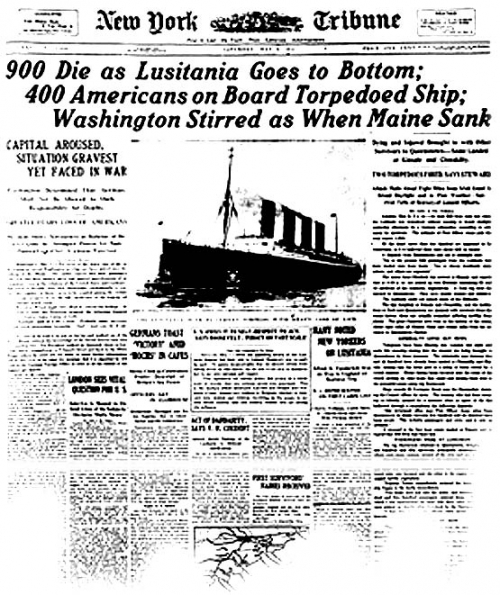
Lusitania Torpedoed (NY Times, 1915)
1915, Lusitania

Lusitania Torpedoed
(NY Times, 1915)

A short column from the front page of The New York Times dated May 6, 1915 in which one of the Lusitania survivors recalled that famous submarine attack and it’s immediate aftermath:

…Immediately we both saw the track of a torpedo followed almost instantly by an explosion. Portions of splintered hull were sent flying into the air, and then another torpedo struck. The ship began to list to starboard.

In 2008 Mr. Gregg Bemis, the American who is the owner of Lusitania, and sole possessor of all salvaging rights, examined the remains of the great ship where it rested some eight miles off Ireland’s South-West coast and provided proof-positive that the ship was indeed hauling armaments.


– from Amazon:


Advertisement

Use shortcode [oma_ad position="summary_top"] (or other position) in your theme or widgets to display OMA Promotions here.

Scroll to Top