Author name: editor

Zam Zam Attacked by German Navy Collier's Magazine 1944 | German Raiding Vessel Shoots Up Lifeboats In South Atlantic
1944, Collier's Magazine, War at Sea

‘I Rode A German Raider”
(Collier’s Magazine, 1944)

Frank Vicovari, veteran ambulance driver, was en route to North Africa on a neutral passenger ship called Zam Zam. He was traveling with numerous other men who would serve under his command; there were 21 top of the line ambulances in the hold that would be put to use by Free French forces when they landed. Zam Zam also carried some 200 American missionaries off to spread the good news south of the equator. This article is Vicovari’s account of his life onboard a Nazi raiding vessel after it sank Zam Zam in the South Atlantic. He eloquently describes how efficiently the crew fired upon other non-combatant vessels and, on one occasion, machine-gunned lifeboats.

Exploited Farm Labor During World War II (Collier's Magazine, 1947)
1947, Agricultural Labor, Collier's Magazine

Exploited Farm Labor During World War II
(Collier’s Magazine, 1947)

This 1947 Collier’s article, Heartless Harvest by Howard Whitman makes clear the sad story of migrant agricultural laborers who picked the fruits and vegetables for the Americans of the Forties:

A new crop of Okies, estimated in the millions, is wandering about the country, following the crops they pick. To get their story the author traveled 9,000 miles through 17 states, toiling in the fields. Here he describes working and living conditions you wouldn’t believe could be tolerated in America today.

Tokyo Living ('48 Magazine)
1948, 48 Magazine, Post-War Japan

Tokyo Living
(’48 Magazine)

The post-war life of a Tokyo family as experienced by Mrs. Tanaya: the wife of a carpenter and mother of one son. This is an eleven page magazine article that will allow you to gain some understanding as to how the Tokyo black-market operated and how that city began to rebuild itself after so many years of war. Also of some interest the Tokyo reaction to the American occupying army:

There is a lot of talk about Americans. To the Japanese women and their husbands, the conquerors are a puzzling combination of good and bad. But they often thank their gods for ‘Marshal’ MacArthur…

•Click here to read about post-World War II Kyoto.

Articles about the daily hardships in post-war Germany can be read by clicking here.

Advertisement

Use shortcode [oma_ad position="summary_top"] (or other position) in your theme or widgets to display OMA Promotions here.

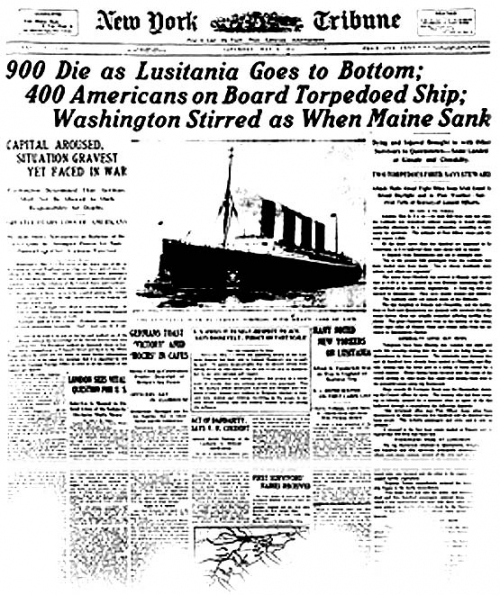
Lusitania Torpedoed (NY Times, 1915)
1915, Lusitania

Lusitania Torpedoed
(NY Times, 1915)

A short column from the front page of The New York Times dated May 6, 1915 in which one of the Lusitania survivors recalled that famous submarine attack and it’s immediate aftermath:

…Immediately we both saw the track of a torpedo followed almost instantly by an explosion. Portions of splintered hull were sent flying into the air, and then another torpedo struck. The ship began to list to starboard.

In 2008 Mr. Gregg Bemis, the American who is the owner of Lusitania, and sole possessor of all salvaging rights, examined the remains of the great ship where it rested some eight miles off Ireland’s South-West coast and provided proof-positive that the ship was indeed hauling armaments.


– from Amazon:


Lusitania Torpedoed (NY Times, 1915)
1915, Harper's Weekly, Lusitania

Lusitania and the Laws of the Sea
(Harper’s Weekly, 1915)

Attached is a two column article pertaining to neutral states and the international laws of war as agreed upon at the Hague Convention of 1899.


This piece appeared three months prior to the infamous submarine attack on the ship and alludes to a little known matter involving Lusitania and the masquerade of flying the flags of non-combatant nations while crossing the Atlantic.

The ruse by which the Lusitania escaped the possible danger of submarines, the use of the American flag, has been resorted to over and over again in modern naval wars.
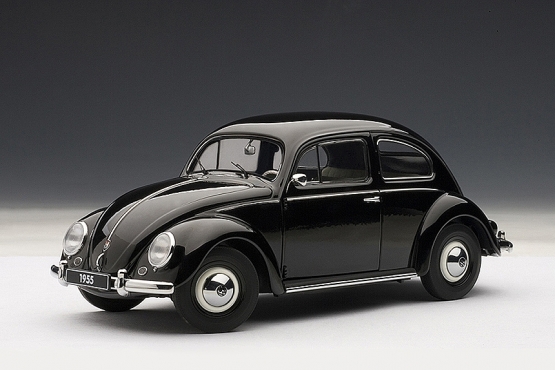

The Amazing Volkswagen (Pic Magazine, 1955)
1950s Cars, 1955, Pic Magazine

The Amazing Volkswagen
(Pic Magazine, 1955)

Much of the credit for the success of Volkswagen immediately after the war was due to the visionary leadership of Volkswagen CEO Heinz Nordhoff (1899 – 1968), who was able to assess the faults of the existing model and make the necessary improvements:

The power was low, and the engine had a life of only 10,000 miles. Nordhoff brought in new experts who redesigned every vital component, working on the original pre-war designs of Ferdinand Porsche… The new car was quieter and more powerful, and had hydraulic brakes and shock absorbers. Soon, models with luxury touches were introduced.

Advertisement

Use shortcode [oma_ad position="summary_top"] (or other position) in your theme or widgets to display OMA Promotions here.

Controlling the Radical Presses (NY Times, 1917)
1917, Censorship

Controlling the Radical Presses
(NY Times, 1917)

Here is a World War I article that appeared on the pages of The New York Times some four months after the American entry into the war and it reported that the U.S. Government was obligated to close all news and opinion organs that questioned any efforts to prosecute the war or support the allied nations. The Times reported that the government was granted this power under Title 1, section 1, 2, and 3 of Title 12 of the Espionage Act (signed by President Wilson on June 13, 1917). Although no publications were named, the reader will be able to recognize that the only ones slandered as pro-German were those that would appeal to the pro-labor readers.


To learn how many African-Americans served in the W.W. I American Army, click here.

US Army Meets USSR Army at Elbe River 1945 | Elbe River Torgau Germany 1945 | US Army 69th Division 1945
1945, Eastern Front, Newsweek

American GIs Meet the Reds on the Elbe
(Newsweek & Yank Magazines, 1945)

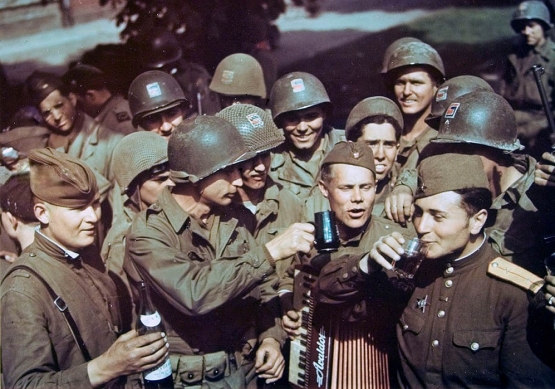
In late April of 1945, American tank crews south of Torgau (Germany) began to pick up the chattering of Soviet infantry units on their radios – the transmissions were generated by the advanced units of Marshal Konev’s (1897 – 1973) First Ukrainian Army and both the allied units were elated to know that the other was nearby, for it meant one thing: the end of the war was at hand.


Thankfully, Yank‘s correspondent Ed Cummings was with the U.S. First Army when the two groups met at the Elbe River and he filed the attached article.

Pare Lorentz Magazine Article |
1933, New Outlook Magazine, The Great Depression

Your Graduation Gift: Despair
(New Outlook, 1933)

This is a graduation commencement speech that was written simply to appear on the printed page of a 1933 magazine – it was far too depressing to have ever been recited before an audience of eager-eared graduates and their doting relatives.

You know, of course, that ‘times are hard’… You know that less than ten percent of the post-graduate professional men from last year’s class have found work. And you have heard from home. Allowances have been cut. Classmates have had to drop out of college. Old family friends have had grave misfortunes. Homes have been lost. You know all these things, but you can’t realize them fully at this moment. You will, unfortunately, realize them only too well when you yourselves try to find a place in the world.

Advertisement

Use shortcode [oma_ad position="summary_top"] (or other position) in your theme or widgets to display OMA Promotions here.

Tailoring at Sea (Popular Mechanics, 1910)
1910, Popular Mechanics Magazine, World War One

Tailoring at Sea
(Popular Mechanics, 1910)

During the First World War a popular songster in the United States penned a little diddy that ran just so:

-Though the Army is the clover


T’was the Navy brought them over

And the Navy will bring them back….


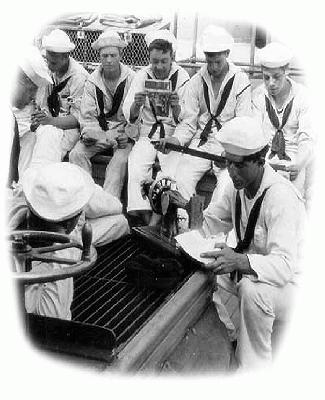
In anticipation of this roll, the far-seeing Department of the Navy ordered each and every American battleship to have within its arsenal at least one sewing machine, and a tar who was proficient at tailoring in order to make themselves worthy of the task.

Advertisement

Use shortcode [oma_ad position="summary_top"] (or other position) in your theme or widgets to display OMA Promotions here.

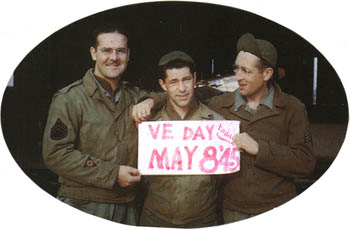
VE-Day at the 108th General Hospital (Yank Magazine, 1945)
1945, VE Day, Yank Magazine

VE-Day at the 108th General Hospital
(Yank Magazine, 1945)

An eyewitness account accompanied by a wonderful Howard Brodie sketch describing the enthusiastic rush enjoyed by all the wounded GIs in the dayroom at the 108th General Hospital in London:

The war was over, and I was still alive. And I thought of all the boys in the 28th Division band who were with me in the Ardennes who are dead now.

Click here to read a short notice about how Imperial Japan took the news of Germany’s surrender.

History of Newsweek Magazine | 1st Issue of Newsweek Magazine Feb 17 1933 |
1945, Magazines, Newsweek

Newsweek
(Newsweek Magazine, 1945)

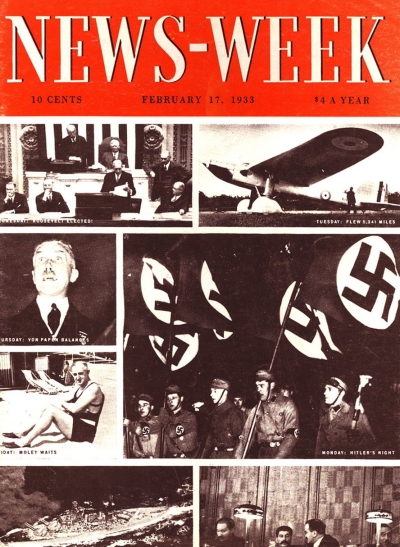
The 625th issue of Newsweek marked their twelfth year on the newsstand:

The first issue, dated February 17, 1933, was a workmanlike job of news digesting by a staff of 22, and for four years it faithfully followed this pattern [until a new publisher took the helm in 1937 and it really kicked into high gear].

Advertisement

Use shortcode [oma_ad position="summary_top"] (or other position) in your theme or widgets to display OMA Promotions here.

Walter Duranty Stalin | Walter Duranty New York Times
1943, Coronet Magazine, Joseph Stalin

The Optimist’s Joseph Stalin
(Coronet Magazine, 1943)

During the Second World War in the United States it would have been an act of treason for a journalist to write a slanderous profile about any of the leaders of the allied nations who were beset against the Axis powers. Not only would the writer face grave charges, but so would his editor and publisher. However, this does not mean that the editors of Coronet Magazine had to go so far over the top as to publish this article by the Soviet cheerleader Walter Duranty (1884 – 1957) of The New York Times.


From Amazon:


Stalin’s Apologist: Walter Duranty: The New York Times’s Man in Moscowstyle=border:none

Ernest Hemingway of Time Magazine (Coronet Magazine, 1953)
1953, Coronet Magazine, War Correspondents

Ernest Hemingway of Time Magazine
(Coronet Magazine, 1953)

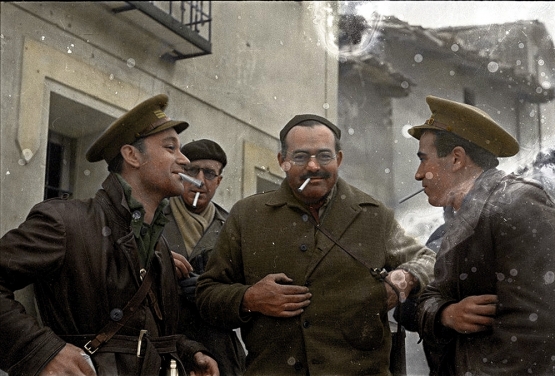
Some wise old wag once opined that by the time W.W. II came along, Hemingway was far too fascinated by his own public image to have ever been an effective war correspondent. However, it should be remembered that he had looked war in the face on many occasions – the Second World War was the seventh conflict that he witnessed as a war reporter. Prior to working as a war correspondent for Time and Collier’s during the Second World War, Hemingway had written for a number of other outlets in six other conflicts.

'The Low State of High Society'' (Coronet Magazine, 1958)
1958, Coronet Magazine, Manners and Society

‘The Low State of High Society”
(Coronet Magazine, 1958)

Another article by a highbred, woebegone, blue-blood who, plagued by a boatload of distinguished primogenitors and over-burdened by a lavish trust fund – to say nothing of a bad case of affluenza, could take no more of it; she broke-down and scribbled the attached expose in hopes that the whole highfalutin’ plutocracy would come crashing down on top of all those icky, pompous know-it-alls.

Life for America’s so-called social aristocrats is colorless and uninspired. Our education, now that I look back at it, seems to have produced a frightening number of properly mannered, emotionally passive and intellectually sterile young snobs… This training is not easily overcome.


Gosh. We thought only Howard Zinn wrote like that.

Advertisement

Use shortcode [oma_ad position="summary_top"] (or other position) in your theme or widgets to display OMA Promotions here.

Scroll to Top