Author name: editor

General Marshall on the Atomic Bomb (Yank Magazine, 1945)
1945, General Marshall, Yank Magazine

General Marshall on the Atomic Bomb
(Yank Magazine, 1945)

The tremendous military advantage of this terrifying weapon fell to us through a combination of good luck, good management and prodigious effort. The harnessing of atomic power should give Americans confidence in their destiny…

Click here to read more magazine articles about the Atomic Bomb.


Click here to read one of the fist opinion pieces condemning the use of the Atomic Bomb.

Uncategorized

W.W. I Clip Art: American Officers

Three commercial illustrations of American World War One officers that originally appeared in the margins of the U.S. army weekly The Stars and Stripes.


Click here if you would like to see the advertisements in which these figures originally appeared.

Advertisement

Use shortcode [oma_ad position="summary_top"] (or other position) in your theme or widgets to display OMA Promotions here.

Another German Advantage (Yank Magazine, 1945)
1945, General Marshall, Yank Magazine

Another German Advantage
(Yank Magazine, 1945)

General Marshall’s post-war report remarked on one clear advantage that the German Army was privileged to exploit again and again throughout the war:

The German ammunition was charged with smokeless, flashless powder which in both night and day fighting helped the enemy tremendously in concealing his fire positions.

A Pacific War Chronology (Yank Magazine, 1945)
1945, World War Two, Yank Magazine

A Pacific War Chronology
(Yank Magazine, 1945)

Here is a printable list of chronological events and battles that took place in the Pacific Theater between December 7, 1941 through May 3, 1945. Please keep in mind that this is only a partial list, the YANK editors who compiled the chronology had no foreknowledge of the U.S. assaults on Iwo Jima and Okinawa.


Click here to read an interview with a Kamikaze pilot.

Manufacturing the Overseas Cap (America's Munitions, 1919)
1919, America's Munitions, Overseas Caps

Manufacturing the Overseas Cap
(America’s Munitions, 1919)

The production of the overseas cap for the American Expeditionary Forces was likewise an extensive undertaking. When the requisition for overseas caps came from France, it was not possible to design one here because of a lack of knowledge as to what was required… As soon as [a] sample was received a meeting of cap makers was called in New York, and 100 manufacturers attended. One and all agreed to turn over their factories to the exclusive production of overseas caps until all requirements were met. It took these cap makers only two weeks to to turn out the first order. In all 4,972,000 caps were delivered.


The concluding paragraph contains more venomous comments as to what these American milliners thought of the lid.


From Amazon: America’s Munitions, 1917-1918style=border:none.

Advertisement

Use shortcode [oma_ad position="summary_top"] (or other position) in your theme or widgets to display OMA Promotions here.

The British Rage Against Pacifism (The Literary Digest, 1915)
1915, The Literary Digest, World War One

The British Rage Against Pacifism
(The Literary Digest, 1915)

While Western Europe was all ablaze during the Spring of 1915, many Americans were tapping their toes to a catchy tune titled, I Didn’t Raise my Boy to be a Soldier (by Alfred Bryan and Al Piantadosi). This really irked the editors at THE SPECTATOR who let their fingers trip across the typewriter keyboard at a tremendous speed spewing-out all sorts of unflattering adjectives; they even went so far as to rewrite a few verses.

The U.S. Fires Her First Mustard Gas Shell (Observer, 1918)
1918, Poison Gas, The Observer

The U.S. Fires Her First Mustard Gas Shell
(Observer, 1918)

A cartoon by Alban B. Butler illustrating the overwhelming sense of glee that overcame American 1st Division artillerymen of World War I when they were charged with the task of firing the very first mustard gas shells ever to be fired by U.S. forces:

For months Americans had suffered from repeated concentrations of German mustard gas without the chance to retaliate in kind.

(No date was given)
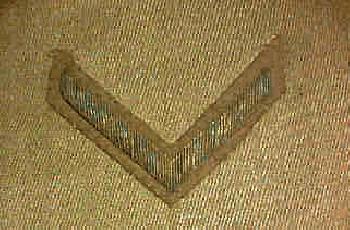
Over-Seas Chevrons (Stars and Stripes, 1918)
1919, The Stars and Stripes, U.S. Army Uniforms of World War One

A Fourth Overseas Chevron for Some
(The Stars and Stripes, 1919)

A short news item named the three American officers who served over there long enough to be granted the adornment of a fourth overseas chevron. Each gold wire chevron, worn on the lower left cuff, represented a single six month period served in theater; the vast majority of A.E.F. uniforms had anywhere between one and three sewn in place.


Another article about over-seas chevrons may be read here…

Advertisement

Use shortcode [oma_ad position="summary_top"] (or other position) in your theme or widgets to display OMA Promotions here.

A German Sniper Captured (What the Boys Did Over There, 1919)
1919, Snipers, What the Boys Did Over There

A German Sniper Captured
(What the Boys Did Over There, 1919)

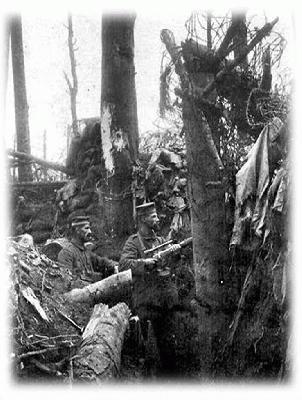
Attached is a remembrance that was written by a Canadian infantryman who participated in the capture of a German sniper in Flanders:

We wasted no time on the return journey but hustled Fritz along at a brisk pace…Like most of his breed there was a wide ‘yellow streak’ in this baby-killer and he cried ‘Kamerad’ instantly. By the time the lieutenant had secured his prisoner’s rifle our barrage was falling and, under its protection, he began his march back with the prisoner, and met us before he had gone twenty-five yards…The prisoner expected to be killed at once and begged piteously for his life, saying ‘he had a wife and three children.’ One of the men replied that if he had his way he would make it a ‘widow and three orphans.’

W.W. I Gas Shells of the German Army (Almanach Hachette, 1919)
1919, Almanach Hachette, Poison Gas

W.W. I Gas Shells of the German Army
(Almanach Hachette, 1919)

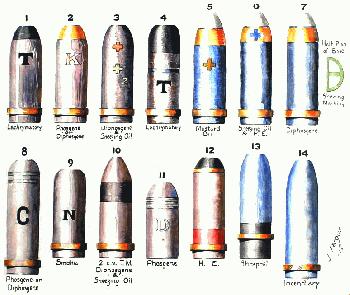
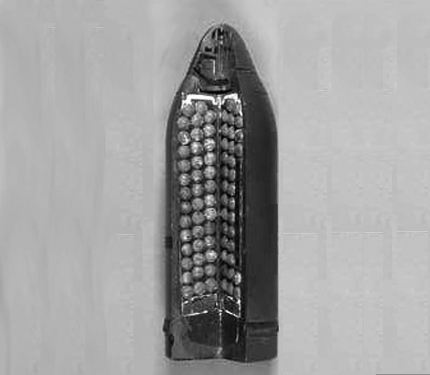
It is often believed that the Germans were the first to use chemical weapons during the Great War, but historians like to point out that they were second to the French in this matter: in August of 1914, French infantry fired tear-gas grenades and in October, the Germans one-upped them with chemical artillery shells during the battle of Neuve Chapelle. However, the Germans are properly credited for being the first of the combatants to use chemical artillery with the most devastating effect. On April 22, 1915, the German Army hurled 520 gas shells at British and Canadian units in Belgium, killing five thousand and incapacitating ten thousand more. Following this historic incident, both sides began producing large amounts of gas shells and, of course, gas masks. The following is a black and white diagram depicting five different German gas artillery shells that were manufactured to be fired from a number of different guns of varying calibers.

A.E.F. Facts and Deployment Information (Times Literary Supplement, 1921)
1921, The Times Literary Supplement, World War One

A.E.F. Facts and Deployment Information
(Times Literary Supplement, 1921)

The attached essay reviews a colossal history written by a veteran of the U.S. First Infantry Division, Captain Shipley Thomas: The History of the A. E. F.style=border:none
– for those who are looking for some knowledge concerning what the American Army was up to during the last six months of the War (it was bloodiest period) the review makes for a good read.

Click here to read about the high desertion rate within the U.S. Army of 1910.


Click here to read some statistical data about the American Doughboys of the First World War.

Advertisement

Use shortcode [oma_ad position="summary_top"] (or other position) in your theme or widgets to display OMA Promotions here.

Feminine Hats from a War-Weary France (Harper's Bazaar, 1918)
1918, Fashion (WWI), Harper's Bazaar Magazine

Feminine Hats from a War-Weary France
(Harper’s Bazaar, 1918)

Six fashionable illustrations from Harper’s Bazaar of the Fall hats for 1918:

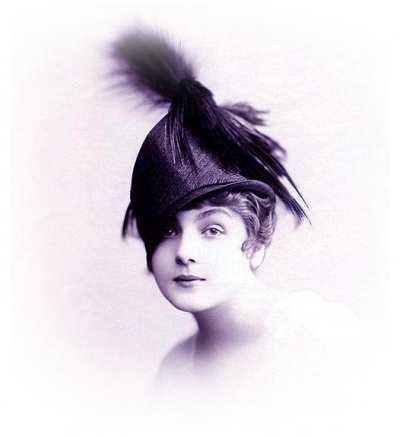
Paris is exceedingly critical in regard to hats even in wartime, and the new ones are most interesting. Black velvet of course is rampant, and Marie Louise especially is using much much black panne velvet…

This wartime fashion review makes one passing reference to the millinery efforts of Coco Channel.

Advertisement

Use shortcode [oma_ad position="summary_top"] (or other position) in your theme or widgets to display OMA Promotions here.

The High and the Mighty and the Movies They Loved(Photoplay Magazine, 1937)
1937, Hollywood History, Photoplay Magazine

The High and the Mighty and the Movies They Loved(Photoplay Magazine, 1937)

Royalty and rulers of the world are movie fans. The cinema tastes of the great are disclosed for the first time in this article.

Listed in the attached 1937 Hollywood fan magazine article are the names of the favorite movies of Gandhi, Stalin, Mussolini, Franco, Hirohito, Roosevelt and many more.

Click here to read about happy Hollywood’s discovery of plastic surgery…

The Berlin Blockade: A Definition (R.O.T.C. Handbook, 1956)
1956, Berlin Blockade, The U.S. Army R.O.T.C. Handbook

The Berlin Blockade: A Definition
(R.O.T.C. Handbook, 1956)

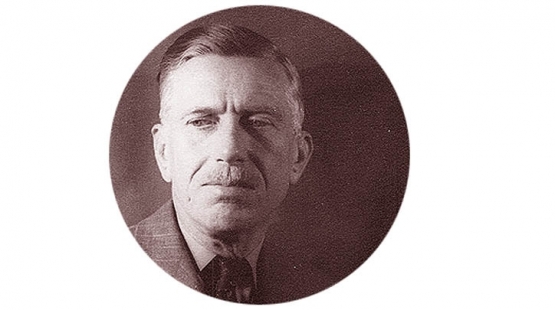
In his 1989 book, Master Spy: The Story of Kim Philbystyle=border:none, author Phillip Knightley pointed out that when the Soviet spy Philby, stationed in Washington, discovered that the U.S. had no atomic bombs on hand, Stalin soon gave the order to commence the blockade of the German capital. That said, here is a two paragraph essay briefly explaining what the 1948 Berlin Blockade was and how the Anglo-American masters of West-Germany dealt with the issues at hand:
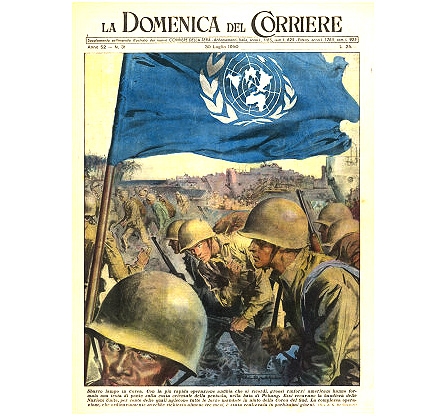

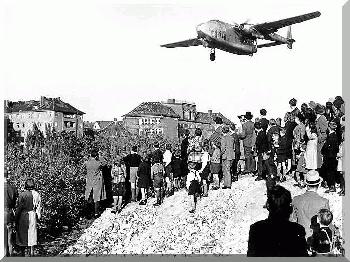
Soviet counter-action to American efforts to rebuild the European economy came swiftly. Besides rejecting participation in the program the Soviets, in October 1947, announced the organization of a permanent committee for coordinating the activities of the Communist parties in Europe…By June 1948 the Russians had cut off all land and water traffic with Berlin and the only means of entry was by air.

The U.N. and Collective Security (Pathfinder Magazine, 1951)
1951, Pathfinder Magazine, The Korean War

The U.N. and Collective Security
(Pathfinder Magazine, 1951)

Eight months into the Korean War came this editorial from an American news magazine pointing out that the burden of defending South Korea was not being evenly shared by the other member states of the United Nations and that the U.S. was over-represented on the battlefields:

When the Korean Communists invaded South Korea last June, the U.N. was quick to authorize the use of armed force to combat the aggression, but not so quick when it came to contributing troops. [As of February, 1951] U.N. forces in Korea total about 275,000. Of this number 150,000 are American and 100,000 are South Koreans. This leaves less than 25,000 from 11 of the other U.N. members – a pitifully small contribution… What is there definition of ‘collective security’? Have they so soon forgotten Munich? Have they forgotten that collective firmness by the Allies, when Germany invaded the Rhineland, might have prevented World War II?

Advertisement

Use shortcode [oma_ad position="summary_top"] (or other position) in your theme or widgets to display OMA Promotions here.

Scroll to Top