
The Army Insignia of the World War I French Army
(1917)
Read more …


Out of the smoldering ruins of Japan came the Honda factories; while Germany amazed their old enemies by rapidly beating their crematoriums into Volkswagens. Confidently managed by a fellow who only a short while before was serving as a lowly private in Hitler’s retreating army, Volkswagen quickly retooled, making the vital improvements that were necessary to compete in the global markets.
Ludwig Erhard (1897 – 1977), West Germany’s Minister of Economics between the years 1949 and 1963, once remarked that Germany was able to launch its Wirtschaftswunder (economic miracle) by implementing the principles of a market economy and laissez-fair capitalism within the framework of a semi-socialist state.
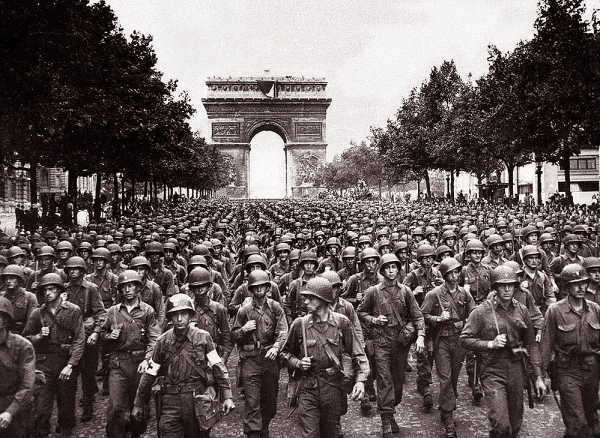
General Marshall recalled the decisions made concerning how many American men would be drafted and in what branches of service they would be needed. He recalled the number of divisions each Allied nation raised and how many divisions the Germans and Japanese put in the field. The article also remembers that two thirds of the German Army was deployed along the Eastern front and he wondered what might the Americans have done had Germany defeated the Reds.
It is remarkable how exactly the mobilization plan fitted the requirements for victory. When Admiral Doenitz surrendered the German Government, every American division was in operational theaters.
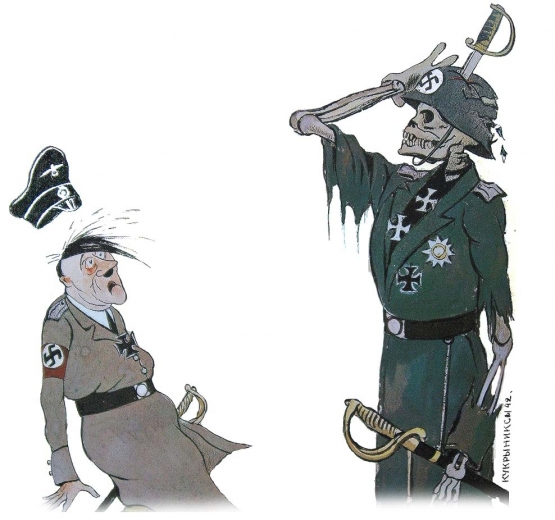
After five and a half years of ever growing battle against ever-stronger enemies, the German Army in 1945 looks, at a glance, much the worse for wear. It is beset on all sides and is short of everything. It has suffered appalling casualties and must resort to old men, boys, invalids and unreliable foreigners for its cannon fodder…Yet this shabby, war-weary machine has struggled on a in a desperate effort to postpone it’s inevitable demise. At the end of 1944 it was still able to mount an offensive calculated to delay for months the definitive piercing of the Western bulwarks of Germany.
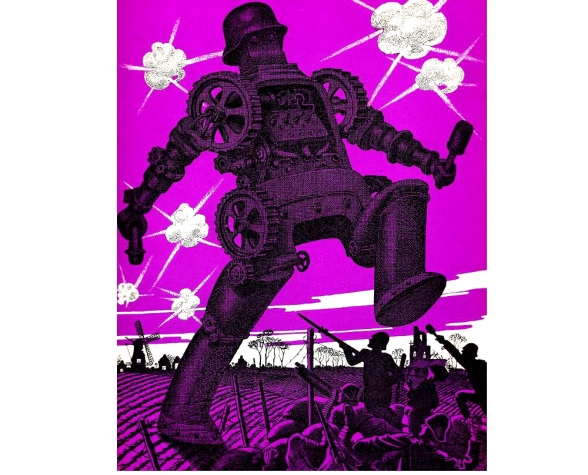
The introductory essay from the U.S. War Department’s intelligence manual concerning fascist Germany:
Total war is neither a contemporary invention nor a German monopoly. But total mobilization, in the sense of the complete and scientific control of all the efforts of the nation for the purpose of war, and total utilization of war as an instrument of national policy have been developed to their highest degree by the German militarists.
To gain some understanding of the nature of total war, you might want to click here and read about how the American cosmetics industry of the 1940s was forced to alter their production patters.
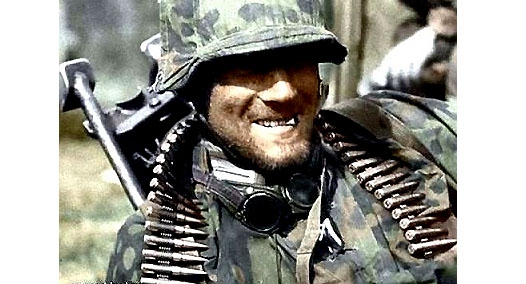
A one page study of German World War II tactics that was created by the United States Department of War two months prior to the German surrender:
…the Germans have placed a considerable reliance on novel and sensational weapons such as the mass use of armor, the robot bomb, and the super-heavy tank. Their principal weaknesses in this regard have been their failure to integrate these new techniques with established arms and tactics –German field artillery, for example, did not maintain pace with German armor -and their devotion to automatic weapons at the expense of accuracy.
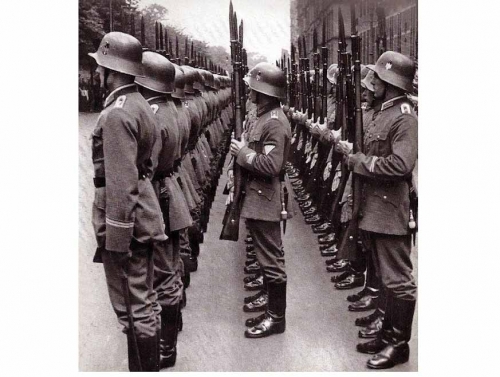
A one and a half page study on the training of the W.W. II German soldier – the soldier’s oath and the rigorous system of discipline that he had to adhere to. Also discussed is the German salute (Heil…), and the German Army’s understanding of soldierly duty.
Also discussed the German Army’s alternate pledge penned especially for atheists.
From Amazon: Soldat: Reflections of a German Soldier, 1936-1949

This is yet another excerpt from Psychology for the Fighting Man which addresses a grave concern that has been on the mind of all soldiers from time immemorial: how to be brave and safe?. In simply three paragraphs the psychologists charged with answering this question actually do a pretty feeble job, but they did a fine job summing up the heavy responsibilities that the front-line G.I. had on his mind when great acts of courage were expected of him.
Perhaps one of the most lucid definitions of bravery was uttered by an anonymous soldier from the Second World War who offered that courage is like a bank, with a finite balance; each soldier is allowed to make a small or a large withdrawal from the account and they can do so when ever they wish, but when the account is empty they can’t go to the bank any longer.
Click here to read a psychological study of fear in combat.

Herein is a 1939 article from a defunct Hollywood trade magazine marking the construction of a 20 acre facility for the Disney studio in Burbank, California:
By 1930, the Walt Disney studio had grown in fantastic fashion. Instead of the 25 employees of 1929, there were now 40 people…By the end of the year there were 66 employees…In 1931 the total number of personnel had jumped to 106…When ‘The Three Little Pigs’ came along in 1933, the studio had grown 1,600 square feet of floor space in 1929, to 20,000 square feet. A hundred and fifty people were now turning out the Disney productions… In 1937, all the employees were still jostling each other… From around 600 employees in the summer of 1937, the organization had grown to almost 900 by the winter of 1938.
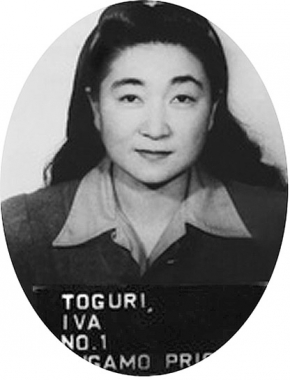
The Americans arriving in Japan after the surrender proceedings were hellbent on capturing the American traitor who presided over so many disheartening broadcasts — the woman they nicknamed Tokyo Rose:
…one of the supreme objectives of American correspondents landing in Japan was Radio Tokyo. There they hoped to find someone to pass off as the one-and-only Rose and scoop their colleagues. When the information had been sifted a little, a girl named Iva Toguri (Iva Toguri D’Aquino: 1916 – 2006), emerged as the only candidate who came close to filling the bill. For three years she had played records, interspersed with snappy comments, beamed to Allied soldiers on the Zero Hour…Her own name for herself was Orphan Ann.
Toguri’s story was an interesting one that went on for many years and finally resulted in a 1977 pardon granted by one who had listened to many such broadcasts: President Gerald R. Ford (1913-2006), who had served in the Pacific on board the aircraft carrier USS Monterey.
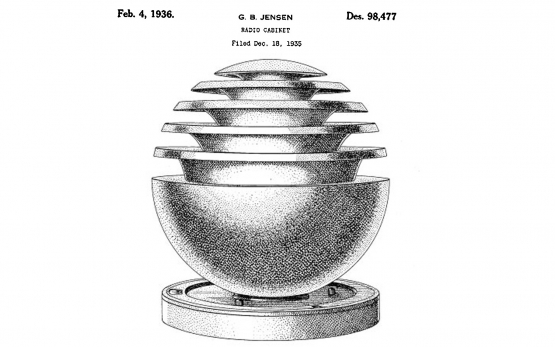
High-Ranking in the roll-call of New York’s industrial designer is a six-foot Dane with the voice of a Viking. Gustav Jensen is an artist, whether he is talking, eating, or performing Herculean labors in cleaning out Plebeian Stables. The creed of the industrial designer is that every implement of modern life can be made into a work of art. Jensen has pursued this creed to fabulous extremes. He has designed kitchen sinks, that have been compared to Renaissance caskets, and he meditates for months before he designs a doorknob….
The article is illustrated with eleven photographs; the image on the right shows Jensen’s design for a table model radio: The radio is a miracle. It should look like a miracle, remarked the designer.

This historic article appeared during the opening weeks of Roosevelt’s first term administration announcing that the new president was taking a novel approach in granting various appointments to government positions of leadership by selecting numerous women who had proved their mettle in the fiery furnace of 1920s Democratic party politics.
1924 was a very important year for American women in politics…

One of the very few literati who recognized what a German military presence in the Rhineland meant was a one legged American veteran of the last war named Laurence Stallings (1894 – 1968). This article appeared to be about the great benefit afforded to us all by hard working photo-journalists who supplied us daily with compelling images of various far-flung events, but it was in all actuality a warning to our grand parents that the world was becoming a more dangerous place.
I think the unforgettable picture of the month will come from shots stolen near a French farmhouse by Strasbourg, when the French were countering Hitler’s move into the Rhineland…Routine were the crustacean stares of the Italian children in gas masks last week, where they practiced first aid against chlorine and mustard barrages…
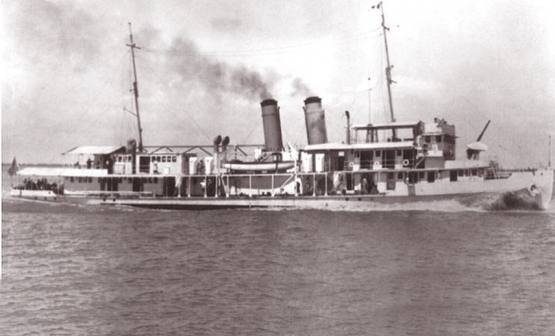
Bombs rained like hailstones and churned the waters all around the ship like geysers.’ said Earl Leaf, United Press correspondent in China and eyewitness of the sinking of the United States gunbpat PANAY
His Majesty’s Ambassador to Tokyo has made the strongest protest to the Japanese Minister of Foreign Affairs.’
Click here if you would like to read more about the sinking of the U.S.S. Panay.
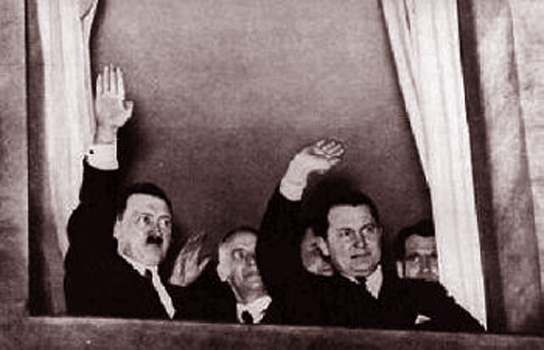
Having been encouraged by Goebels to show more than a little excitement about meeting Adolf Hitler, the German screen actress Renate Müller (1906 – 1937) recalled that during their time alone, the Führer slandered Reichsmarschall Hermann Goering for his gluttonous appearance…
The entire story is told in a longer article about Hitler’s wish for a wife.
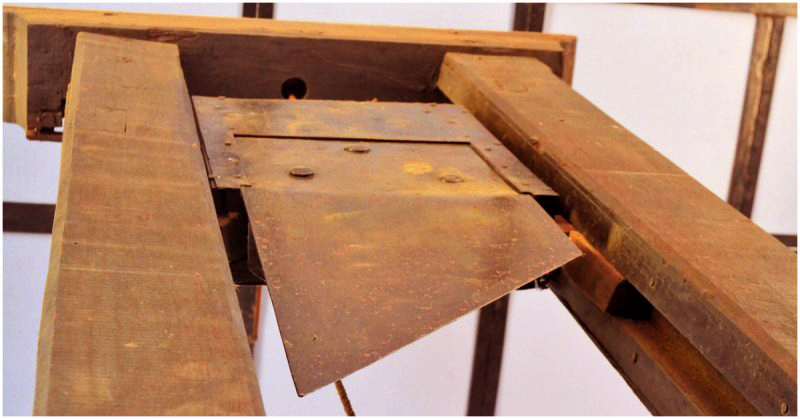
This magazine article was filed during the suspenseful phony war that was waged between Poland and Germany over the Danzig issue. It reported on the beheading of two German women convicted of spying on behalf of a Polish cavalry officer by the name of Baron Georges Von Sosnowski:
In London, THE NEWS CHRONICLE, Liberal Party organ, declared that the beheading of the two women was ‘disgusting savagery’, and was not the first evidence of ‘a strain of sheer barbarism in the Nazi creed…


A whimsical article about the topography of New York’s Greenwich Village and the migratory habits of all it’s assorted bohemians, vagrants, spinsters and vegetarians during the Prohibition era.
Click here to read some high praise for Greenwich Village from a French film star.

A dispatch from the old China watcher Lewis S. Gannett was printed in the left-leaning American magazine, THE NATION:
All China has been won to half the Nationalist program – that which is directed to the reestablishment of national independence. The fundamental conflict between ‘moderates’ and ‘extremists’ is, I think, between short-sighted men who think that the Nationalist passion can subside without causing fundamental changes in China’s social fabric, and those who recognize the inevitability of industrialization in China and are determined that their country shall not pass through all the miserable phases of capitalistic industrialism which created a disinherited proletariat in the West.
