
The Big Spenders in Washington
(New Outlook Magazine, 1934)
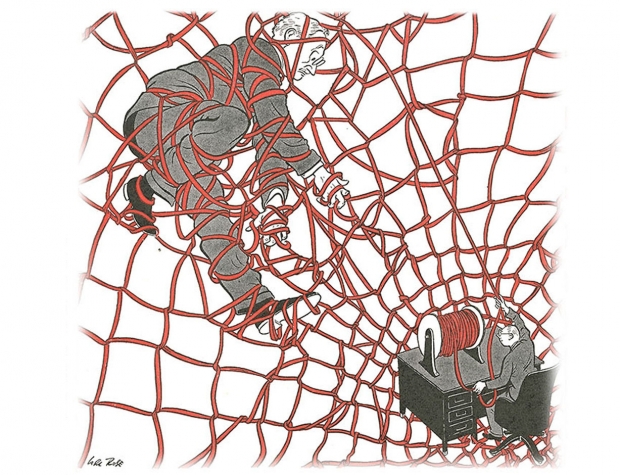
The figure pictured in the far left of this image is one of the biggest spenders in FDR’s cabinet and […]
This article from February, 1950 goes on in some detail explaining why Americans should not be worried in the least about the fact that the Soviets now have atomic capability because the U.S. military has bigger and far more destructive bombs.
A hydrogen bomb could cause damage almost without limit. The Nagasaki plutonium bomb affected an area of 10 square miles. The new weapon could destroy an area of 100, or 1,000 square miles.
Among the many dubious legacies of the Second World War is a growing cult of males who have tended to feel that the German women of the SS are worthy of their attention (Kate Winslet’s appearance in the 2008 movie, The Reader didn’t help). This article (and the accompanying photographs) make it quite clear that no one would have found these men more pathetic than the G.I. guards of Prisoner of War Enclosure 334, who were charged with the task of lording over these Teutonic gorgons and who, to the man, found these women to be wildly unattractive.
The girls who served in Adolf’s army are a sorry, slovenly looking lot. In a P.O.W. camp near Florence they spill their gripes to G.I guards.
Click here to read about a member of Hitler’s SS in captivity.
So much had changed in the world as a result of the Second World War, and although those shifting sands had moved much of the fashion industry to New York, the heart and soul of women’s fashion was still in Paris. This article is all about the fashion kings and queens who remained in the French capital. These columns explain what all the finest French designers were up to: Dior, Balmain, Schiaparelli, Fath, Balenciaga, Lanvin etc, etc, etc…
To read further about post-war Paris fashion, click here…
During much of the war, inventors from all combatant nations had been trying to make a artillery projectile that could eradicate the obstacle that had become one of the symbols of trench warfare: barbed-wire. No one seemed up to the task and in the end, wire-cutters were still the best way to deal with the problem.
This article is about one inventor’s failed effort to create a time fuse artillery shell that would deploy hooks that grab the wire as it goes speeding by and thereby saving the day. Needless to say, the hook thing didn’t work out terribly well and the difficulty inherit with time fuse artillery shells would be perfected in the inter-war years.
The early career of broadcast journalist Mike Wallace (1918 – 2012) are discussed at length in this six page magazine article from the late Fifties.
We were amused to read that in one of his earliest forays into broadcasting he played a character in a radio soap opera.
Matthew Weiss is a German-English translator specializing in historical texts, bringing old language into the present without sacrificing its sense of heritage and with an emphasis on idiom, colloquialism and immediacy. Areas of translating expertise also include poetry, fiction, Holocaust and war documentation, diaries, theatrical and motion picture scripts, film subtitles, librettos, but also journalism, technical writing and all manner of online content.
Click here to read his translation of a 1914 short story.
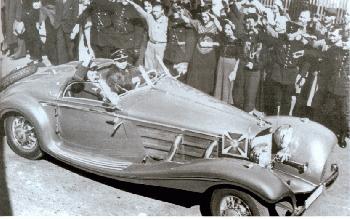
A remarkable 1948 photo essay from the pages of the defunct weekly SEE MAGAZINE illustrating the bullet-proof, 2-door, 4 passenger, Mercedes convertible roadster that was previously owned by Nazi Field Marshal Hermann Göering (1893 – 1946). The car was purchased by the Danish industrialist Svend Vestergaard:
Vestergaard purchased the 8-cylinder, 240 h.p., under-slung speedster from British occupation authorities…The car was especially built according to the ostentatious Number 2 Nazi’s exacting specifications, the German-made product of Stuttgart’s famed Daimler-Benz Aktiengesellschaft is 11 feet long, weighs three truck-like tons,[and] has six forward speeds.
Click here to read about the dating history of Adolf Hitler.
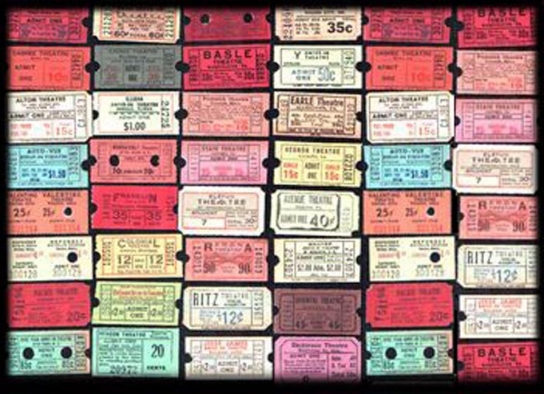
Pulled from the business section of a 1940 issue of PATHFINDER MAGAZINE was this list of Hollywood statistics that should be of interest to all you old movie fans. If you’ve ever wondered how the Dream Factory fared following the Great Depression, you can stop scratching your head bone – herein you will learn how many souls were on Hollywood’s payroll, how many movies did the town make each year (give or take), what percentage of global film production was turned out by Hollywood and how many American movie theaters were there in 1940.
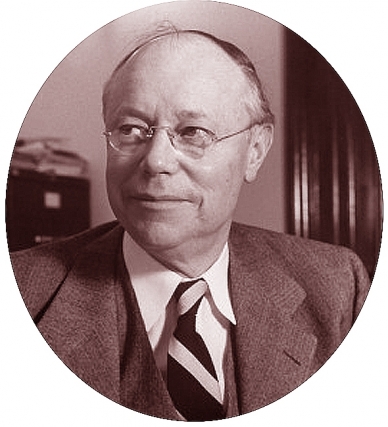
This is a 1943 editorial that was penned by Republican Senator Robert Taft (1889 – 1953) who explained in the most clinical terms that President Roosevelt’s loyal opposition on Capitol Hill can be relied upon to support him in all matters involving his roll as Commander-in-Chief. However, Taft implied, any further efforts to go gallivanting about the Capitol creating any more of those agencies with the New Deal trademark names like FSA, WPA, NYA, REA, TVA etc. etc. etc will be met with the stiffest opposition from the Republicans, who were well outnumbered, anyway.
Taft’s column was answered by his opposite number in the Democratic Party: New York Senator Robert F. Wagner (1877 – 1953); his column can also be read here.
The historian Henry Steele Commager chose to rank FDR at number 19 insofar as his impact on the American mind was concerned – click here to understand his reasoning…
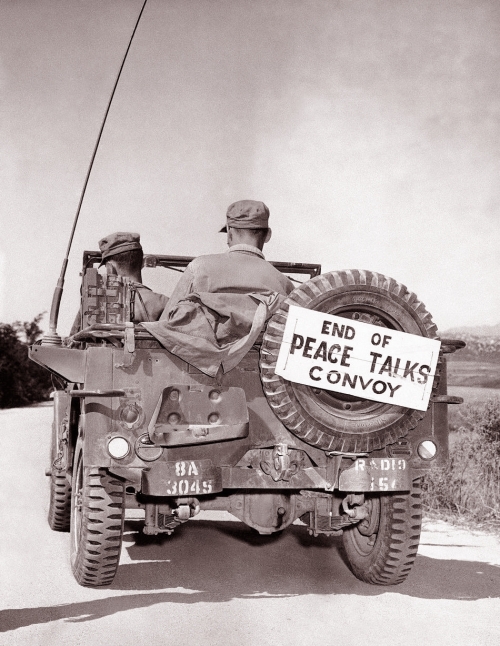
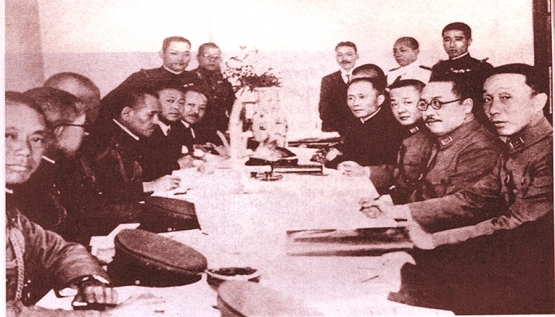
During the final months of the Korean war, when it seemed that both sides were willing to make an arrangement that would bring the hostilities to an agreed upon end, the Chinese diplomats upped the ante
… the Red regime in Peiping [Beijing] wanted a Great Power conference on Korea’s future as a preface to new truce talks… Zhou Enlai, premier in Mao Tse Tung’s government, has secretly proposed tossing all disputes – the prisoner exchange issue as well as the political future of Korea – into a conference of 11 nations.
Watch an informative Christian documentary on Korea in 1953 (- its in color).
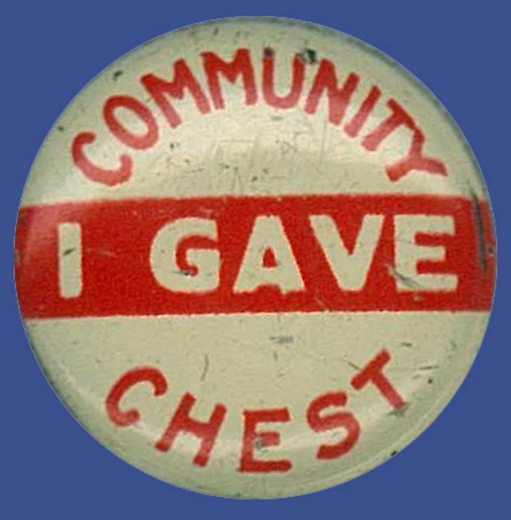
The obligation for giving this year does not fall on the shoulders of the rich and powerful business concerns alone! It is an obligation which rests upon all who are gainfully employed…They should give, not because it is good policy, but because they have at heart the preservation of the human interests of the country.
– so wrote Newton D. Baker in this editorial from 1932 in which he promoted the effectiveness of the private charity that he was chairing: the Committee for Welfare Relief Mobilization. When President Hoover stepped-up and advocated for public donations to private charity organizations America answered the call in various forms.
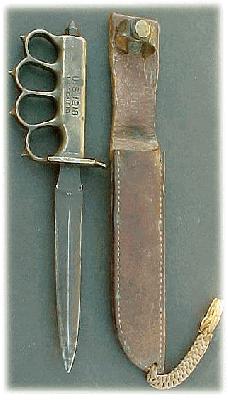
Three notices appeared in the fall of 1918 announcing changes in design for three items issued to American troops: the 1918 combat knife, a.k.a. ‘the Knuckle-Duster, the mess kit and the canteen. Interestingly, the notice pertaining to the canteen states that Doughboys had been carrying both French canteens and American canteens by the end of the war.
Click here to read magazine articles from the Second World War.
The attached 1936 magazine article presents a picture of the Polish city of Danzig as it was during the mid-thirties. It was a city in which Danzig Nazis, like Arthur Karl Greiser, spoke of making that town a part of Germany once more (it was ordained a Polish city as a result of the Versailles Treaty) and Minister Joseph Beck who liked everything just the way it was, thank you very much:
NAZI PATIENCE: Neither Beck nor Hitler is anxious to come to a break over Danzig. Hitler, a sworn enemy of Soviet Russia, advises his Danzig Nazis to forbear from mentioning their intention of completely abandoning League control for secession to Germany…
Hitler’s troops invaded Poland on August 31, 1939.
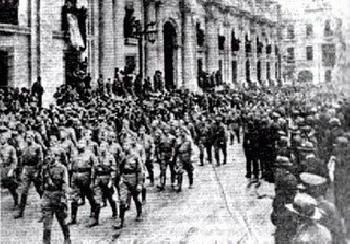
Cabled from Santiago, Chile came this report that on May 7, 1933 the broad-belted boulevards of that grand city were filled with 15,000 Chilean fascists, cheered on by a crowed that was estimated at a number higher than 400,000 – a throng composed almost entirely of citizens who had all come to see the first parade of the Nacional Milicia Republicana:
Along the lines of the march there were many demonstrations for the Fascists, and a few against them. Women tossed flowers from flag-bedecked windows. Domingo Duran, Minister of Education and Justice, a regimental commander of the militia, received almost continual applause.
A squadron of Fascist planes flew overhead as the units, unarmed, and marching to airs played by two dozen bands and fife corps, moved through the spacious Boulevard Alamada, past the Presidential Palace to the Plaza des Aramas.
From Amazon: Chile and the Nazis: From Hitler to Pinochet
President Franklin Delano Roosevelt was well-known for cracking wise about the members of the American business community, such as stock brokers, speculators, company functionaries and the leading corporate executives during the Great Depression – believing that there actually could be an economy worth saving if they didn’t exist. Throughout the Thirties the New Deal launched numerous tax laws and assorted other pieces of legislation that served only to stymy competition, raise prices and slow all economic growth. The editors of COLLIER’S MAGAZINE published this spirited and rational defense of corporate America in 1938 and it is attached herein:
American business, whatever its limitations, has produced a better living for more people than any other system of production… The American big-business system has fed people better and more generously. It has provided more convenient and more wholesome shelter. It has distributed vastly more of the mechanical aids to civilized living.
Click here to read about FDR’s tax plan from 1935.
An article from 1947 that clearly indicated that modern furnishings were a commercial hit in New York City during the immediate period following the war. The furnishings in particular were the product of German modernist named Klaus Grabe. A refugee from Hitler’s Germany, Grabe was a Bauhaus-educated designer who had first settled in Mexico with Josef Albers before moving to New York.
Shortly after this article appeared, Klaus Grabe would write this book: Build Your Own Modern Furniture.
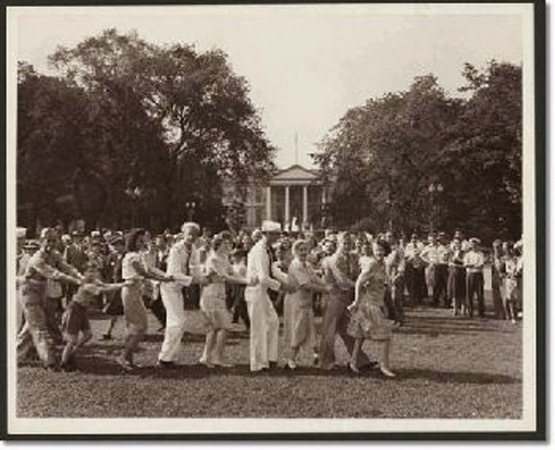
When World War Two finally reached it’s end, the small, quiet and usually well-behaved city of Washington, D.C. gave a big sigh of relief, forgot about Robert’s Rules of Order for the day and shrieked with joy:
One officer, standing in the middle of Pennsylvania Avenue outside the White House, waved a fifth of Rye at arms length, repeatedly inviting passers-by to have a drink on the European Theater of Operations.
Click here if you would like to read an article about 1940s fabric rationing and the home front fashions.