Author name: editor

Dogs in the First World War
1919, Animals (WWI), The American Legion Weekly

A History of Dogs in the First World War
(American Legion Weekly, 1919)

The training of dogs for war purposes began in a limited way a number of years prior to the outbreak of the European war, the Germans being particularly interested in it. There were some trained war dogs in both the French and Belgian armies, but the British had none to speak of, nor did the United States. The dog began his general usefulness in the late war as a beast of burden.

'Invasion Fever'' (Yank Magazine, 1944)
1944, D-Day, Yank Magazine

‘Invasion Fever”
(Yank Magazine, 1944)

As increasing aerial bombardment of Nazi-occupied Europe mounted in Fury day after day, every American civilian was talking last week about when and how the actual land invasion of the continent would begin.

Newspaper editors were already dragging out their largest headline type, and when more than 40 top Washington correspondents were called to the White House for what turned out to be a routine announcement, telephone lines from a dozen National Press building offices were being kept open in case this was ‘it’

Advertisement

Use shortcode [oma_ad position="summary_top"] (or other position) in your theme or widgets to display OMA Promotions here.

Pre-Invasion Bombs (Yank Magazine, 1944)
1944, D-Day, Yank Magazine

Pre-Invasion Bombs
(Yank Magazine, 1944)

Invasion, however, will not begin until the Nazis have been virtually knocked out of the sky. The target of the moment, therefore, is the German air force. …From 500 airdromes scattered throughout Britain, Allied planes fly night and day – frequently every hour of the 24 – some in fleets of a thousand or more to battle the Luftwaffe…Air war as such is almost over in Europe; the Allied infantryman is preparing now to march across a continent, battling along a ‘road’ already cut wide and long by bombers and fighters four miles upward.

WW1 Cartoon about the Dubious Peace That Follwed The War
1927, Cartoons, Cartoons (WWI), Life Magazine

Who Won World War One?
(Life Magazine, 1927)

Who won the war? asks the satirist Herb Roth (1887 – 1953) in this cartoon that appeared in print ten years after America’s entry into the war.

By the time 1927 rolled around, the popular opinion across the Western world was that the war of 1914 – 1918, and the subsequent peace treaty that followed, was a big mistake that left a bad taste in everyone’s mouth. Although there was paper work indicating that World War One was victoriously brought to a close by the collective strength of the French, British, and American armies (among other nations) – by the time 1927 rolled around it didn’t feel like anyone’s victory.

Click here if you would like to read about the 1918 Armistice Day celebrations in Paris.


Click here to read about W.W. I art.

Advertisement

Use shortcode [oma_ad position="summary_top"] (or other position) in your theme or widgets to display OMA Promotions here.

Post War Britain and Clement Atlee (Yank Magazine, 1945)
1945, Aftermath (WWII), Yank Magazine

Post War Britain and Clement Atlee
(Yank Magazine, 1945)

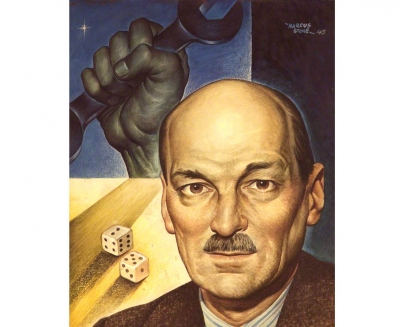
The attached column is a 1945 magazine profile of Clement Attlee (1883 – 1967: U.K. Prime Minister: 1945 – 1951) it appeared just a few weeks following the long over-do wrap-up of the Second World War and the hasty ouster of Conservative Party Prime Minister Winston Churchill (1874 – 1965).


You might also want to read an article about Soviet Foreign Minister Andre Gromyko.
No Combat Pay for Combat Medics (Yank Magazine, 1944)
1944, World War Two, Yank Magazine

No Combat Pay for Combat Medics
(Yank Magazine, 1944)

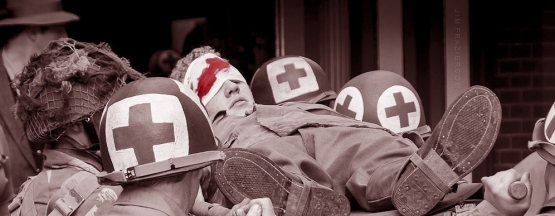
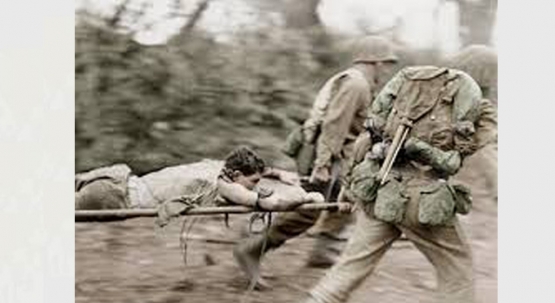
The World War II pay raise that was granted to U.S. Army combat infantrymen in the summer of 1944 did not extend to the front-line medic for reasons involving the Geneva Convention Rules of War. This triggered a number of infantrymen to write kind words regarding the medics while at the same time condemning the Geneva restrictions:

…I’ve seen the medics in action and I take my hat off to them. Most of them have more guts then us guys with the rifles…I’ve seen them dash into cross-fire that would cut a man to ribbons to help a guy who was in bad shape. I say give them all the credit they deserve.

Aphasia Patient in WW2 | Disambiguation Patient in World War II
1947, 47 Magazine, World War Two

Suffering A W.W. II Head Wound
(’47 Magazine, 1947)

When Joe Martin received a shrapnel wound to the head it affected that region of his brain that processes language. He spent a good deal of time in military hospitals trying to regain his lost ability to communicate, as he articulated clearly in the attached article:

He then held up a pencil in front of me and asked, ‘Joe, what is this?’

I heard myself reply, ‘A paddle’.

Advertisement

Use shortcode [oma_ad position="summary_top"] (or other position) in your theme or widgets to display OMA Promotions here.

Interesting architecture along Highland Avenue Hollywood | Los Angeles architecture of Gene and Joseph Weston
1930, Miscellaneous, The American Legion Monthly

Hollywood, California: American Legion Post 43
(American Legion Monthly, 1930)

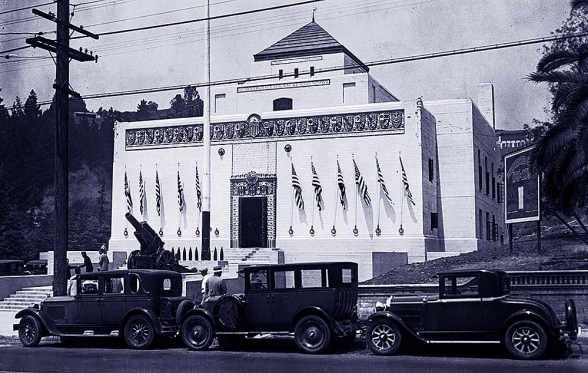
The attached article tells the story of American Legion Post 43, which is housed at 2035 North Highland Avenue in Hollywood, California. Designed by the Weston brothers in 1930 (both men were members) the building represents not only the home of the a Legion post but also [serves as] a memorial to the fighting divisions of the American Army and every American who took part in the World War.

Advertisement

Use shortcode [oma_ad position="summary_top"] (or other position) in your theme or widgets to display OMA Promotions here.

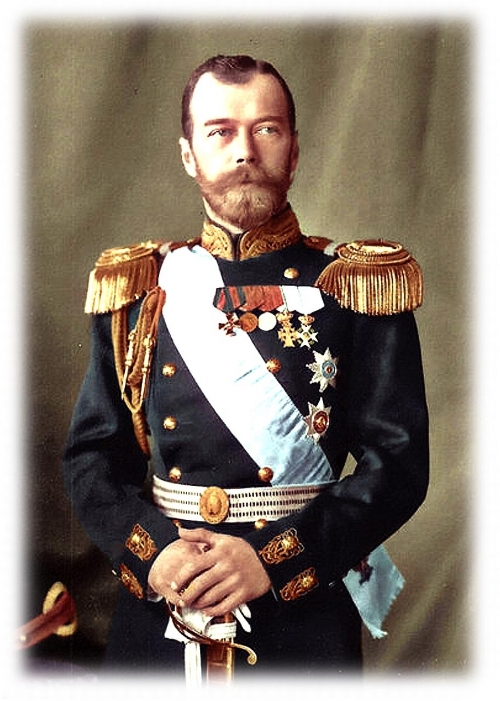
The Czar Abdicates (The Atlanta Georgian, 1917)
1917, European Royalty, The Atlanta Georgian

The Czar Abdicates
(The Atlanta Georgian, 1917)

Attached is a news report from a 1917 issue of THE ATLANTA GEORGIAN announcing:

Czar Nicholas decided to abdicate the Russian throne only after he had been held up by soldiers and the necessity for such action impressed upon him, according to a dispatch printed in DIE FRANKFURTER ZEITUNG…


Also included in the report were the text of a speech delivered by the Czar which called for national unity.

Advertisement

Use shortcode [oma_ad position="summary_top"] (or other position) in your theme or widgets to display OMA Promotions here.

Anna Rosenberg Under Secretary of Defense 1952
1952, Collier's Magazine, The Korean War

‘This I Saw In Korea”
(Collier’s Magazine, 1952)

Those darn misogynists in Washington fell asleep at the switch again when they appointed a woman to fill the number two spot at the Department of Defense. The woman in question was Anna Rosenberg (1902 – 1983), an experienced and well-respected hand in the Nation’s Capital who served in that post between 1950 and 1953. During the middle of the war she paid a visit to the American military installations in Korea and wrote warmly about all that she had seen.

The First 365 Days of the Korean War (Pathfinder Magazine, 1951)
1951, Pathfinder Magazine, The Korean War

The First 365 Days of the Korean War
(Pathfinder Magazine, 1951)

When the Korean War began during the summer of 1950 many Americans were wondering aloud Is this the beginning of W.W. III? One year later they were relieved to find that it was not a world war, but the butcher’s bill stood at 70,000 U.S. casualties and still there was no end in sight. This article examines these first 365 days of combat, taking into account all losses and gains.

Helmets Along the Western Front (Literary Digest, 1915)
1915, Inventions and Weapons, The Literary Digest

Helmets Along the Western Front
(Literary Digest, 1915)

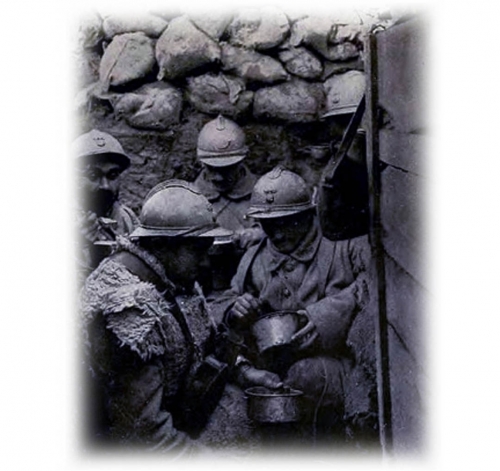
The tremendous advances in artillery that took place during the years leading up to the war helped to reintroduce an old, time-tested element to the uniforms of the 20th Century soldier: the helmet.


So numerous were head injuries from high-explosive shells during the first year of the war that it compelled the doctors on both sides to beg their respective generals to issue some measure of cranium protection in order to reduce the casualty figures. As you will read in the attached article, the French began to wear helmets in the fall of 1915; the British and Germans a year later.

Advertisement

Use shortcode [oma_ad position="summary_top"] (or other position) in your theme or widgets to display OMA Promotions here.

Scroll to Top