Author name: editor

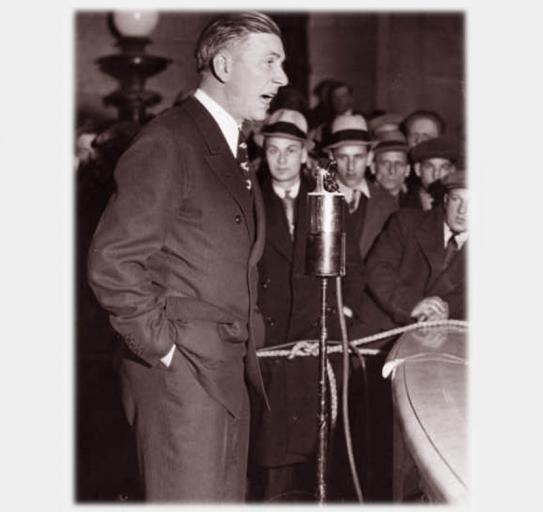
1930s Minnesota Governor Floyd B Olson Article | The Great Depression in Minnesota 1933
1933, The Great Depression, The Literary Digest

The Governor Who Threatened Martial Law
(Literary Digest, 1933)

An article about Governor Floyd B. Olson (1891 – 1936) of Minnesota who allowed his emotions to get the better of him one day in the early Spring of 1933 when he threatened to impose martial law throughout the state in order to confiscate private wealth should his proposed relief legislation fail to pass the Minnesota Senate:


Was former Democratic vice-President Henry Wallace a dirty Red?
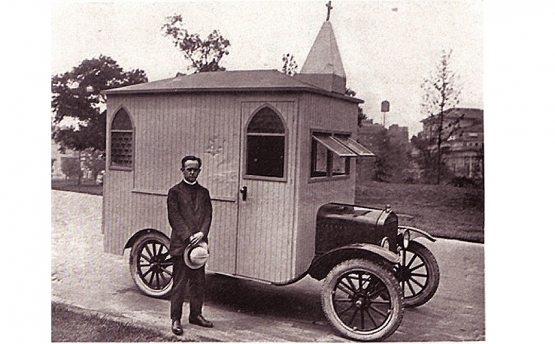
A Church on Wheels (Literary Digest, 1913)
1913, Cars, The Literary Digest

A Church on Wheels
(Literary Digest, 1913)

In our era we think nothing of bookmobiles and bloodmobiles or any number of other converted trucks and vans that are fashioned for various unique uses; this link will enable you to learn about a Catholic chapel-on-wheels (a.k.a. the Jesus-Jalopy, the Nun-Truck, the Pope Pick-Up, the Bishop-Bus) from 1913, that very well might have served as the inspiration for them all.

1919, Interviews: 1912 - 1960, The American Legion Weekly

An Interview With P.G. Wodehouse
(The American Legion Weekly, 1919)

At the time this magazine profile first appeared in 1919, P.G. Wodehousestyle=border:none (1904-1975) had recently resigned his post as the Drama Critic for VANITY FAIR MAGAZINE in order to pursue his ambition as a novelist and playwright. This article revealed to all Wodehouse’s keen interest in American slang and the language of American comic strips.


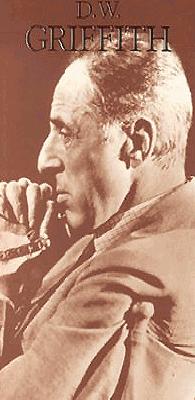
Click here to read magazine articles about D.W. Griffith.

Advertisement

Use shortcode [oma_ad position="summary_top"] (or other position) in your theme or widgets to display OMA Promotions here.

How Public Relief Operated During the Great Depression | 1934 Public Relief from the Federal Government
1934, New Outlook Magazine, The Great Depression

‘Nobody Starves”
(New Outlook Magazine, 1934)

This article attempted to explain to that portion of the reading public fortunate enough to have jobs, just how the county relief programs worked and what was provided to the subscribers. The journalist did not weigh-in as to whether she approved or disapproved of the program but sought to explain that in places like the Mid-West, where houses outnumbered apartment buildings, allowances for such possessions were made. In the congested cities of the East it might be expected that the family car be sold prior to receiving relief funds, but in the states where distances were greater subscribers were permitted to hold on to their cars.

Ronald Reagan in his Own Words (Photoplay Magazine, 1942)
1942, Interviews: 1912 - 1960, Photoplay Magazine

Ronald Reagan in his Own Words
(Photoplay Magazine, 1942)

In the attached PHOTOPLAY MAGAZINE article, Ronald Wilson Reagan (1911 – 2004), the Hollywood actor who would one day become the fortieth president of the United States (1981–1989), gives a tidy account as to who he was in 1942, and what was dear to him:

My favorite menu is steaks smothered with onions and strawberry short cake. I play bridge adequately and collect guns, always carry a penny as a good luck charm…I’m interested in politics and governmental problems. My favorite books are Turnabout, by Thorne Smith, Babbitt, The Adventures of Tom Sawyer and the works of Pearl Buck, H.G. Wells, Damon Runyon and Erich Remarque.


A good read and a revealing article by a complicated man.


Click here to read about a Cold War prophet who was much admired by President Reagan…

Clare Boothe: The Woman Behind ''The Women'' (Stage Magazine, 1938)
1938, Interviews: 1912 - 1960, Stage Magazine

Clare Boothe: The Woman Behind ”The Women”
(Stage Magazine, 1938)

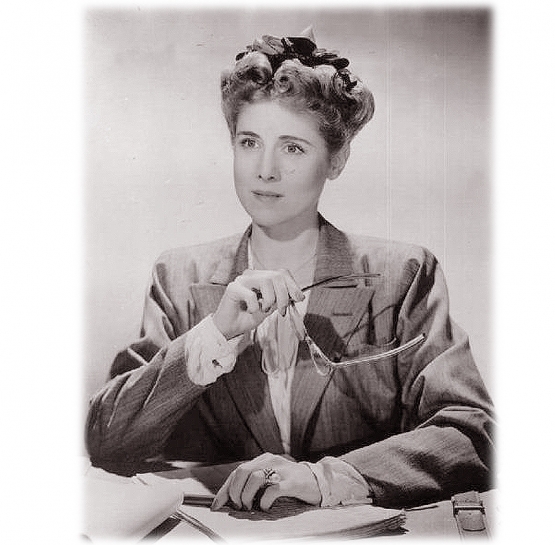
The following STAGE MAGAZINE article by American playwright Clare Boothe (Clare Boothe Luce 1903 – 1987) appeared in print shortly after the successful opening of her play, The Women:

Of course, writing plays wasn’t exactly a flash of genius. I mean I am shewed in spots…But inspiration or calculation, it was frightfully lucky that I hit on writing plays, wasn’t it? And it was so wonderfully fortunate that quite a lot of people that I’d met socially on Park Avenue, at very exclusive parties, people like cowboys, cooks, manicurists, nurses, hat-check girls, fitters, exchorines, declasses countesses, Westport intellectuals, Hollywood producers Southern girls and radical columnists, gave me such lovely material to write about.

Click here to read about feminine conversations overheard in the best New York nightclubs of 1937.

Advertisement

Use shortcode [oma_ad position="summary_top"] (or other position) in your theme or widgets to display OMA Promotions here.

Advertisement

Use shortcode [oma_ad position="summary_top"] (or other position) in your theme or widgets to display OMA Promotions here.

US Army Warfare Compared to Imperial German Army Warfare
1919, Doughboys

Intent on Battle
(U.S. Army Report, 1919)

Here is a page from The Enemy Order of Battle report (1919) by the subsection of the same name that was an arm of the U.S. Army General Staff. The report tells of Baccarat, a portion of the Western Front during the later part of the war that was quiet, by mutual agreement between the French and Germans – until the U.S. Army took their place in the French position – and then all Hell broke loose.

Home Front Feminism (Collier's Magazine, 1943)
1943, Collier's Magazine, Home Front

Home Front Feminism
(Collier’s Magazine, 1943)

1940s feminism bares no resemblance to the take-no-prisoners feminism of today. This is made clear in the attached article by Amaran Scheinfeld (1900 – 1979), a writer, whose book Women and Men (1944), as stated by the New York Times, foreshadowed many issues of the feminist movement. The primary difference between the two lay in the fact that seventy-five years ago it was believed that it was nature that had established many of the rolls played by the (two) genders.

Advertisement

Use shortcode [oma_ad position="summary_top"] (or other position) in your theme or widgets to display OMA Promotions here.

WW I PTSD Disorder | WW I Veterans Suffered From Shell Shock 1919 | Shell Shock Newspaper Article 1919
1919, Aftermath (WWI), The American Legion Weekly

The Shell-Shocked Millions
(American Legion Weekly, 1919)

With the close of the war came the release of millions of combat veterans onto the streets of the world. Some of these veterans adjusted nicely to the post-war world – but many had a difficult time. Their maladjustment was called Shell Shock and it could manifest itself in any number of ways; in the attached article, written less than a year after the war, one anonymous American veteran explained his own personal encounter with the illness.


Click here to read a post-W.W. I poem about combat-related stress…

Night Patrol in the Toul Sector (Stars and Stripes, 1918)
1918, The Stars and Stripes

Night Patrol in the Toul Sector
(Stars and Stripes, 1918)

Mr. Junius B. Wood, correspondent of the Chicago Daily News with the A.E.F. recently spent a week in the sector held by the American Army Northwest of Toul. He lived the life of a Doughboy, slept a little and saw a lot. He spent his days in and near the front line and some of his nights in No Man’s Land. Here is the second and concluding installment of his story, depicting life at the front as it actually is…


Click here to read an article about the German veterans of W.W. I.

Martha Vickers (Pic Magazine, 1945)
1945, Hollywood History, Pic Magazine

Martha Vickers
(Pic Magazine, 1945)

Perhaps one of the first magazine articles about the beautiful actress Martha Vickers (1925 – 1971) who is best remembered by fans for her performance as the fabulously slutty Carmen Sternwood in the 1946 film The Big Sleep.


This article tells the tale of her early days in 1940s Los Angeles and her work as a photographer’s model, which turned more than a few of the crowned heads of Hollywood.

Advertisement

Use shortcode [oma_ad position="summary_top"] (or other position) in your theme or widgets to display OMA Promotions here.

WW II Ends | New Era Begins 1945
1945, World War Two, Yank Magazine

The Last 125 Days of the War
(Yank Magazine, 1945)

A YANK staff writer Robert Bendiner (1910 – 2009), summed-up the eventful period that began with the death of President Franklin Delano Roosevelt on
April 12, and ended with the Japanese surrender on August 10, 1945. He pointed out that within that period remarkable changes had been made; not merely the deaths of Hitler, Mussolini and the collapse of Imperial Japan, but it was clear to many that the stage was being set for a new world. The foundations were in place for the creation of a durable world security organization and as if that wasn’t enough, there was a new, hideous weapon called the Atomic Bomb that would cast a long shadow across the land and mark this new era as a unique period in world history.

After a streak like that it would not be surprising if a revulsion against big news should set in. It may well be that people long to pick up a paper in which nothing more cosmic is reported than the city’s reception of a visiting channel-swimmer, and nothing more violent than a tie-up on the Magnolia Avenue trolley line.

Click here to read how British women struggled to understand American slang.

Was Allied Air Power Decisive During World War II? (Yank Magazine, 1945)
1945, World War Two, Yank Magazine

Was Allied Air Power Decisive During World War II?
(Yank Magazine, 1945)

A light and breezy review concerning the findings of a U.S. government study regarding the effectiveness of the Allied strategic bombing campaign against Nazi Germany:

…the survey authorities report that although air power might have been more advantageously applied in this case or that, its decisive bearing on the victory was undeniable…At sea, its contribution, combined with naval air power, brought an end to the enemy’s greatest naval threat -the U-boat; on land, it helped turn the tide overwhelmingly in favor of allied ground forces.

Articles about the daily hardships in post-war Germany can be read by clicking here.

The Defense of Bastogne (Combat Studies Group, 1986)
1986, Paratroopers, The U.S. Army Combat Studies Group

The 101st Division at Bastogne
(Combat Studies Group, 1986)

Attached is the concluding essay from a U.S. Army report written in 1986 concerning the spirited defense that was offered by the 101st Airborne Divisionstyle=border:none at the Battle of the Bulge.

At Bastogne, well-coordinated combined arms teams defeated uncoordinated armored and infantry forces committed to an unrealistic plan.


Click here to read more about W.W. II parachute infantry…


Another article about this battle can be read by clicking here…

Advertisement

Use shortcode [oma_ad position="summary_top"] (or other position) in your theme or widgets to display OMA Promotions here.

Scroll to Top