Author name: editor

The Man Germany Hates Most (Collier's Magazine, 1944)
1944, Collier's Magazine, World War Two

The Man Germany Hates Most
(Collier’s Magazine, 1944)

This is the story of Bomber Harris, also known as Sir Arthur Travers Harris, Marshal of the Royal Air Force (1892 – 1984) between the years 1942 through 1945. He was the daily tormentor of Nazi Germany, striving relentlessly to bring an end to German hostilities by bombing their home front without pity. This article tells the tale of Harris the soldier and Harris the man: his W.W. I experiences, his inter-war training and Washington posting, his W.W. II contributions as Air Marshal as well as his family life.


Click here to read W.W. II articles about life in Harris-plagued Germany.


Click here to read about the 1943 bombing campaign against Germany.

U.S. Army Carrier Pigeons of World War II (Click Magazine, 1943)
1943, Animals (WWII), Click Magazine

U.S. Army Carrier Pigeons of World War II
(Click Magazine, 1943)

Although historians may like to refer to World War II as the first hi-tech war, some of the ancient tools were still put to use with great effect. The attached article gives a very brief outline concerning the W.W. II use of carrier pigeons and the goings on at Camp Crowder, Missouri, where these birds were trained.

Since 1400 B.C. these birds have acted as couriers; they are the oldest instruments of war still in use. Although they form only a small part of our tremendous Signal Corps resources, the Army maintains a corps of expert pigeoneers who have rendered their birds, by scientific training and breeding, ten percent stronger than those used in World War One.

During the course of World War II the U.S. Army signal Corps deployed more than 50,000 carrier pigeons.

You might also enjoy reading this article about the carrier pigeons of W.W. I.

Advertisement

Use shortcode [oma_ad position="summary_top"] (or other position) in your theme or widgets to display OMA Promotions here.

'Assault Climbing'' (Click Magazine, 1944)
1944, Click Magazine, Combat Training

‘Assault Climbing”
(Click Magazine, 1944)

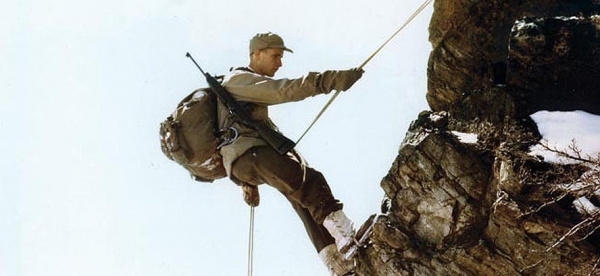
One month after this article was seen on the newsstands, America would be reading a good deal about the U.S. Army Assault Climbers when they thirsted to read further about those hardy lads who climbed the steep cliffs at Point du Hoc on D-Day; but in May of 1944, the term was new to them. The article is well illustrated with two color images and a brief explanation as to what was involved in the training of those lucky souls who were charged with the task of learning how to climb the rocky terrain held by the Fascist powers.


Read what the U.S. Army psychologists had to say about fear in combat.
D-Day with the Eighth Air Force (Yank Magazine, 1944)
1944, D-Day, Yank Magazine

D-Day with the Eighth Air Force
(Yank Magazine, 1944)

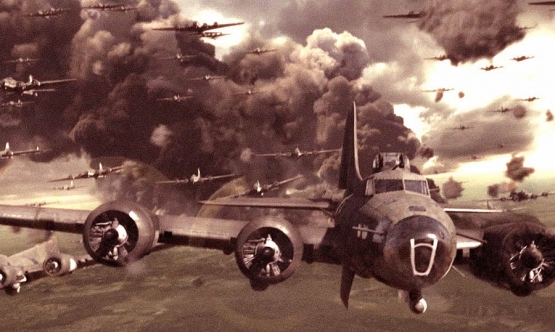
D-Day for the lads of the U.S. Army Air Corps’ Eighth Air Force was a time of great excitement and anticipation. Despite the exhaustion that comes with a fifteen hour day, all concerned recognized well that they were participating in an historic event that would be discussed long after they had left this world, but of greater importance was their understanding that the tides of war were shifting in the Allies’ favor.


In his book Wartime, Paul Fussel noted that the Allies had placed as many as 11,000 planes in the skies above France that day.


Click here to read about the 8th Air Force and their bombing efforts in the skies above Germany.

Advertisement

Use shortcode [oma_ad position="summary_top"] (or other position) in your theme or widgets to display OMA Promotions here.

FDR Takes On the Great Depression (The Literary Digest, 1933)
1933, The Great Depression, The Literary Digest

FDR Takes On the Great Depression
(The Literary Digest, 1933)

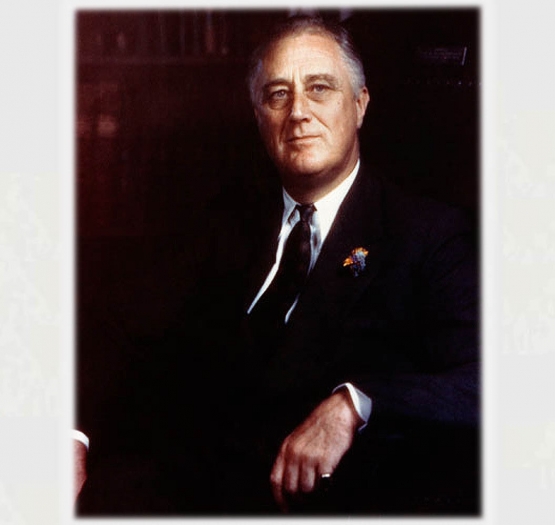
All the editorial writers quoted in this 1933 article agreed that FDR was the first U.S. President to ever have faced a genuine economic calamity as that which was created by the Great Depression:

Look at the picture flung into the face of Franklin Roosevelt:

Ships are tied up in harbors and their hulls are rotting; freight trains are idle; passenger trains are empty; 11,000,000 people are without work; business is at a standstill; the treasury building is bursting with gold, yet Congress wrestles with a deficit mounting into the billions, the result of wild and extravagant spending; granaries are overflowing with wheat and corn; cotton is a drag on the market, food crops are gigantic and unsalable, yet millions beg for food; mines are shut down; oil industries are engaged in cutthroat competition; farmers are desperate, taking the law into their own hands to prevent foreclosures; factories are idle; industry is paralyzed…

'The Roosevelt I Knew'' (Collier's Magazine, 1946)
1946, Collier's Magazine, F.D.R.

‘The Roosevelt I Knew”
(Collier’s Magazine, 1946)

Here is the recollection of FDR by a woman who worked closely with the man for nearly thirty five years as political colleague, state governor appointee and Labor Secretary: Francis Perkins (1880 – 1965).


Secretary Perkins and President Roosevelt were a vital team when it came to crafting many of the labor laws that are still enforced today. Click here to read a 1937 magazine article about the creation of the first minimum wage laws…

John Nance Garner on F.D.R. (Collier's, 1948)
1948, Collier's Magazine, F.D.R.

John Nance Garner on F.D.R.
(Collier’s, 1948)

A printable article by John Nance Garner (1868 – 1967), FDR’s first Vice-President (1933 – 1941), who wrote a number of pieces for the readers of COLLIER’S MAGAZINE in 1948 outlining the various reasons for their contentious relationship.

Cactus Jack Garner bickered with F.D.R. on a number of issues; primarily supporting a balanced federal budget and opposing F.D.R.’s efforts to pack the Supreme Court. Within these attached pages, Garner tells how Roosevelt lost the support of his Democratic Congress.


Read about FDR’s African-American advisers here…

Advertisement

Use shortcode [oma_ad position="summary_top"] (or other position) in your theme or widgets to display OMA Promotions here.

The Significance of the Union Victory at Vicksburg (The National Park Service, 1954)
1954, The National Park Service, Vicksburg

The Significance of the Union Victory at Vicksburg
(The National Park Service, 1954)

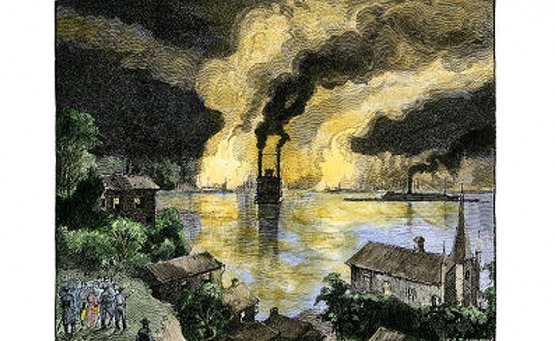
The great objective of the war in the West – the opening of the Mississippi River and the severing of the Confederacy – had been realized with the fall of Vicksburg.

On July 9 [1863], the Confederate commander at Port Hudson, upon learning of the fall of Vicksburg, surrendered his garrison of 6,000 men. One week later the merchant steamboat Imperial tied up at the wharf at New Orleans, completing the 1,000-mile passage from St. Louis undisturbed by hostile guns. After two years of land and naval warfare, the Mississippi River was open, the grip of the South had been broken, and merchant and military traffic had now a safe avenue to the gulf of Mexico. In the words of Lincoln:


The Father of Waters again goes unvexed to the sea.

Mr Average American Poll Data | Average American Man in the 1950s | Average American Man Statistics
1955, Americana, Pageant Magazine

A Profile of ”Mr. America”
(Pageant Magazine, 1955)

WHO, WHAT, AND WHY is the average American [man]? What does he eat? What does he wear? What does he worry about? These questions and more like them have taken us on a long journey through the realm of statistics. Out of the discoveries of the Department of Commerce, the Census Bureau and Dr. Gallup’s polls, we’ve succeeded in piecing together an uncommon portrait of the common man.

Facts About the Statue of Liberty
1955, Americana, Coronet Magazine

The Lady in the Harbor
(Coronet Magazine, 1955)

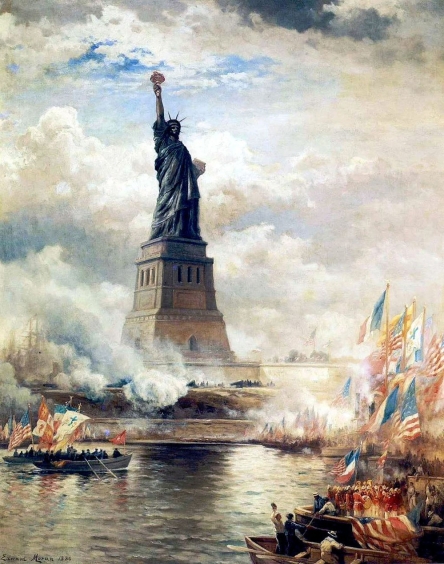
When this article first appeared, the Statue of Liberty was praised as the tallest statue in the world – today, it doesn’t even make the list of the tallest statues; nonetheless, here is a collection of facts about the Ladyy Liberty:


• 200,000 pounds of copper were used in the statue, enough copper for more than 100 stacks of pennies, each as tall as the Empire State Building.


• Trans-Atlantic voyagers do not see Liberty until their ship enters N.Y. Harbor, but her torch can be seen 15 miles out.


• Her index finger is eight feet long.

Advertisement

Use shortcode [oma_ad position="summary_top"] (or other position) in your theme or widgets to display OMA Promotions here.

'Patriotism'' (The Crisis, 1918)
1918, African-Americans

‘Patriotism”
(The Crisis, 1918)

An interesting editorial from World War I in which the writer (possibly W.E.B. Duboise) expressed that an African-American’s sense of patriotism in that era was based on the nation’s potential to be judicious and fair.


The article is a fine example illustrating the influence that George Creel and his Committee on Public Information had strong-arming the American magazine editors during the period of World War One.

D.W. Griffith: His Minor Masterworks (Rob Wagner's Script, 1946)
1946, D.W. Griffith, Rob Wagner's Script Magazine

D.W. Griffith: His Minor Masterworks
(Rob Wagner’s Script, 1946)

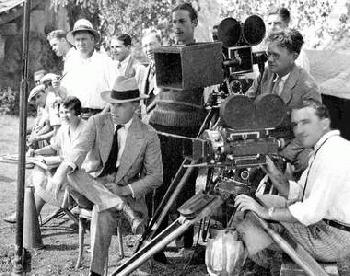
In 1946 the Museum of Modern Art Film Department decided to exhibit only the most famous films of D.W. Griffith for the retrospective that was being launched to celebrate the famed director. This enormous omission inspired film critic Herb Sterne (1906 – 1995) to think again about the large body of work that the director created and, putting pen to paper, he wrote:

Because of the museum’s lack of judgment, the Griffith collection it has chosen to circulate is woefully incomplete, thereby giving contemporary students of the motion picture a distorted and erroneous impression of the scope of the man’s achievements.


To read a 1924 article regarding Hollywood film executive Irving Thalberg, click here.

Advertisement

Use shortcode [oma_ad position="summary_top"] (or other position) in your theme or widgets to display OMA Promotions here.

How One School Turned Itself Around (Pageant Magazine, 1961)
1961, Education, Pageant Magazine

How One School Turned Itself Around
(Pageant Magazine, 1961)

When the Soviet Union launched the first artificial satellite, Sputnik, in the Autumn of 1957 it shocked the American people and set in motion an event that was quickly labeled the Sputnik Crises. Almost at once, school boards all across the fruited plane resolved to improve their math and science programs in order to ensure the blessings of liberty for generations yet unborn.


One of these institutions was Laguna Beach High School in Southern California and the attached article, Turning Bad Schools into Good Schools, will tell you about the various steps they had taken in order to alter their curriculum and the prevailing campus culture as well.


We were gratified to learn that some fifty-odd years later, Laguna Beach High is still one of the finest schools in the country.


A Profile of H.L. Mencken (The English Review, 1922)
1922, Interviews: 1912 - 1960, The English Review

A Profile of H.L. Mencken
(The English Review, 1922)

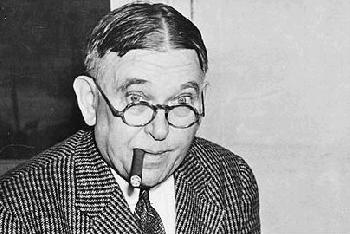
During much of the 20s and 30s satirist H.L. Mencken (1880 – 1956) was widely read and respected for the critic that he was -and as you read this British essay from the arts journal, The English Review, you’ll get a sense that the author/groupie must have been waiting by the docks for several years in anticipation of his arrival.


The historian Henry Steele Commager ranked H.L. Mencken at number 9 insofar as his impact on the American mind was concerned – click here to understand his reasoning…


Click here to read an article about one of New York’s greatest mayors: Fiorello LaGuardia.

Advertisement

Use shortcode [oma_ad position="summary_top"] (or other position) in your theme or widgets to display OMA Promotions here.

Scroll to Top