Author name: editor

Life in a Trench (What the Boys Did Over There, 1919)
1919, What the Boys Did Over There

Life in a Trench
(What the Boys Did Over There, 1919)

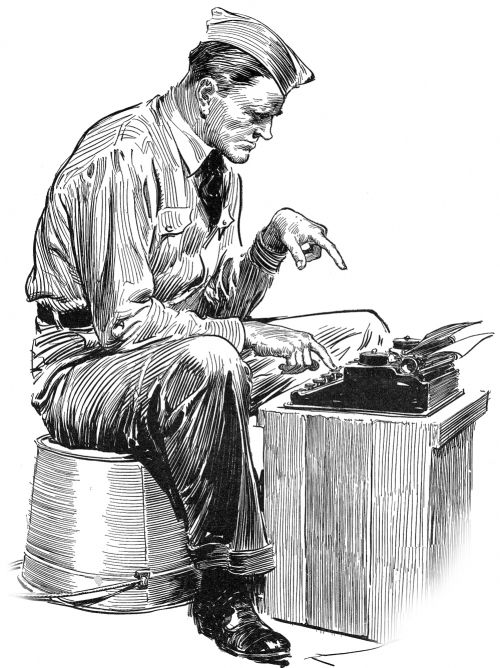
Corporal Frank Sears of the American Expeditionary Force put pen to paper and explained for all posterity the unsanitary conditions of <b.living in a W.W. I trench in France:

Life in the trenches is made up of cooties, rats, mud and gas masks…
We became so used to mud up in the lines that if our chow did not have some mud, or muddy water in it we could not digest it. It was just a case of mud all over: eat, drink, sleep and wash in mud.

1963 Events in the Vietnam War | Kennedy Vietnam Policy 1963
1963, The United States News, The Vietnam War

1963: A Pivotal Year
(United States News, 1963)

The 1963 struggle in Vietnam was important for a number of reasons: as the year began the world saw the first major defeat for the Army of the Republic of Vietnam at the hands of the Viet Cong guerrillas at Ap Bac. Five months later Buddhist clergymen revealed their deep distaste for the war effort which quickly resulted in the Diem administration putting numerous Buddhist pagodas to the torch. Ngo Dinh Diem himself would be put to the torch in November when he and his brother would be overthrown in an American-backed coup. Historians have long maintained that by meddling in the internal political affairs of South Vietnam, JFK had unwittingly doomed any chance for their self-reliance; following the November coup, that country became more and more reliant upon the United States – and when the U.S. abandoned the cause of a free and independent South Vietnam, their fate was sealed.

The Tiger Tank at the Aberdeen Proving Ground (Yank Magazine, 1944)
1944, Weapons and Inventions, Yank Magazine

The Tiger Tank at the Aberdeen Proving Ground
(Yank Magazine, 1944)

The American army’s Aberdeen Proving Ground rests on 72,962 acres in Aberdeen, Maryland. Since 1917 it has been the one spot where the U.S. Army puts to the test both American and foreign ordnance and in 1944 the gang at Aberdeen got a hold of a 61 1/2 ton German battle-wagon, popularly known as the Tiger Tank (PZKW-VI). This is a nicely illustrated single page article that explains what they learned.


For further reading about the Tiger Tank, click here.

Advertisement

Use shortcode [oma_ad position="summary_top"] (or other position) in your theme or widgets to display OMA Promotions here.

A Study of the German Tiger Tank (The U.S. War Department, 1945)
1945, The U.S. War Department, Weapons and Inventions

A Study of the German Tiger Tank
(The U.S. War Department, 1945)

Attached is the sweetest conte crayon illustration ever to depict a Tiger tank is accompanied by some vital statistics and assorted observations that were recorded by the U.S. Department of War and printed in one of their manuals in March of 1945:

This tank, originally the Pz. Kpfw. VI, first was encountered by the Russians in the last half of 1942, and by the Western Allies in Tunisia early in 1943…

Click here to read about the German King Tiger Tank.


Click here to read a 1944 article about the Tiger Tank.

1940s American Pop Culture Observed | American Society in the 1940s
1945, Coronet Magazine, POWs

The Returned P.O.W.
(Coronet Magazine, 1945)

Merchant Marine William T. Mitchell, having been locked-up for three and half years in a Japanese POW camp, recalled those terrible days intermittently as he explains what it was like to return to a changed America. One of the amusing stories concerned a time when his captors assembled the camp to announce [falsely] that movie stars Judy Garland and Deanna Durbin had been killed:

The Nips had lied to us, and I fell for it. You believe anything – almost – when you’re cut off from your home.

War Relocation Authority Japanese-American Internment Camps | Americans Opposition to Japanese-American Internment Camps
1944, Japanese-American Internment

Outraged Soldiers and Marines
(U.S. Dept. of the Interior, 1944)

That administering government agency charged with the management of the Japanese-American internment camps was the War Relocation Authoritystyle=border:none, which was an arm of the U.S. Department of the Interior. Much to their credit, in 1944, this bureaucracy saw fit to published a small booklet containing the letters of many outraged American servicemen who vented their anger on the subject that their fellow Americans were being singled-out for persecution:


…I’m putting it mildly when I say that it makes my blood boil…We shall fight this injustice, intolerance and un-Americanism at home! We will not break faith with those who died…We have fought the Japanese and are recuperating to fight again. We can endure the hell of battle, but we are resolved not to be sold out at home.


Advertisement

Use shortcode [oma_ad position="summary_top"] (or other position) in your theme or widgets to display OMA Promotions here.

World War Two Hollywood (Yank Magazine, 1945)
1945, Hollywood History, Yank Magazine

World War Two Hollywood
(Yank Magazine, 1945)

The attached article is a swell piece of journalism that truly catches the spirit of home front America. You will read about the war-weary Hollywood that existed between the years 1941-1945 and the movie shortages, the hair-pin rationing, the rise of the independent producers and the ascent of Van Johnson (4-F slacker) and Lauren Becall:

Lauren, a Warner Brothers property, is a blonde-haired chick with a tall, hippy figure, a voice that sounds like a sexy foghorn and a pair of so-what-are-you-going-to-do-about-it eyes

Washington, D.C. During Wartime (Yank Magazine, 1944)
1944, Home Front, Yank Magazine

Washington, D.C. During Wartime
(Yank Magazine, 1944)

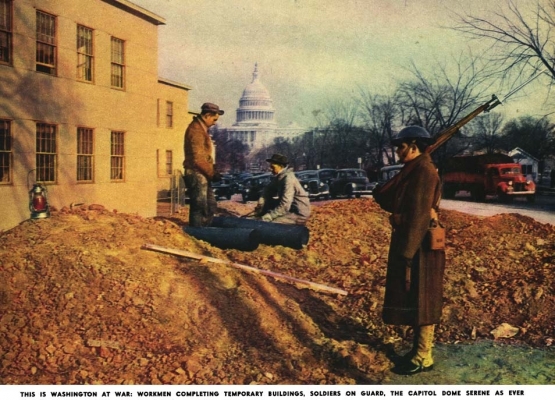
Washington, D.C. has always been described as a pretty dull place and the only ones who ever seem to feel differently must have had a good deal of experiences in far worse locations. In this case, I am referring to Iowa and the war-torn portions of the South Pacific, which are the only two locations this YANK journalist had ever called home; so he liked Washington just fine. The author in question, Sergeant Merle Miller (1919 – 1986), does not ramble on about historic bone-yards or any other pedantic clap-trap, but rather presents useful information that a G.I. can apply to his life:

Of course, getting a fair date while you’re in town is no problem. A Canadian newspaperman recently discovered that, judging from ration-book requests, there are 82,000 single girls of what he called the right marrying age of 20 to 24 in town, and only 26,000 men of the same age Therefore, he concluded, a girl has only about a 30-percent chance of getting a husband — or, for that matter, a date


The missing period at the close of the article, I assume, is due entirely to war-time shortages.


To read about the VJ-Day celebrations in Washington, click here.

Advertisement

Use shortcode [oma_ad position="summary_top"] (or other position) in your theme or widgets to display OMA Promotions here.

Armistice Day Mussolini Style (American Legion Monthly, 1936)
1936, Benito Mussolini, The American Legion Monthly

Armistice Day Mussolini Style
(American Legion Monthly, 1936)

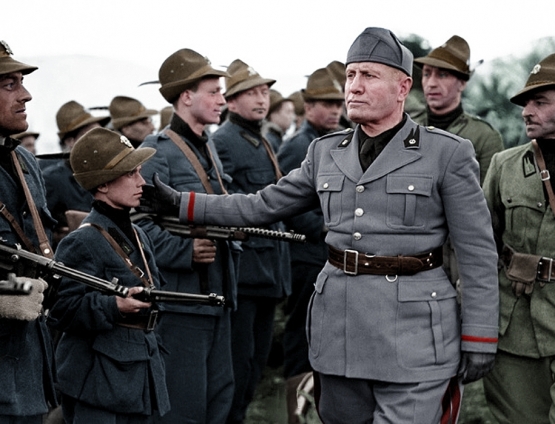
American World War I veteran John Roberts Tunis (1889 – 1975) was charged with the task of writing about the two Armistice Day ceremonies as they were marked in both London and Rome; needless to say they were entirely different in nature and spirit. The attached piece is an excerpt from that article and reported on the manner in which fascist Italy observed the anniversary of November 11, 1918 – the day World War I came to a close; a war in which Italy lost 1,240,000 men. Tunnis was disgusted to observe how the Italians seemed to learn nothing from the war – Mussolini’s Armistice celebration was drenched in fascist pageantry and the attending masses had far greater interest in their current military adventures in Africa than remembering their sons and fathers who had perished just eighteen years earlier.

German Anti-Semitism in 1915 (Harper's Weekly, 1915)
1915, Harper's Weekly, Jews in the 20th Century

German Anti-Semitism in 1915
(Harper’s Weekly, 1915)

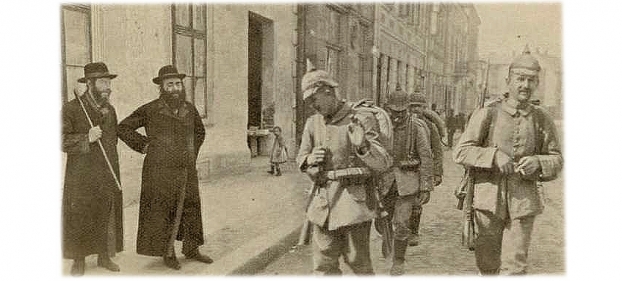
A two column item on anti-Semitismstyle=border:none as it existed in Germany during World War I:
In the calamity of war we act now as if we were one heart and one soul with the Jews. However, and I am pained to say it, I must declare that the Jewish question remains and will perhaps, just because of the war, become still more acute. The Jews are a foreign people and are our opponents in France, Russia and England, together with the enormous means at their disposal.

Click here to read an article about the Warsaw Ghetto.

1943, American English, Yank Magazine

British Attempts to Comprehend the American Lingo
(Yank Magazine, 1943)

Attached is small Yank Magazine article pertaining to a booklet titled, When You Meet an American that was distributed to assorted British girls by their government during the Second World War:

Try not to appear shocked at some of their expressions…if a lad from back home asks for a hot dog he actually means, ‘fried sausage in split rolls’…’Hi’ya baby!’ is legitimate.


Click here to read further about American teen slang.

Advertisement

Use shortcode [oma_ad position="summary_top"] (or other position) in your theme or widgets to display OMA Promotions here.

Is There an American Art? (Current Opinion, 1922)
1922, Current Opinion Magazine, Modern Art

Is There an American Art?
(Current Opinion, 1922)

Prior to the establishment of the New York School in the 1940s, there has always been a popular belief among Europeans (and a few Americans) that the art produced in the U.S. was purely derivative and lacked true originality in conception and style. In the attached article from the early Twenties, some of these Europeans and Americans step forward and identify themselves while continuing to crack wise on the topic; however, the editors of ART NEWS will not suffer this abuse and they return fire offering plenty of evidence to the contrary.

John Philip Sousa: The March King (The Literary Digest, 1897)
1897, Music History, The Literary Digest

John Philip Sousa: The March King
(The Literary Digest, 1897)

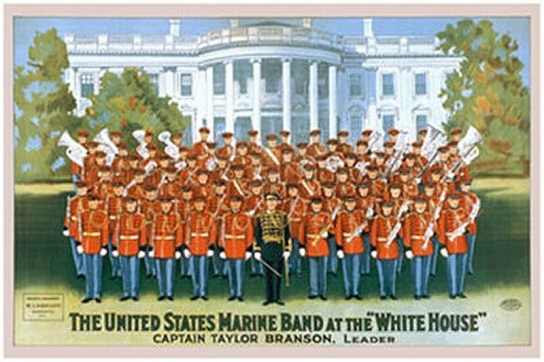
This 1897 profile of composer John Philip Sousa (1854 – 1932) was written shortly after his triumphal return from Queen Victoria’s Jubilee, where he was feted like a native son for all his glorious march compositions – particularly The Washington Post March, which was performed while her household infantry passed in review:

There is probably no composer in the world with a popularity equal to that of Mr. Sousa. Tho he sold his ‘Washington Post’ march outright for $35.00, his ‘Liberty Bell’ march is said to have brought him $35,000…At the age of twenty-six Mr. Sousa became the leader of the United States Marine Corps Band. In the twelve years of his leadership,he developed this unimportant organization into one of the best military bands in the world.

Advertisement

Use shortcode [oma_ad position="summary_top"] (or other position) in your theme or widgets to display OMA Promotions here.

End of Allied Occupation of Germany 1930 | Pathfinder Magazine Article About Occupied Germany 1930
1930, Versailles Treaty

Allied Occupation of Germany Ends
(The Pathfinder, 1930)

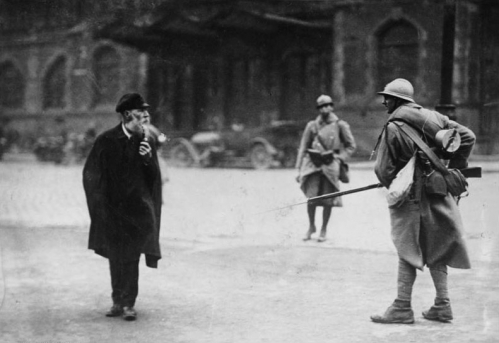
The foreign correspondent for Pathfinder Magazine filed this brief report about the goings-on in Germany on June 30, 1930, when the last Allied regiments had completed their occupation duties mandated under the Treaty of Versailles and withdrew to their own borders:

For the most part the German population waited patiently until the last uniformed Frenchman had entrained and then they raised the German flags, [and] began to sing ‘Deutschland Ueber Alles’…

President Hindenburg issued a proclamation saying in part:


‘After long years of hardships and waiting, the demand of all Germans was today fulfilled. Loyalty to her fatherland, patient perseverance and common sacrifices have restored to the occupied territory the highest possession of every people – freedom.’

The Versailles Treaty and the German Colonies (Leslie's Weekly, 1919)
1919, Leslie's Weekly, Versailles Treaty

The Versailles Treaty and the German Colonies
(Leslie’s Weekly, 1919)

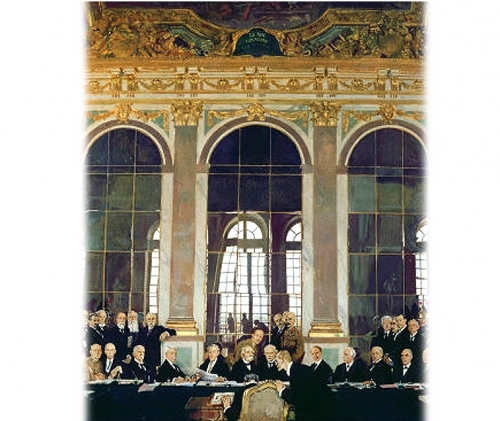
Half way through the year of 1919, editorials like this one began to appear in many places which served to inform the English-speaking world that the Germans were peacefully handing over their African colonies (as they were obliged to do in article 119 of the Versailles Treaty):

Germany renounces in favor of the principal Allied and Associated Powers all her rights and titles over her overseas possessions.

What Did the Germans Think of Their Occupiers? (Prevent W.W. III Magazine, 1947)
1947, Aftermath (WWII), Prevent W.W. III Magazine

What Did the Germans Think of Their Occupiers?
(Prevent W.W. III Magazine, 1947)

By the time this article appeared on paper, the defeated Germans had been living among the soldiers of four different military powers for two years: the British, the French, the Russians and the Americans – each army had their own distinct personality and the Teutonic natives knew them well. With that in mind, an American reporter decided to put the question to them as to what they thought of these squatters – what did they like most about them and what did the detest most about them?


The Germans did not truly believe that the Americans were there friends until they proved themselves during the Berlin Blockade; click here to read about that…

Advertisement

Use shortcode [oma_ad position="summary_top"] (or other position) in your theme or widgets to display OMA Promotions here.

Scroll to Top