

























47 Magazine Articles
Click Magazine Articles
Collier's Magazine Articles
Confederate Veteran Magazine Articles
Confidential Magazine Articles
Creative Art Magazine Articles
Current Literature Magazine Articles
Direction Magazine Articles
Film Daily Magazine Articles
Freedom's Triumph Articles
G.I. Joe Magazine Articles
Harper's Bazaar Magazine Articles
Harper's Weekly Articles
Hearst's Sunday American Articles
Ken Magazine Articles
La Baionnette Articles
Leslie's Magazine Articles
Liberty Magazine Articles
Life Magazine Articles
Men's Wear Magazine Articles
Newsweek Articles
Outing Magazine Articles
Outlook Magazine Articles
People Today Magazine Articles
Photoplay Magazine Articles
Pic Magazine Articles
PM Tabloid Articles
Punch Magazine Articles
Rob Wagner's Script Magazine Articles
Scribner's Magazine Articles
Sea Power Magazine Articles
Stage Magazine Articles
The American Legion Monthly Articles
The American Legion Weekly Articles
The Atlantic Monthly Articles
The Dial Magazine Articles
The Film Spectator Magazine Articles
The Flapper Magazine Articles
The National Park Service Articles
The New Republic Articles
The New York Times Articles
The North American Review Articles
The Saturday Evening Post Articles
The Saturday Review Articles
The Smart Set Articles
Theatre Arts Magazine Articles
Touchstone Magazine Articles
Trench Warfare Articles
Vanity Fair Magazine Articles
Vogue Magazine Articles

Radio History

1932 and the
Differences Between
European & American Broadcasting

• Pathfinder Magazine, 1932 •


“A recent study of broadcasting programs of 15 European countries for a period of three months, by the International Broadcasting Office at Geneva, shows their average composition as follows:

Musical Entertainment – 44.3%

Literature – 5.4%

Talks – 10.5%

Criticism and News – 12.7%

Religion – 3.65%

Miscellaneous – 25.1%

Commercial broadcasts were largely discouraged and comedic programming was non-existent.

“Educational broadcasting is growing in popularity in Europe and is being extended into the afternoon school hours.”

“But ‘commercial America,’ with more than 600 of the word’s 1,400 radio stations, seems so far to have gotten the most dough out of radio. This business now contributes $500,000,000 a year to the nation’s wealth.”

A good deal of column space explains how the Soviet Union used radio.
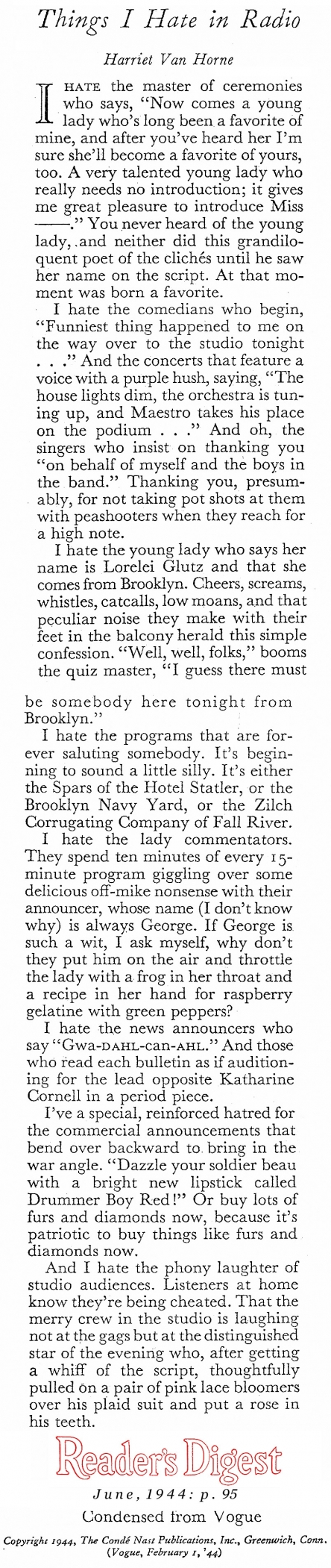
Read ‘Radio Here and Abroad”<br>(Pathfinder Magazine, 1932) for Free
1930s radio programming1930s american radio programs vs 1930s european radio programs

1932 and the[br] Differences Between[br]European & American Broadcasting

1932 and the[br] Differences Between[br]European & American Broadcasting

1930s radio programming1930s american radio programs vs 1930s european radio programs
Scroll to Top