Author name: editor

ww1 German Home Front Article | 1916 German Home Front
1916, The Literary Digest, World War One

Grim Determination on the German Home Front
(Literary Digest, 1916)

This report, filed from Switzerland, stood in stark contrast to hundreds of other articles previously published by the Allied presses that reported how regretful the Germans were for having provoked war and how economic privations were making them even more-so. This unnamed journalist insisted that the German home front that he saw in 1916 was composed of a proud and determined people who were fully prepared to see the war through to a German victory.

Harold Lloyd: The Man, The Cornball (The American Magazine, 1922)
1922, Silent Movie History, The American Magazine

Harold Lloyd: The Man, The Cornball
(The American Magazine, 1922)

An in-depth interview with the great silent film comedian Harold Lloyd (1893 – 1971) accompanied by a seldom seen picture of the man WITHOUT his glasses (he didn’t really need them).

One blogger read the attached article and wrote the following:

I’ve never read this before – it’s great. It’s always good to hear Harold’s own thoughts on his films; I enjoyed his description of the stunt he did in on top of the locomotive at the mouth of an approaching tunnel in the film Now or Never. It’s a spectacularly funny gag, but we sometimes forget the effort that went into these scenes; Harold was one comedy star who was prepared to suffer for his art!

Advertisement

Use shortcode [oma_ad position="summary_top"] (or other position) in your theme or widgets to display OMA Promotions here.

Panmunjom Peace Treaty 1953
1953, The Korean War, Weekly News Review

Fingers Crossed for a Lasting Peace
(Weekly News Review, 1953)

Fighting in Korea ended under a truce effective July 27. It is a well known fact, though, that the truce is no guarantee that fighting won’t start again. The UN wants to work out an agreement with the Reds that will mean no more war for Korea.


– and work it out they did; the truce has held for some sixty-five years. This article concerns all the various minutia both sides had to agree to in order to reach the agreement.

Virginia Woolf Reviews E.M. Forster (Atlantic Monthly, 1927)
1927, The Atlantic Monthly, Twentieth Century Writers

Virginia Woolf Reviews E.M. Forster
(Atlantic Monthly, 1927)

Virginia Woolf (1882 – 1941) had her say regarding the novels of E.M. Forster (1879 – 1970):

There are a many reasons which should prevent one from criticizing the work of contemporaries… With a novelist like E.M. Forster this is specially true, for he is in any case an author about whom there is considerable disagreement. There is something baffling and evasive in the very nature of his gifts.

Advertisement

Use shortcode [oma_ad position="summary_top"] (or other position) in your theme or widgets to display OMA Promotions here.

General Dai Li: ''The Himmler of The East (Collier's, 1946)
1946, Collier's Magazine, Sino-Japanese Wars

General Dai Li: ”The Himmler of The East
(Collier’s, 1946)

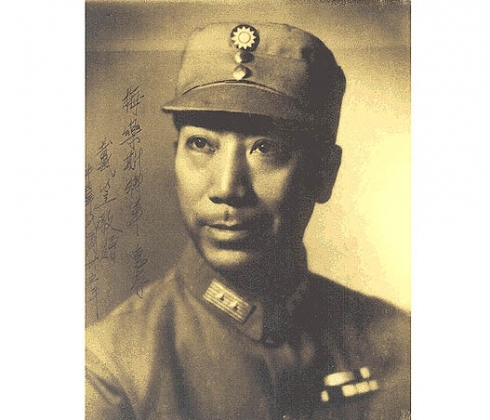
Kind words are written herein by Lt. Commander Charles G. Dobbin regarding the Himmler of the East, General Dai Li(1897 – 1946), founder of China’s secret police under Generalissimo Chiang Kai-shek (1887 – 1975). Written in 1946, this reminiscence concerns the tight cooperation that existed between General Li’s guerrilla units and the American military (Sino-American Co-Operative Organization: S.A.C.O.) during the later years of the Second Sino-Japanese War. Dobbins emphasized how deeply General Dai Li’s intelligence operatives were able to circulate during the period in which U.S. Rear Admiral Milton Mary Miles commanded the S.A.C.O. troops.

The Basket Bags (Quick Magazines, 1952)
1950s Fashion, 1952, Quick Magazine

The Basket Bags
(Quick Magazines, 1952)

They clogged the shelves of every thrift shop, church bazaar and Goodwill outlet throughout all of the 70s and 80s – and during that same period costume designers used them to signify how detached and estranged a feminine antagonist was in dozens of movies and TV productions. We are referring, of course, to the basket bags of the early fifties and their heavy presence in the bric-a-brac shoppes of yore only serve to testify as to how remarkably popular they were as fashion accessories in the land of the free and home of the brave. The attached article from 1952 is illustrated with six images of the various swells of old Palm Beach clinging proudly to their wicker trophies.


(We were delighted to see that basket bags enjoyed a small come-back in the fashion world during the summer of 2017.)

Advertisement

Use shortcode [oma_ad position="summary_top"] (or other position) in your theme or widgets to display OMA Promotions here.

John Gunther Editorial | Korean War was Important | 1950 Korean War Editorial
1950, Quick Magazine, The Korean War

The Importance of Winning
(Quick Magazine, 1950)

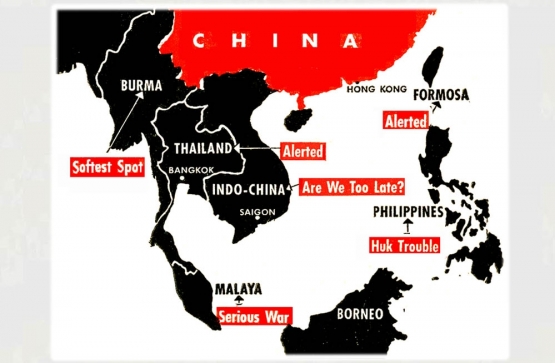
Policy makers in Washington were divided into two groups during the early Cold War days: one held that Communist expansion was most dangerous in Asia while the other believed that Europe was the spot most deserving of attention. This short editorial by John Gunther (1901 – 1970) argued that Asia was the vulnerable zone and if Korea was lost to the Reds – the whole world would follow.

Eastern European Jews Slaughtered (Current Opinion, 1920)
1920, Aftermath (WWI), Current Opinion Magazine

Eastern European Jews Slaughtered
(Current Opinion, 1920)

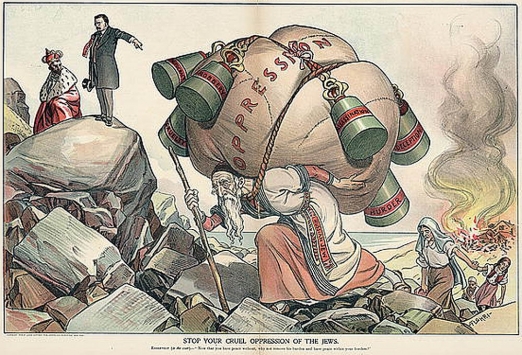
One of the most sinister results of the war has been a new wave of anti-Semitism in Europe. Recent dispatches from Berlin describe street demonstrations against Jews and speak of a veritable pogrom atmosphere in Munich and Budapest. In Poland, Jewish blood has flown freely, amid scenes of horror described by Herman Bernstein and other writers in American newspapers. In Ukraine the number of Jews massacred during the early part of the present year is estimated anywhere from 40,000 to 100,000.

Advertisement

Use shortcode [oma_ad position="summary_top"] (or other position) in your theme or widgets to display OMA Promotions here.

Aircraftman Shaw was Lawrence of Arabia | THE MINT by TE Lawrence Summary and Review
1933, The Literary Digest, Twentieth Century Writers

T.E. Lawrence: Tiresome Literary Celebrity
(Literary Digest, 1933)

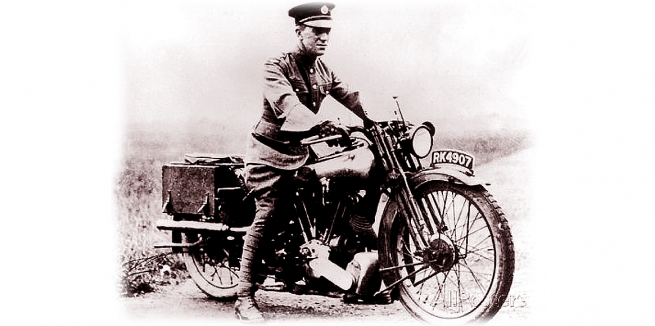
Hannen Swaffer (1879 – 1962), long-time dead British journalist who once presided as the Grand Pooh-Bah of Fleet Street’s chattering classes declared in this editorial that one by one the war heroes of the past are being debunked and now it is Lawrence’s turn…


Read these various accounts that serve as proof that there is a life after this one.

T.E. Lawrence and the Literary Coup of 1935 (Literary Digest, 1935)
1935, The Literary Digest, Twentieth Century Writers

T.E. Lawrence and the Literary Coup of 1935
(Literary Digest, 1935)

The accidental death of T.E. Lawrence (1888 – 1935) triggered an event within the publishing world that was much discussed in all quarters:

THE SATURDAY REVIEW of LITERATURE, weekly guide-post for the literati, last week scooped the world with an air-tight exclusive story that was scheduled to be front page news fourteen years hence. The editorial coup was a review of Thomas Edward Lawrence’s (Lawrence of Arabia) final book, The Mintstyle=border:none, which by the terms of his will was not to be made known to the world until 1950.
Advertisement

Use shortcode [oma_ad position="summary_top"] (or other position) in your theme or widgets to display OMA Promotions here.

A Warning to the West (Pathfinder Magazine, 1948)
1948, Pathfinder Magazine, The Cold War

A Warning to the West
(Pathfinder Magazine, 1948)

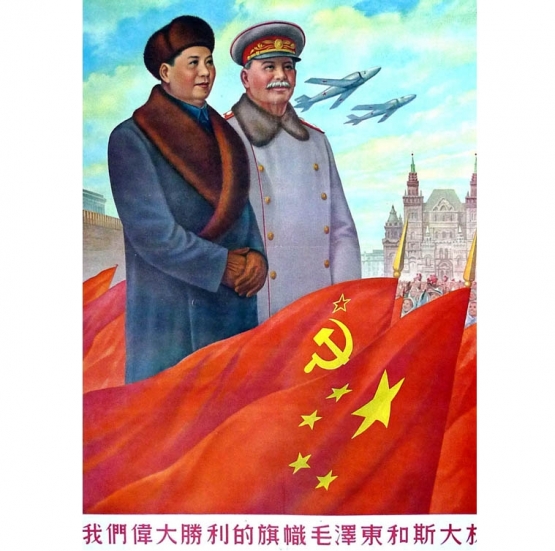
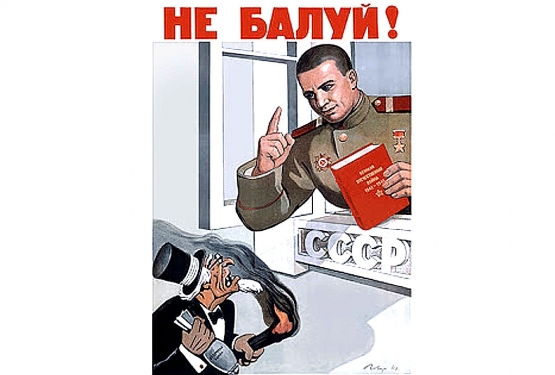
This is a 1948 Soviet poster that foreign correspondents of the day reported as having been widely distributed across the Worker’s Paradise. A veiled piece of patriotic pageantry, it was clearly intended to intimidate the Western democracies; it made its appearance a few weeks into the Berlin Blockade (June, 1948 – May, 1949) – an international stunt that gained the Soviets nothing.

From Amazon:
Iconography of Power: Soviet Political Posters Under Lenin and Stalinstyle=border:none

Would America Beat Russia | USA vs Soviets in W.W. III | Cold War Aircraft Production Article
1951, Pathfinder Magazine, The Cold War

Why America Could Win A War Against Russia
(Pathfinder Magazine, 1951)

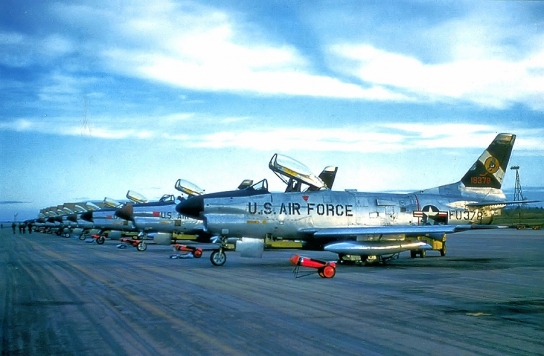
When this article first went to print, American forces had been slugging it out on the Korean peninsula for the past six months – and the American people had genuine concerns about that dust-up snowballing into a much larger conflict. This article was written to remind them that mighty air armadas do not simply appear when necessary; they must be planned and budgeted. The author goes into great depth concerning all the impressive aircraft that was both available in limited numbers and on the drawing boards – but the military-industrial complex would need a lead time of 18 months to produce them in effective numbers.

If we win this war or any part of it, it won’t be due to the wisdom or foresight of our political leaders but to what U.S. industry has heretofore conclusively proved itself capable of – an outright production miracle.


Were Russian MIGS Better Than American Fighter Jets?

School of Fashion Journalism 1936 | First Fashion Journalism Class Introduced in 1936 | Traphagan School Article
1930s Fashion, 1936, The Art Digest

Fashion Journalism Goes Legit
(Art Digest, 1936)

Keeping abreast with current need, the Traphagan School (New York) offers for the first time a course in fashion journalism, which prepares students for positions on magazines and newspapers in advertising departments and agencies where they will interpret in words what they themselves or some other designer relates. The course is conducted by Marie Stark, formerly associate editor of Vogue…

Advertisement

Use shortcode [oma_ad position="summary_top"] (or other position) in your theme or widgets to display OMA Promotions here.

Scroll to Top