Author name: editor

The Birth of Donald Duck (Stage Magazine, 1935)
1935, Stage Magazine, Walt Disney

The Birth of Donald Duck
(Stage Magazine, 1935)

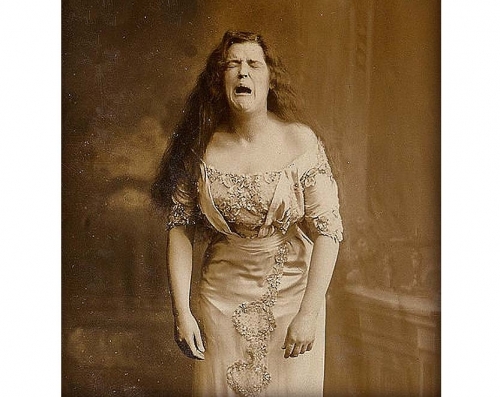
The introduction of Donald Duck in Silly Symphony Number Thirteen had’em rolling in the isles, to be sure – and if you don’t think so, here’s proof from STAGE MAGAZINE’s Helen G. Thompson:

If you didn’t see him in The Orphan’s Benefit, you missed the performance of the generation. Like Bergner’s show, it ran for Donald the whole gamut of his emotions. Voted the toughest duck of the season, Long Island included, and now crashing Europe, a breathless American public awaits his acclaim. Will his fare be raspberries or chuckle-berries? Donald says whatever the decision, he’ll fight.

Warner Brothers Opens Fire on Nazi Germany (Stage Magazine, 1939)
1939, Hollywood, Stage Magazine

Warner Brothers Opens Fire on Nazi Germany
(Stage Magazine, 1939)

STAGE MAGAZINE correspondent Katherine Best was not shy about giving credit where credit was due, as you will read in this article that stands as one big pat on the back for the producers at Warner Brother’s for possessing the testicular fortitude needed to launch the first anti-Nazi movie in Hollywood: Confessions of a Nazi Spystyle=border:none (1939).


In October of 1940, Charlie Chaplin released his anti-fascist masterpiece: The Great Dictator. Click here to read about that.

Advertisement

Use shortcode [oma_ad position="summary_top"] (or other position) in your theme or widgets to display OMA Promotions here.

'The Attack of the Super Novelists'' (Vanity Fair, 1919)
1919, Twentieth Century Writers, Vanity Fair Hall of Fame

‘The Attack of the Super Novelists”
(Vanity Fair, 1919)

In this article, P.G. Wodehouse (1904 – 1975) sounded-off on a new type of novelist that had surfaced in 1919 – and has yet to decamp. He breaks the novelizing classes into two groups:

…the ordinary novelist, the straightforward, horny-handed dealer in narrative, who is perfectly contented to turn out two books a year, on the understanding – a gentleman’s agreement between himself and his public – that he reserves movie rights and is allowed an occasional photograph in the papers..

A Pre-D-Day Interview with General Eisenhower (Yank, 1944)
1944, General Eisenhower, Yank Magazine

A Pre-D-Day Interview with General Eisenhower
(Yank, 1944)

Written in the interest of promoting U.S. Army morale, this is a profile of five-star General Dwight David Eisenhower by an anonymous YANK MAGAZINE journalist. An interesting interview, it was printed six months prior to the Normandy invasion:

General Eisenhower’s rise is surely without parallel in American military history. From colonel to supreme commander and full general in two years – from the ‘mock’ war maneuvers in the delta country of Louisiana to the real maneuvers that face him now as he must figure out the when and how of the attack that must drive to the very heart of Nazi Europe – that is his story.


Click here to read about Hitler’s slanderous comment regarding the glutinous Hermann Goering.

military influence on men s fashion 1917
1917, Magazine Ad, Trench Coats

One of the First Trench Coats for U.S. Civilians
(Magazine Ad, 1917)

No doubt, the fashionable minds who sat so comfortably in America, far removed from the dung and destruction of the European war, would thumb through magazines such as Leslie’s, Collier’s or Current History looking for fashion’s newest thing. How pleased these fops must have been that the ink-stained photogravure boys didn’t let them down! The Brothers Guiterman in Minnesota must have been numbered among these macaronis because they seemed to have been the first to begin production of a trench coat intended solely for civilian production (although it must be remembered that during the war, trench coats were a private purchase item, available only to officers sold only by haberdashers and privately-owned military furnishing establishments).

Advertisement

Use shortcode [oma_ad position="summary_top"] (or other position) in your theme or widgets to display OMA Promotions here.

Christmas Shopping for the Doughboys (Vogue, 1918)
1918, The Stars and Stripes, Trench Coats

A Trench Coat by Thresher and Glenny
(The Stars and Stripes, 1918)

Let the word go out here and now to all stylists and fashion journalists as well as all the other assorted fops who like to play fast and loose with the language; we know who you are and we know your game. The term trench coat will not suffer the same abuse as the word Martini. Both have clear, lucid definitions; there can be no such thing as a chocolate Martini and those actors in the movie The Matrix were not wearing trench coats (they were wearing frocks). A quick waltz through this section illustrates well the characteristics shared by all Great War trench coats: they were double-breasted (although it is said single-breasted did exist), they must be belted, and they must be cut like a sac, and they must have wrist-straps. Raglan sleeves, storm patches and billows pockets were all optional -and most important: there were NO D rings, those were added later.


1934, Golf History, Photoplay Magazine

1930s Golf Attire
(Photoplay Magazine, 1934)

The attached 1933 and 1934 photos will give some indication as to what golf clothes looked like during the early Thirties. Depicted in the first image are four actors of the Hollywood tribe: Adolphe Menjou (clad in plus-fours), a slovenly Johnny Weismuller, Bruce Cabot and Richard Arlen.

Full-cut trousers were the rule of the day, as can clearly be seen in the second photo that was indifferently ripped from the browning pages of Delineator Magazine, which also shows a smashing linen shirtwaist dress that was worn on the Bermuda links.

'The Philosophy of Auguste Rodin'' (Vanity Fair, 1917)
1917, Modern Art, Vanity Fair Hall of Fame

‘The Philosophy of Auguste Rodin”
(Vanity Fair, 1917)

Just prior to the death of Auguste Rodin (1840 – 1917), the Welsh poet and essayist, Arthur Symonsstyle=border:none (1865-1945), reviewed a book written by the French writer, Judith Cladelstyle=border:none (1873-1958) concerning the artist’s work and creative temperament:
AUGUSTE RODIN PRIS SUR LA VIE at once a document and a living thing. The main interest lies in the exactitude with which it records the actual words of Rodin, much as he must have spoken them y

Advertisement

Use shortcode [oma_ad position="summary_top"] (or other position) in your theme or widgets to display OMA Promotions here.

Italian Futurist Manifesto in Vanity Fair Magazine 1915 | Futurist Painters Primary Source
1915, Modern Art, Vanity Fair Hall of Fame

‘Some Italian Futurists with a Past”
(Vanity Fair, 1915)

VANITY FAIR critic James Huneker(1860 – 1921) had a few words regarding the Italian Futurist painters. Huneker stated that he had been following their progress since he first attended a 1912 Futurist exhibit, and in the subsequent years had gained a familiarity with their 1910 manifesto, which he summed up for this articleVanity Fair critic James Huneker(1860 – 1921) had a few words regarding the Italian Futurist painters. Huneker stated that he had been following their progress since he first attended a 1912 Futurist exhibit, and in the subsequent years had gained a familiarity with their 1910 manifesto, which he summed up for this article.

Big Band Happenings in 1944 (Yank Magazine, 1944)
1944, Big Band 1930s-1940s, Yank Magazine

Big Band Happenings in 1944
(Yank Magazine, 1944)

One of the most popular portions of YANK MAGAZINE was a that small corner devoted to the happenings within the Big Band world titled Band Beat. Attached herein is the Big Band news from that department for the Spring of 1944 which kept the far-flung Americans up to date as to what was going on with Vaughan Monroe, Lina Romay, Duke Ellington, Charlie Powell, Jon Arthur, Jimmy Cook, Red Norvo and Bob Strong’s orchestra.

Advertisement

Use shortcode [oma_ad position="summary_top"] (or other position) in your theme or widgets to display OMA Promotions here.

The Great Native-American Athletes of the Early 20th Century (American Legion Magazine, 1940)
1940, Football History, The American Legion Magazine

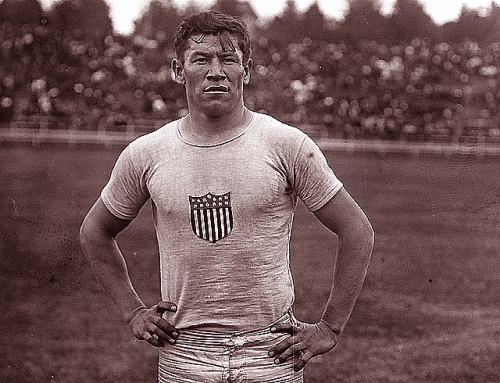
Jim Thorpe and the Carlisle Indians
(American Legion Magazine, 1940)

This football article recounts the glory days of Jim Thorpe (1888 – 1953) and his Carlisle football team as well as a number of other Native-American jocks of lesser fame who were active in other sports during the same time period.

A remarkable all-around athlete, Jim Thorpe at Carlisle Indian School in Pennsylvania was a whiz at reversing his field or skirting an end, and there was bonecrunching power behind his charges into the line. He could punt with any of them and was a good drop kicker. But it was as a place kicker that he was really tops. He rarely missed one.


We recommend this unique college football site

War Guilt Clause Questioned | Mistranslated Versailles Treaty War Clause 231 | Count Ulrich von Brockdorff-Rantzau Mistranslated War Clause
1935, New Outlook Magazine, War Guilt

The Mistranslated Clause
(New Outlook Magazine, 1935)

This surprising article appeared sixteen years after the Versailles Treaty was signed; it argued that the War Guilt clause (article 231) had been deliberately mistranslated by the German Foreign Minister, Count Ulrich von Brockdorff-Rantzau (1869 – 1928):

Brockdorff-Rantzau, coldly, haughtily, in the best German manner but with trembling legs, carried the thick [treaty] back to his hotel and he and his aides made their own translation into German… Count Brockdorff not only exercised his prerogative there; but he inserted words not synonymous with any that the Allies had written.

Advertisement

Use shortcode [oma_ad position="summary_top"] (or other position) in your theme or widgets to display OMA Promotions here.

The U.S. Occupation of Turkey (Pathfinder Magazine, 1920)
1920, Pathfinder Magazine, Versailles Treaty

The U.S. Occupation of Turkey
(Pathfinder Magazine, 1920)

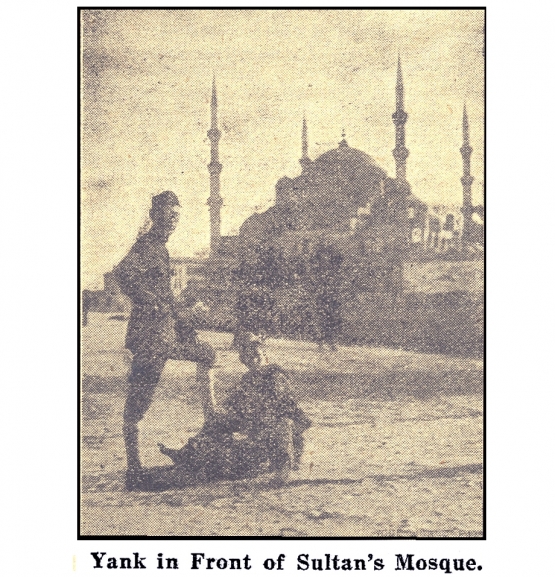
There aren’t many Yanks in Turkey but an American naval force of eight destroyers is being kept in Turkish waters to protect American interests and to assist the British, French and Italian navies before Constantinople to induce compliance by Turkey with the terms of the peace treaty and to serve as a warning to cease her practices against the Armenians in Asia Minor.

The German Rebellion Against the Treaty (Literary Digest, 1923)
1923, The Literary Digest, Versailles Treaty

The German Rebellion Against the Treaty
(Literary Digest, 1923)

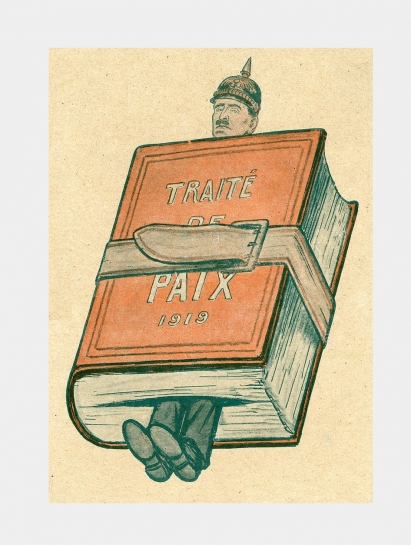
This 1923 German editorial by Professor Rudolf Euken (coincidentally published in THE EUKEN REVIEW) was accompanied by an anti-Versailles Treaty cartoon which attempted to rally the German working classes to join together in rebellion against the treaty.

The so-called Peace of Versailles subjects the German people to unheard-of treatment; has injured and crippled Germany; has, with refined cruelty, deprived her of fertile territories; robbed her of sources indispensable to her existence; has heaped upon her huge burdens, and this for an indenite time – the intention being, if possible, to reduce her people to serfdom.


Click here to read another one of Rudolf Euken’s post-war efforts.


Click here if you would like to read about the 1936 Versailles Treaty violations.

The U.S. First Division at Cantigny (The Stars and Stripes, 1918)
1919, Stars and Stripes Archive, The Stars and Stripes

Remembering Cantigny and Chateau-Thierry
(The Stars and Stripes, 1919)

Monday, June 2 (1919), was a holiday in the 2nd Division in the bridgehead on the Rhine. The anniversary of the battle of Chateau-Thierry was observed. It is just a year ago that infantry and Marines of the 2nd Division were thrown against the Boche on the Paris-Metz road near Chateau-Thierry, and from that moment on the Americans were in continual fighting until November 11.

Advertisement

Use shortcode [oma_ad position="summary_top"] (or other position) in your theme or widgets to display OMA Promotions here.

Scroll to Top