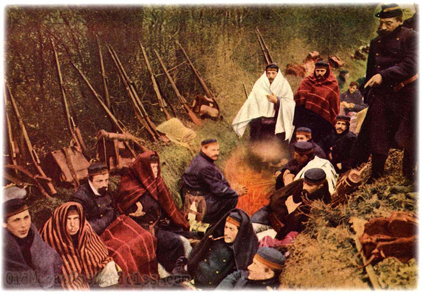
The war has changed many things, and it may have altered conceptions of military smartness as well. For from Paris, the home of ‘mode’ and ‘chic’, comes a daily fashion hint from the front that is upsetting. It is from Henri Barbusse (1873 – 1935), author of the novel Under Fire
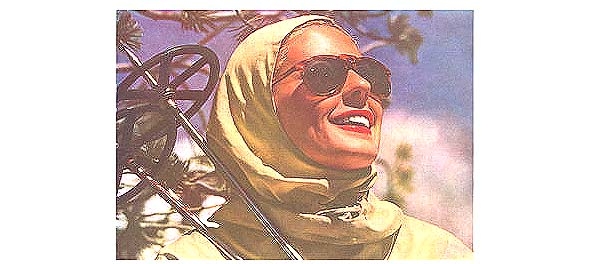
Clipped from the pages of a 1948 issue of COLLIER’S MAGAZINE were these four color pictures of skiers loafing about the slopes in a place that had just recently been discovered for such purposes; it was called Aspen, in Colorado.
You will no doubt notice that there is no real difference between the skiing togs worn by either gender; both wore only wool, jaunty ski sweaters and pegged trousers.
Click here if you would like to read the entire article about Aspen in 1948; there are additional color photographs.
A bitter article written by a Hollywood veteran concerning what was at the time recognized as a growing cottage industry: recreational law suits that lay claim to falsified violations of movie plagiarism. Robert Lord (b. 1902, Best Original Screenplay Oscar in 1932) penned this two page article and outlined it all quite clearly as to how the plagiarism game was played in 1930s Hollywood.
Advertisement
Use shortcode [oma_ad position="summary_top"] (or other position) in your theme or widgets to display OMA Promotions here.
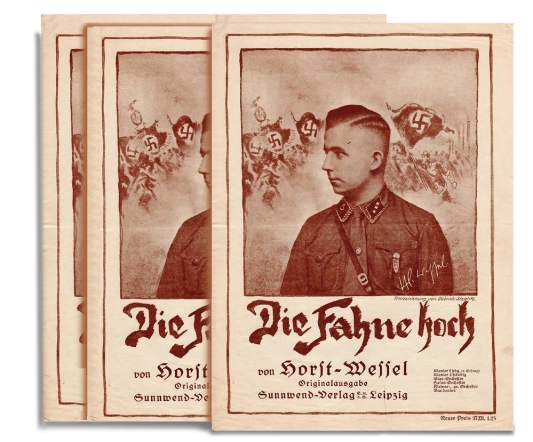
By clicking the title link posted above you will see a photo of what appears to be the Fascist’s answer to the von Trapp Family Singers – but hold, good reader – it was something far more sinister.
This 1939 article from Ken Magazine lays out the real story of the life and death of Nazi storm trooper Horst Wessel (1907 – 1930) – not the one believed by the fascists he left behind:
In Germany, 1930, a pimp killed another pimp for cutting in on his girl’s territory. The slain pimp was a Nazi named Horst Wessel. Then Hitler came into power, and propagandist Goebbels, in need of a ‘Hell-rouser’, dreamed up the Wessel legend, made him an official Nazi martyr-saint.’
When robbing Peter to pay Paul, you can pretty much be guaranteed of Paul’s support come election time.
This 1935 opinion piece went into greater detail on this matter believing that this is (and has been for the past 70 years) the campaign strategy of the Democratic Party.
Not pacifists, but soldiers, have signed what several editors term one of the most striking and remarkable appeals for peace that have come to their tables.
Veterans of the 1914-1918 slaughter called for their respective governments to oppose territorial aggrandizement and demanded that an international court be established to outlaw war; following the establishment of said court, the immediate effort to disarm and disband sea and air forces and destroy the implements of warfare should begin. The American Legion Commander-in-Chief, Alvin Owsley (1888 – 1967), was among the signators.
Click here to read an article about the German veterans of W.W. I.
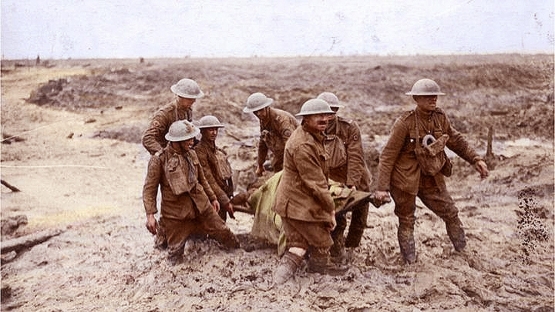
In a letter to his family, a soldier from one of the Scottish territorial regiments gives an account of his experiences fighting in Belgium.
He was in the thick of the fighting that came as a result of the Kaiser’s desperate attempt to take Ypres, yet he indulges in no heroics. He writes as though reporting a cricket game or a boat race.
When only a few wet months were left before all alcohol was banned from the United States, THE NATION reviewed the 1918 Anti-Prohibition Manual and the Year Book of the United States Brewers Association (1917) and came away with this brief, but amusing and informative history of drinking.
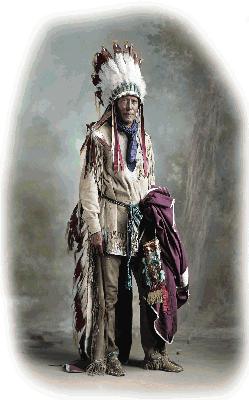
Twenty five years after the long march that has come to be known as the ‘Trail of Tears’, an account of that sad injustice was written by one of the first archeologists of the American south-west, O.K. Davis.
The troops and Indians marched side by side for two days for Fort Bowie. Then, Geronimo, Natchez, and about twenty men…escaped…
The second half of the article is available upon request.
Advertisement
Use shortcode [oma_ad position="summary_top"] (or other position) in your theme or widgets to display OMA Promotions here.
This is an opinion piece written at a time when the world stood at the doorstep of World War II. The writer went to some length to outline the fatal error made just one generation earlier and how the sins were to be paid for by their sons and daughters:
The world of today, an upheaval of antagonisms heading toward destructive war, was not inevitable. Russia need not have fallen to the Bolshevists, Germany to the Nazis, Italy to the Fascists. The United States need not have entered the Great War. Two million men slain in battle need not have died. These consequences resulted from a decision of a few men during the World War.
He argued that the Dardanelles Campaign is where the whole war went sideways.
Click here to read what the Kaiser thought of Adolf Hitler.
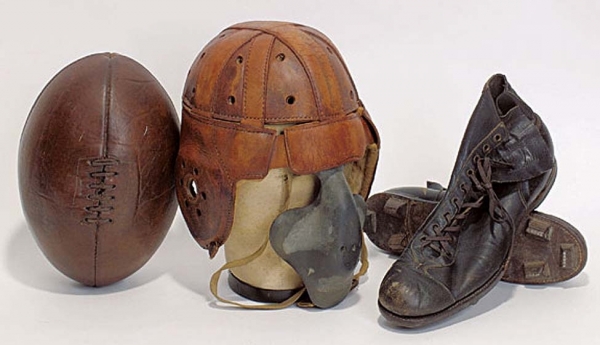
This is a sports article that summarizes the meteoric course of the Green Bay Packers, from their earliest days in 1918, when Curly Lambeau approached a meat packing plant beseeching their patronage in order that the team could have uniforms, to the high perch they held in 1936.
Consider for a moment the success this team has had, coming as it does from the smallest city in the pro league. After battling first division teams in the National Professional Football League for many years, the Packers finally came through and won three successive world championships in 1929, 1930 and 1931… If you were to ask most college football stars which pro team they would like to play on, most of them would invariably answer, ‘The Green Bay Packers‘.
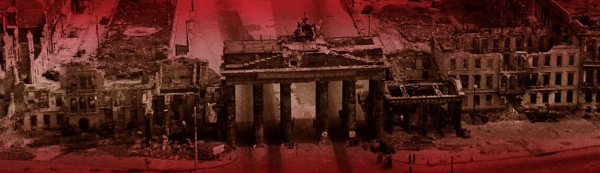
ESPIONAGE is big business in Berlin and has it’s painstaking, pecuniary bureaucracy. It is practiced by small fry (who is willing to procure for you anything from the latest deployment plan of the Red Army to a lock of Hitler’s hair) and by big-time operators who deal nonchalantly and lucratively in international secrets.
Advertisement
Use shortcode [oma_ad position="summary_top"] (or other position) in your theme or widgets to display OMA Promotions here.
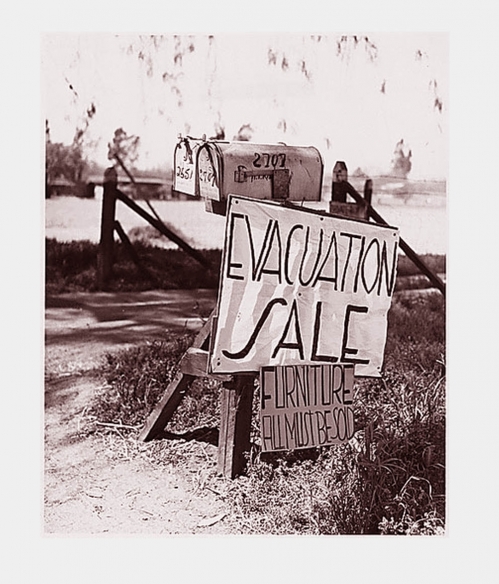
A report from the regional directors of the Resettlement Administration (an arm of the FDR’s Department of Agriculture) stated that:
15,000 farmers have moved out of the Dakotas, Western Kansas and Eastern Montana, leaving soil which because a aridity or exhaustion could not yield any crop… [Having moved to the states of the Pacific Northwestern] Some of them are squatting in shacks and makeshift dwellings made of tree branches, stray boards [and] strips of tin.
An article written by one of the grand old men of football and one of the game’s most legendary coaches: Knute Rockne (1888 – 1931). Before there was the NFL, there was only college football and it was football pioneers like Rockne who brought out the excitement of the game, generating such enthusiasm for the sport and creating a fan-base that grew steadily throughout the century. Just as Redskin Coach Joe Gibbs had The Hogs in the Eighties, Knute Rockne was famous for a group of players in the Twenties called the Four Horsemen (Harry Stuhldreher, Don Miller, Elmer Layden, and Jim Crowley), and that is who the coach wrote about on the attached pages:
Individually, at first, they were just four compact youths, no better than football’s average…Within a season they became famous – the Four Horsemen of Notre Dame…They amazed even their own coach
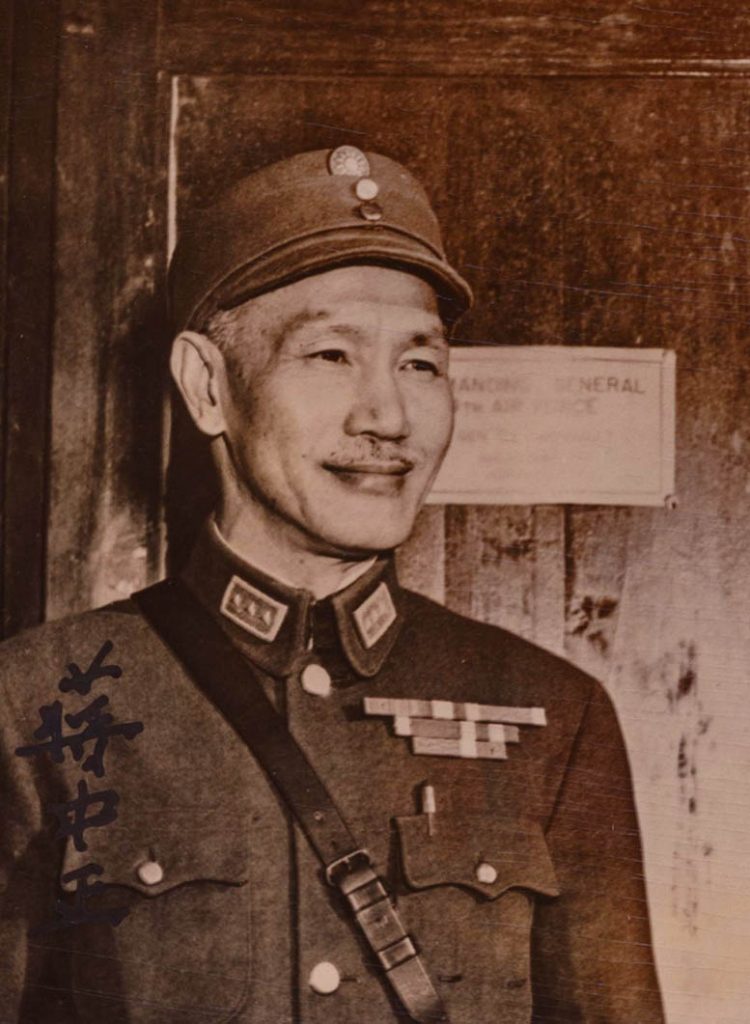
The years 1927 through 1947 has largely been remembered as a victorious era for the Chinese Nationalists in their struggle against the Communist rebels under Mao Zedong (1893 – 1976). However, following Mao’s 1947 retreat to Manchuria and the subsequent training and reforms that took place within his army, the Nationalist Chinese troops began to feel the humiliation of defeat until they made good their strategic withdrawal to Formosa (ie. Taiwan), where they have remained ever since.
This single page article goes into greater detain outlining the chronology of events.
Advertisement
Use shortcode [oma_ad position="summary_top"] (or other position) in your theme or widgets to display OMA Promotions here.