Author name: editor

Football's First Half-Century (Coronet Magazine, 1953)
1953, Coronet Magazine, Football History

Football’s First Half-Century
(Coronet Magazine, 1953)

No one is certain how football came to America. There are those who say it has always been here in the guise of an Indian game like lacrosse; its resemblance to English Rugby is apparent. But the game we know today is uniquely American, its place on the American scene secures. From September until long after the snow falls, Saturday afternoon means the Big Game to millions; and to millions the names of Heffelfinger, Grange, Harmon, Kazmaier and other gridiron greats will never lose their luster. This year [1953], more than 15,000,000 Americans – old grads, subway alumni and just plain football fans – will turn out to see their favorites do battle in a game that bears little resemblance to the scrambling, uncoordinated melees of 50 years ago. This is the story of how football grew up, of its heroes, and of the great games of yesteryear.

The First Five Year Plan (The Literary Digest, 1933)
1933, Soviet History, The Literary Digest

The First Five Year Plan
(The Literary Digest, 1933)

A 1933 magazine article that reported on the success of the Soviet Union’s first (of many) Five Year Plans.


The myriad five year economic development plans dreamed-up by the assorted butchers of the dear dead Soviet Union all had one thing in common that was never lost on the Russian people: they always involved the construction of new factories, but never the construction of new housing.


Additional magazine and newspaper articles about the Cold War may be read on this page.

Advertisement

Use shortcode [oma_ad position="summary_top"] (or other position) in your theme or widgets to display OMA Promotions here.

Sonia Shankman O School in Chicago | Pioneers in Autistic Education
1950, Education, Pathfinder Magazine

‘The O School”
(Pathfinder Magazine, 1950)

The Sonia Shankman Orthogenic School in Chicago turned some heads when it first opened. As you read the attached column you will learn about the unorthodox approach they bring to the subject of educating the autistic and the emotionally disturbed. With the fullness of time it has been revealed that they must be doing something right – it has been in business since 1944.

Advertisement

Use shortcode [oma_ad position="summary_top"] (or other position) in your theme or widgets to display OMA Promotions here.

American Trucks & Armored Cars (Vanity Fair Magazine, 1916)
1916, Inventions and Weapons, Vanity Fair Hall of Fame

Armored Cars and Trucks
(Vanity Fair, 1916)

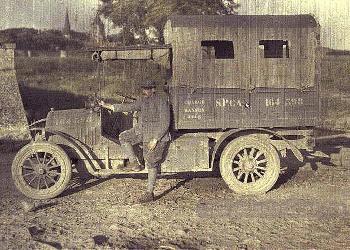
The American trucks and armored cars pictured here were not created specifically for the Great War, but no doubt they were sold to the French and British; a year later these trucks arrived with the A.E.F.. The bull dog that has for so long adorned the hood of the Mack truck dates to this conflict -the bull dog was the nick-name bestowed upon that vehicle by the Tommies.

Recognizing the importance of armored vehicles, a group of American Millionaires, among them Henry Clay Frick (1849 – 1919), pooled their money and donated a number of such items to the New York National Guard. Vanity Fair Magazine followed this story and produced this article as it developed with a thorough review of each of the donated military vehicles. Although the trucks are photographed, few are named.

Advertisement

Use shortcode [oma_ad position="summary_top"] (or other position) in your theme or widgets to display OMA Promotions here.

Franklin D Roosevelt Third Term Election Magazine Article
1940, F.D.R., Pathfinder Magazine

FDR’s Third Term: Vox Populi
(Pathfinder Magazine, 1940)

Here are the results of PATHFINDER MAGAZINE‘s 1940 poll concerning FDR’s controversial run for a third term. The pollsters were interested in discovering the voter’s thoughts on the third term as a concept for future presidents – rather than gaining a better understanding as to the popularity of President Roosevelt.


The poll considered the opinions of citizens who voted for FDR in 1936 and those who sided with Republican Alf Landon in the same election. They concluded that 68.6% of poll’s participants were against a third presidential term.

Advertisement

Use shortcode [oma_ad position="summary_top"] (or other position) in your theme or widgets to display OMA Promotions here.

1951 Hats | 1951 Fashion Hats
1950s Fashion, 1951, Collier's Magazine

The Milliner’s Collaboration
(Collier’s Magazine, 1951)

In 1951 the finest minds in American millinery were asked to put their collective craniums together and design some hats; each brought something unique to the table – the most humorous design element that appeared in each hat included a telephone!

Collaborators in the struggle to produce a taller plume, a more involved bird’s nest, are the hat designer’s – to whom carrots and cornstalks, bean bean pods and bumper-shoots are all perfectly acceptable decorations for the head.

The Long Haul (Quick Magazine, 1951)
1951, Quick Magazine, The Korean War

The Long Haul
(Quick Magazine, 1951)

By the Winter of 1951 another round of cease-fire and truce agreements between UN and Communist field commanders had once again come to naught – and America’s second Thanksgiving in Korea soon gave way to America’s second Christmas in Korea. This brief column lays out what went wrong in the last negotiations and American Secretary of State Dean Acheson declared that the U.S. would remain in Korea even after a peace agreement has been signed.

Advertisement

Use shortcode [oma_ad position="summary_top"] (or other position) in your theme or widgets to display OMA Promotions here.

Inadequacies in Combat Training (Yank Magazine, 1945)
1945, Combat Training, Yank Magazine

Inadequacies in Combat Training
(Yank Magazine, 1945)

Training for combat, according to veterans in Italy, should be a hell of a lot more realistic and a hell of a lot more thorough.

‘They oughta learn them guys’ is that favorite beef you hear from combat veterans when they talk about replacements who have just joined their outfits…the average replacement doesn’t know enough about the weapons an infantryman uses. ‘He usually knows enough about one or two weapons…but he should know them all. He may know how to use and take care of the M1 or carbine, but if you need a BARman or machine-gunner quick, you’re up a creek.’


Statistical data concerning the U.S. Army casualties in June and July of 1944 can be read in this article.

Advertisement

Use shortcode [oma_ad position="summary_top"] (or other position) in your theme or widgets to display OMA Promotions here.

Scroll to Top