





Freedom's Triumph Articles
Outing Magazine Articles
47 Magazine Articles
Click Magazine Articles
PM Tabloid Articles
The New York Times Articles
G.I. Joe Magazine Articles
The Flapper Magazine Articles
The North American Review Articles
Vogue Magazine Articles
The Atlantic Monthly Articles
Current Literature Magazine Articles
The New Republic Articles
Creative Art Magazine Articles
Theatre Arts Magazine Articles
Outlook Magazine Articles
The American Legion Monthly Articles
Punch Magazine Articles
Confederate Veteran Magazine Articles
Collier's Magazine Articles
The Smart Set Articles
Sea Power Magazine Articles
The American Legion Weekly Articles
The Saturday Evening Post Articles
Rob Wagner's Script Magazine Articles
The Dial Magazine Articles
Direction Magazine Articles
The Film Spectator Magazine Articles
People Today Magazine Articles
La Baionnette Articles
Touchstone Magazine Articles
Hearst's Sunday American Articles
Vanity Fair Magazine Articles
Newsweek Articles
Scribner's Magazine Articles
Trench Warfare Articles
Harper's Weekly Articles
Liberty Magazine Articles
The Saturday Review Articles
Life Magazine Articles
Film Daily Magazine Articles
Photoplay Magazine Articles
The National Park Service Articles
Harper's Bazaar Magazine Articles
Ken Magazine Articles
Men's Wear Magazine Articles
Confidential Magazine Articles
Leslie's Magazine Articles
Pic Magazine Articles
Stage Magazine Articles

F.D.R.

The Twilight of the New Deal
(United States News and World Report, 1946)

The crusading spirit that Franklin D. Roosevelt was able to summon up in the minds of Government employees at the outset of his first administration, and again in the years that followed, now is vanishing. The spirit and imagination of Mr. Roosevelt brought into public service would not have been there.

It was this quality that captured the enthusiasm of engineers like J.A. Krug; of lawyers like Oscar S. Cox, Ben Cohen and Thomas Corcoran; of economists like Robert Nathan, Launchlin Curie, Leon Henderson and Isadore Lubin.

Integrating the Home Front
(Collier’s Magazine 1941)

Although the Roosevelt administration believed that integrating the armed forces was far too risky a proposition during wartime, it did take one important step to insure that fair hiring practices were followed by all businesses that held defense contracts with the Federal government; during the summer of 1941, while American industry was still fulfilling its roll as the arsenal of democracy, a Federal law was passed that criminalized racist hiring practices. The attached editorial from Collier’s Magazine applauded the President for doing the right thing.


Read an anti-Gandhi article from 1921…

The 1940 Election Polls and FDR
(Coronet Magazine, 1941)

The attached article was written by Dr. George Gallup (1901 – 1984), the pioneering American pollster and founder of the Institute of Public Opinion. Gallup’s article reveals some surprising information about American voters and their thoughts concerning FDR’s 1940 bid for re-election against Wendell Willkie (1892 – 1944).

Advertisement

Use shortcode [oma_ad position="summary_top"] (or other position) in your theme or widgets to display OMA Promotions here.

The Champ is Gone
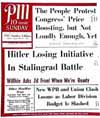
(PM Tabloid, 1945)

This highly personal column appeared in one of New York City’s evening papers and seemed characteristic of the feeling experienced by much of the U.S. after hearing about the unexpected death of President Roosevelt.
Written by Joe Cummiskey, the column stands out as the type of remembrance that is thoroughly unique to those who write about sports all day long, which is who Mr. Commiskey was:

Somehow or other, if you were in sports, you never thought of FDR so much as connected with the high office which he held. Rather, you remembered him most the way he’d chuckle, getting ready to throw out the the first ball to open the baseball season. Or how he’d sit on the 50 at the Army-Navy game…

His Female Chief-of-Staff
(Literary Digest, 1938)

Missy Le Hand (1896 – 1944) was a pretty big deal in the life of President Franklin Roosevelt. FDR had many secretaries, but only one was a woman (and she was the first woman to ever serve in this capacity to a U.S. president). When the Germans attacked Poland, the State Department called her first, knowing full well that she was the only one in the White House with the permission to wake him up. Although this article lists many of the personal tasks she was charged with, it should be known that Missy Le Hand was the target of many Washington influence-peddlers.

Sam Rosenman: FDR’s Right Arm
(Coronet Magazine, 1944)

Samuel Rosenman (1896 – 1973) was an attorney, judge and a highly placed insider within the ranks of the Democratic Party, both in Albany and the nation’s capital. It was Rosenman who helped articulated many of FDR’s policies, wrote numerous executive orders and conceived of the moniker New Deal. He was the first lawyer to hold the position White House Counsel and he was an indispensable advisor to Roosevelt throughout the course of his New York governorship as well as his presidency.

Advertisement

Use shortcode [oma_ad position="summary_top"] (or other position) in your theme or widgets to display OMA Promotions here.

The GIs Hear About the Death of President Roosevelt
(Yank Magazine, 1945)

Gathered from all the various battlefronts around the globe, the attached article serves as a archive of spontaneous reactions uttered by a smattering of stunned GIs when they heard that President Roosevelt had died:


Pvt. Howard McWaters of Nevada City, California, just released from the hospital and waiting to go back to the Americal Division, shook his head slowly. ‘Roosevelt made a lot of mistakes,’ he said. ‘But I think he did the best he could, and when he made mistakes he usually admitted it. Nobody could compare with him as President.’


Click here to read about President Harry Truman…

Advertisement

Use shortcode [oma_ad position="summary_top"] (or other position) in your theme or widgets to display OMA Promotions here.

FDR’s Funeral
(Yank Magazine, 1945)

Here is a series of articles from YANK magazine that reported on the funeral of President Franklin Delano Roosevelt. One of these four correspondents was assigned to write about the general sense of loss that New Yorkers felt upon learning of the death of their president:


Not in my lifetime or in yours, will we again see see such a man.


CLICK HERE… to read the obituary of President Kennedy.

He Re-Organized
(Literary Digest, 1937)

Congressional eyes bulged last January when President Roosevelt handed Congress his plan to streamline the executive branch of the Government. He asked for sixspecial assistants, two new cabinet officers, an auditor general (to supplant the all-powerful Controller General), a reshuffling and consolidation of boards and bureaus and an expansion of the civil service in all directions.

Advertisement

Use shortcode [oma_ad position="summary_top"] (or other position) in your theme or widgets to display OMA Promotions here.

A Cartoonist Slams FDR
(Click Magazine, 1939)

Rube Goldberg (1883 – 1970), one of the iconic, Grand Master ink slingers from days of yore, applied his signature thought pattern to presidential politics in the creation of the attached FDR cartoon. Unlike President Roosevelt, Goldberg recognized that the New Deal was naive in their belief they could create and fund numerous government agencies that bedevil small businesses, reduce productivity, and fix prices while expecting the whole time that the national economy would bloom as a result.

John Nance Garner on F.D.R.
(Collier’s, 1948)

A printable article by John Nance Garner (1868 – 1967), FDR’s first Vice-President (1933 – 1941), who wrote a number of pieces for the readers of COLLIER’S MAGAZINE in 1948 outlining the various reasons for their contentious relationship.

Cactus Jack Garner bickered with F.D.R. on a number of issues; primarily supporting a balanced federal budget and opposing F.D.R.’s efforts to pack the Supreme Court. Within these attached pages, Garner tells how Roosevelt lost the support of his Democratic Congress.


Read about FDR’s African-American advisers here…

Advertisement

Use shortcode [oma_ad position="summary_top"] (or other position) in your theme or widgets to display OMA Promotions here.

Inside Hyde Park
(Confidential Magazine, 1954)

Appearing in CONFIDENTIAL MAGAZINE during the early months of 1954 were these pages from a memoir that was written by the sergeant who rode herd on the New York Police Security Detail for President Franklin Roosevelt. As far as we can figure, Prisoner at Hyde Park by New York State Policeman Edward J. Dougherty was never published, but as you will soon read, it was full of many obscure and unheard of stories of FDR and the world he dominated while in the Empire State.

Roosevelt Takes Charge…
(The Literary Digest, 1933)

This 1933 magazine article anticipating the reign of FDR appeared on the newsstands on the same day as the man’s first inauguration. The article is composed of various musings that had been published in numerous papers across the economically depressed nation as to what manner of leadership might the Americans expect from their new President.

No President has ever inherited such a load of problems and responsibilities as Roosevelt.

Click here to read President Hoover’s
farewell warning to the nation.

The Navy Mourned
(Newsweek, 1945)

It was no secret around Washington that President Franklin Roosevelt was partial to the U.S. Navy. The admirals and other senior officers of the navy certainly knew – and loved it. The attached essay was an appreciative salute to FDR composed shortly after his death by Admiral William Pratt (1869 – 1957):

Other men, military in training and veterans of successful land campaigns, have sat in the White House, but never before in the history of our country has any man ever sat there whose instincts at heart were essentially those of a sailor.

Advertisement

Use shortcode [oma_ad position="summary_top"] (or other position) in your theme or widgets to display OMA Promotions here.

Scroll to Top