Author name: editor

New York Theatre in the Forties (Yank Magazine, 1945)
1945, Old New York History, Yank Magazine

New York Theatre in the Forties
(Yank Magazine, 1945)

An article about New York’s Broadway theater scene during the Second World War:

Show people will never forget the year 1944. Thousands of men and women from the legitimate theater were overseas in uniform -actors and actresses, writers, scene designers, stage hands – and all looked back in wonderment at what war had done to the business… Letters and newspapers from home told the story. On Broadway even bad shows were packing them in…


Click Here to Read an Article About KKK Activity in New York City

Bernie Sanders Socialist Birthplace | What was Brooklyn Like During WW2
1945, Old New York History, Yank Magazine

Brooklyn During Wartime
(Yank Magazine, 1945)

Written for those far-flung, home-sick Brooklynites of yore who were cast hither and yon in order to repel the forces of fascism, this two page article from 1945 is illustrated with seven pictures of a Brooklyn that had been out of sorts since the close of the 1944 baseball season, when the Dodgers had finished 42 games behind.

Six Color Photos of 1940 Manhattan (Click Magazine, 1940)
1940, Click Magazine, Old New York History

Six Color Photos of 1940 Manhattan
(Click Magazine, 1940)

If you’ve been wandering the internet hoping to get some idea what the fair isle of Manhattan looked like on 1940s color film, then your search is over (for a little while). These color images first appeared in a 1940 issue of Click Magazine and you will get a glimpse of the Bowery, Broadway, and Fifth Avenue -there are also two color pictures of New York at night for all of you wanted to see what the door man at El Morocco wore or the club-crawlers in Harlem.

Advertisement

Use shortcode [oma_ad position="summary_top"] (or other position) in your theme or widgets to display OMA Promotions here.

New York Beneath a Bombsight (Coronet Magazine, 1941)
1941, Coronet Magazine, Old New York History

New York Beneath a Bombsight
(Coronet Magazine, 1941)

When this article hit the newsstands, W.W. II was in full swing throughout many parts of Asia, Europe and North Africa. America had not yet committed itself to the war, but the grim, far-seeing souls who ran New York City recognized that it was inevitable – and much to their credit, they had been studying the possibility of New York City air raids since 1939.


Another article about wartime N.Y. can be read here…

Click here to learn about the New Yorkers who volunteered to fight the Germans and Japanese in W.W. II.

Has Germany Forgotten Anne Frank? (Coronet Magazine, 1960)
1960, Aftermath (WWII), Coronet Magazine

Has Germany Forgotten Anne Frank?
(Coronet Magazine, 1960)

In this article the proud father of Anne Frank, Otto Frank (1889 – 1980), explains that by the late Fifties it seemed more and more teenagers were contacting him to say that very few parents or teachers seemed willing to discuss the Nazi years in Germany. These inquiries were too often dismissed as bothersome or simply brushed away with hasty answers like, The Nazis built the Autobahns.


Otto Frank points out that this was not always the case, and goes on to recall that there existed a more sympathetic and regretful Germany for at least a decade after the war. Yet, in 1960 he sensed that there existed a subtle movement to whitewash Hitler; a battle was being waged for the mind of this teenage generation.


From Amazon: A German Generationstyle=border:none


Click here to read about the inmate rebellions that took place at Auschwitz, Sobibor and Triblinka.

Advertisement

Use shortcode [oma_ad position="summary_top"] (or other position) in your theme or widgets to display OMA Promotions here.

Brazil Goes to War (Click Magazine, 1942)
1942, Click Magazine, World War Two

Brazil Goes to War
(Click Magazine, 1942)

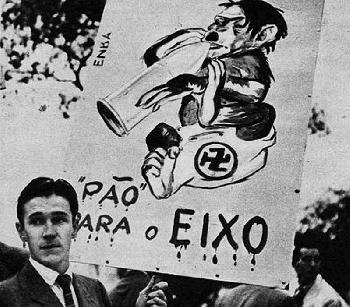
The government of Brazil declared war on Hitler’s Germany on August 22, 1942, and you’d best believe that the over-paid photographers of CLICK MAGAZINE were Johnny-on-the-spot to document all the joyous mayhem that let loose on those flag-strewn boulevards of the Brazilian capitol:

Brazilians are fighting mad. When Brazil joined the United Nations in war on August 22nd, the formal declaration was a climax to the democratic action of its citizens who began, months ago, to let the world know how they felt about the Axis.

The pent-up rage of a sorely-tried nation burst in earnest when war was declared. With unanimous enthusiasm, the people mobbed the streets, cheering everything that was part of the Allied cause…Day after day, anti-fascist demonstrations, and pageants choked the streets of Rio de Janiero, where the pictures on this page were taken.


On that day, Brazil became the 32nd nation to declare war against Germany.

*Read a 1944 Article About the Brazilian Army in Italy*

The Lampooning of Picasso (Literary Digest, 1913)
1913, Cubism, The Literary Digest

The Lampooning of Picasso
(Literary Digest, 1913)

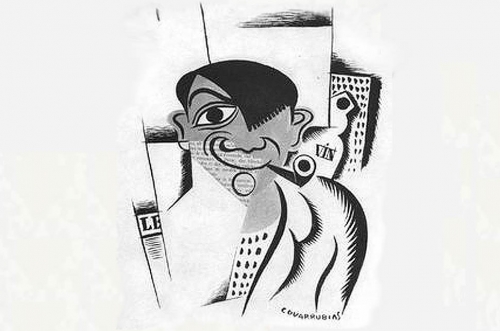
A child could do that has been one of the most common utterances in response to the avant-garde movements of modern art. This short article reflects that view and was written in response to the New York Armory Show, which at that time, was attracting a good deal of attention in the press. The Armory Show is well-remembered today as the first art exhibition to introduce European-style modernism to the people (and artists) of that city. Pablo Picasso (1881 – 1973), as the co-creator of Cubism, is among those lampooned, as is Marcel Duchamp (1887 – 1968) for his painting, A Nude Descending the Staircase.


Another Picasso article can be read here…

Advertisement

Use shortcode [oma_ad position="summary_top"] (or other position) in your theme or widgets to display OMA Promotions here.

French Amazement at American Esteem of Lafayette (Current Opinion Magazine, 1922)
1922, Current Opinion Magazine, World War One

French Amazement at American Esteem of Lafayette
(Current Opinion Magazine, 1922)

France has discovered Lafayette in this age only because America never forgot him


The attached article reported that the Marquis de Lafayette (Marie-Joseph-Paul-Yves-Roch-Gilbert du Motier de Lafayette, 1757 – 1834), who seemed heaven-sent when he appeared in Philadelphia in order to aid the Americans in their revolt against the British, had been largely forgotten by the French in the Twentieth Century. Indeed, the French were baffled to hear his name invoked as often as it was during the period of America’s participation in the World War One.
It was said that during the war some disgruntled wit in the American Army woke up one morning in the trenches and grumbled: Alright, we paid Lafayette back; now what other Frog son-of-a-bitch do we owe?
Oddly, there is no mention made whatever of that unique trait so common to the Homo Americanus- selective memory: during the 1870 German invasion of France there seemed to have been no one who recalled Lafayette’s name at all.

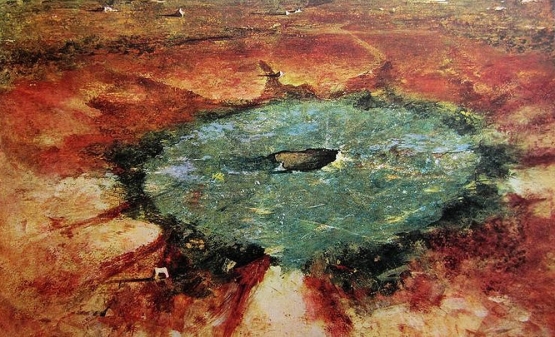
Major General Leslie R Groves Gave Tours of Trinity Test Site | First Reporters to Visit Trinity Test Site New Mexico 1945
1945, Atomic Bombs, PM Tabloid

Ground Zero, New Mexico
(PM Tabloid, 1945)

Weeks after the atomic blast that took place over the city of Nagasaki, American Journalists were allowed to see the crystalized ground that was the Trinity test site in New Mexico. They pocketed the queer pieces of glass that made up ground zero and openly mocked the Japanese scientists who said the radioactivity in Hiroshima and Nagasaki was continuing to kill four weeks later.

How Tokyo Learned of Hiroshima (Coronet Magazine, 1946)
1946, Atomic Bombs, Coronet Magazine

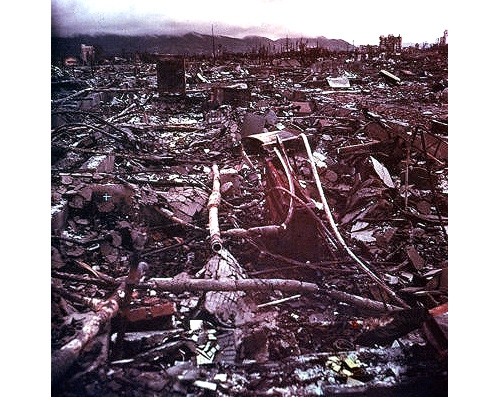
How Tokyo Learned of Hiroshima
(Coronet Magazine, 1946)

Shortly after Tokyo’s capitulation, an advance team of American Army researchers were dispatched to Hiroshima to study the effects that the Atom Bomb had on that city. What we found most interesting about this reminiscence was the narrative told by a young Japanese Army major as to how Tokyo learned of the city’s destruction:

Again and again the air-raid defense headquarters called the army wireless station at Hiroshima. No answer. Something had happened to Hiroshima…

Advertisement

Use shortcode [oma_ad position="summary_top"] (or other position) in your theme or widgets to display OMA Promotions here.

Lampooning the American Tourists (Punch, 1922)
1922, Foreign Opinions About America, Punch Magazine

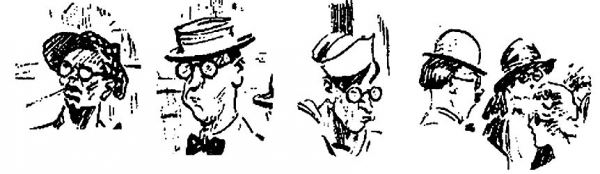
American Tourists Lampooned by Punch
(Punch Magazine, 1922)

This gag concerns itself with another kind of American Expeditionary Force; when Pershing’s Doughboys left, they were replaced by the American tourists. The U.S. had had invented a new category of tourist that the world had never seen before, and they must have been a site to behold: middle class tourists.


There is another article on this site (click here) that states a popular belief held by the Europeans of 1919 that American men were all clean shaven, tended to sport gold teeth, and were most easily recognized by their big tortoise shell glasses (a strikingly accurate description of this site’s editor!); however, this is the first visual manifestation of this caricature that we could find. This Punch cartoonist did not simply believe that this was a fitting description of the white guys, but black guys, too -and the white women as well; an entire nation resembling Harold Lloyd.


Click here to read about Punch Magazine.

Nazi Art Plunder (Click Magazine, 1943)
1943, Click Magazine, The Nazis

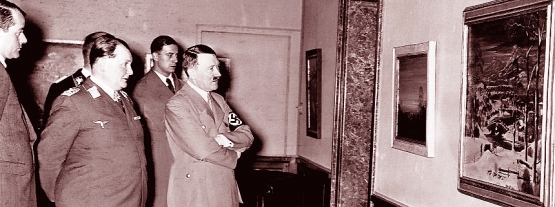
Nazi Art Plunder
(Click Magazine, 1943)

The attached article tells the story of an organization that was formed by the German Foreign Office in order to steal the treasures of the occupied European nations. It was called the Nazi Art Corps and it was divided into four battalions of SS men; they stole manuscripts, sculpture, paintings, jewels etc, etc, etc. They answered to the Reich Minister of Foreign Affairs, Joachim von Ribbentrop (1893 – 1946).


Click here to read about the inmate rebellions that took place at Auschwitz, Sobibor and Triblinka.

Advertisement

Use shortcode [oma_ad position="summary_top"] (or other position) in your theme or widgets to display OMA Promotions here.

How I was Saved (Coronet Magazine, 1951)
1951, Coronet Magazine, Titanic History

How I was Saved
(Coronet Magazine, 1951)

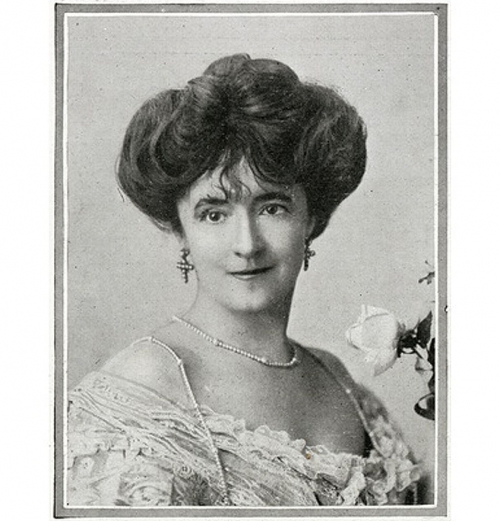
No doubt, the most glam passenger to survive the Titanic disaster was the fashion designer Lady Duff-Gordon (1863 – 1935: a.k.a. Lucile). Attached is the great couturier’s account describing the pandemonium she witnessed on deck, the screams heard as Titanic began her plunge and the sun coming up the next morning:

I shall never forget the beauty of that April dawn, stealing over the cold Atlantic, lighting up the icebergs till they looked like giant opals. As we saw other boats rowing alongside, we imagined that most passengers on the Titanic had been saved, like us; not one of us even guessed the appalling truth…

The Plot to Restore the Corset (The New Republic, 1922)
1922, Flappers, The New Republic

The Plot to Restore the Corset
(The New Republic, 1922)

A shewed observer of fashion, Mary Alden Hopkins (1856 – 1930) noted how the Victorian dinosaurs who lorded-over the male-dominated, pro-corset fashion industry had attempted (unsuccessfully) to manipulate and coerce the shoppers of the early Twenties to reject the Chanel-inspired revolt that the young flappers were currently enjoying.

How can I sell these styles?…the flappers won’t buy them.

Advertisement

Use shortcode [oma_ad position="summary_top"] (or other position) in your theme or widgets to display OMA Promotions here.

Scroll to Top