Author name: editor

PM Tabloid Newspaper History | Ralph Ingersoll Famous Magazine Editor
1940, Click Magazine, Magazines

PM: the Evening Tabloid
(Click Magazine, 1940)

PM (1940 – 1948) was a left-leaning, New York-based evening paper that enjoyed some notoriety across the fruited plane on account of its founding editor, Ralph Ingersoll (1900 – 1985), who liked to believe that his steady mission was to create A tabloid for literates:


Contributors included Theodor Geisel (aka Dr. Seuss), I. F. Stone, Ad Reinhardt, J.T. Winterich, Leane Zug‐Smith, Louis Kronenberger and Ben Hecht; the photographs of Margaret Bourke‐White and Arthur Felig (aka Weegee) appeared regularly. Occasional contributors included Erskine Caldwell, Myril Axlerod, McGeorge Bundy, Saul K. Padover, Heywood Broun, James Thurber, Dorothy Parker, Ernest Hemingway, Eugene Lyons, Earl Conrad; Ben Stolberg, Malcolm Cowley.


Preferring to rely more on subscribers than advertisers, PM only lasted eight years.

1945, Home Front, Yank Magazine

Home Front Teen Slang
(Yank Magazine, 1945)

A 1945 Yank Magazine article concerning American teen culture on the W.W. II home front in which the journalist/anthropologist paid particular attention to the teen-age slang of the day.

Some of today’s teenagers —pleasantly not many — talk the strange new language of sling swing. In this bright lexicon of the good citizens of tomorrow, a girl with sex appeal is an able Grable or a ready Hedy. A pretty girl is whistle bait. A boy whose mug and muscles appeal to the girls is a mellow man, a hunk of heart break or a glad lad.


To read about one of the fashion legacies of W.W. II, click here…


Click here to learn how the Beatniks spoke.
Click here if you would like to read a glossary of WAC slang terms.

•Suggested Reading• Flappers 2 Rappers: American Youth Slangstyle=border:none

Advertisement

Use shortcode [oma_ad position="summary_top"] (or other position) in your theme or widgets to display OMA Promotions here.

Greta Garbo's First Impressions of Hollywood (Photoplay Magazine, 1930)
1930, Greta Garbo, Photoplay Magazine

Greta Garbo’s First Impressions of Hollywood
(Photoplay Magazine, 1930)

Greta Garbo (1905 – 1990) was well known for keeping to herself and preferring to act on movie sets free of executives, pals and all sorts of other hangers-on and she was very famous for refusing to grant members of the press corps interviews. With that in mind, it is a wonder that Katherine Albert of PHOTOPLAY MAGAZINE was able to piece enough together for this 1930 article:

She has no place in the life of Hollywood. She has never adapted herself to it.


Garbo will continue to remain an enigma…


Click here to read about early cosmetic surgery in Hollywood.

General George C. Marshall Profile 1940 | General George C Marshall Before WW II
1940, General Marshall, The American Magazine

General George C. Marshall
(American Magazine, 1940)

A brief 1940 profile of the man President Roosevelt preferred over 33 other generals of higher grade: General George C. Marshall (1880 – 1959):

His most spectacular military feat occurred during the [First] World War, when, as operations chief of the First Army, he moved 500,000 men and 2,700 pieces of artillery from one battlefield to another without a hitch and without letting the enemy get wind of what he was doing.

Common Argument Against Socialism | Argument Against Democratic Socialism
1894, The Literary Digest, The Nanny State

Who Pays the Bills Racked-Up in a Socialist State?
(Literary Digest, 1894)

This article was written long before the crumbling Euro and the economic collapse of Greece, Spain, Portugal, Venezuela, East Germany and the USSR – it is an 1894 editorial that outlines why socialism cannot not work:

He insists that all previous Social evolutions have meant an improvement in production and an increase in income, but the peculiarity of the Socialistic programme is that “it is to be not a money-making, but a money-spending evolution,” in which “everybody is to live a great deal better than he has been in the habit of living, and to have far more fun.


This 1946 article argued that Socialism is simply un-American

Advertisement

Use shortcode [oma_ad position="summary_top"] (or other position) in your theme or widgets to display OMA Promotions here.

Discovered: The Tomb of King Tutankhamun (Literary Digest, 1923)
1923, Miscellaneous, The Literary Digest

Discovered: The Tomb of King Tutankhamun
(Literary Digest, 1923)

One of the first American magazine articles heralding the November 4, 1922 discovery of the ancient tomb of King Tutankhamen (1341 BC – 1323 BC) by the British archaeologist Howard Carter (1874 – 1939); who was in this article, erroneously sited as an American:

What is thought may prove the greatest archeological discovery of all time has recently been made in Egypt, in the Valley of the Kings, near Luxor. Two chambers of a tomb have been found filled with the funeral paraphernalia of the Egyptian King Tutankhamen, and hopes are entertained that the third chamber, yet unopened, may contain the royal mummy itself.

Advertisement

Use shortcode [oma_ad position="summary_top"] (or other position) in your theme or widgets to display OMA Promotions here.

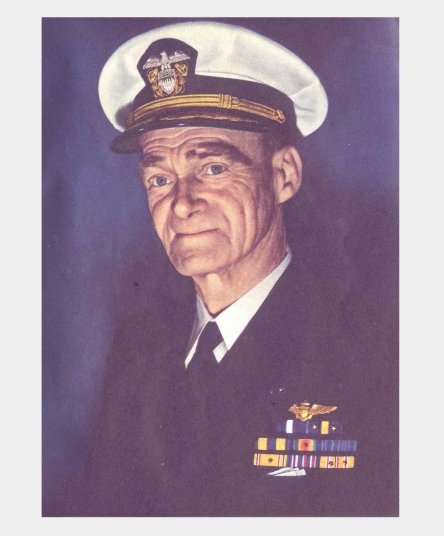
marc andrew mitscher
1945, Coronet Magazine, War at Sea

Admiral Mitscher, U.S.N.
(Coronet Magazine, 1945)

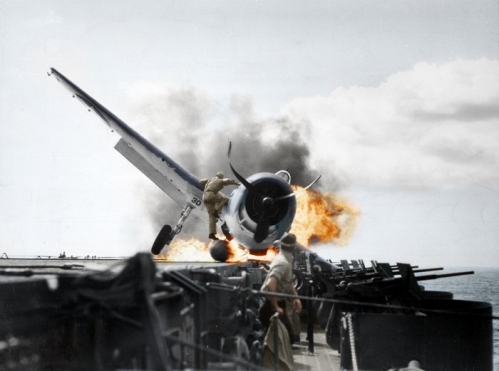
Admiral Pete Mitscher was one of the primary architects of American naval aviation during the 20th Century.In this column, one of the officers who served under him during the admiral’s command of carrier Task Force 58 recalls why he came to admire the man as deeply as he did.
One of Admiral Pete Mitscher’s officers recalls the man with tremendous admiration:

They used to think a carrier was a hit-and-run fighter, but Pete changed that. He said, ‘Hit’em and stay. Hit’em again tomorrow. And he did.’


Click here to read about Admiral Nimitz…

WW II Convoy Shipping | WW II War Shipping Administration Article | Lend Lese Shipping to Allies
1944, Collier's Magazine, War at Sea

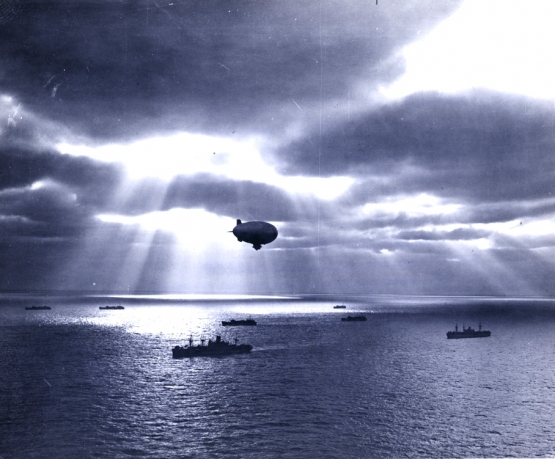
The Atlantic Convoys
(Collier’s Magazine, 1944)

The War Shipping Administration is never at a loss for an answer when asked what’s been authorized, what’s in the works, what’s been shipped and where everything is at the moment? Nevertheless, the Transportation Inventory Department is a tidy place, with no visible signs of agitation. The TID has never lost so much as a bolt. Once it took twenty-two weeks to find a couple of airplane engines which had got themselves lost.

The Lack of German Naval Power (United States News, 1946)
1946, The U.S. News and World Report, War at Sea

The Lack of German Naval Power
(United States News, 1946)

Not only did Germany limit the size of her fleet, but she failed to push technical developments. For example, she was behind the Allies in developing radar, and her torpedoes were mechanically deficient. She was ahead of the Allies in perfecting magnetic mines, but these proved to be a short-lived advantage… The priority for naval construction was so low that when the war began in September, 1939, the naval strength allowed in the treaty of 1935 had not been reached.

Thus, in the opinion of Admiral Doenitz, Germany, for the second time within 25 years, lost her bid for world supremacy because of her weakness at sea.


Click here to read about an American destroyer on D-Day.

Advertisement

Use shortcode [oma_ad position="summary_top"] (or other position) in your theme or widgets to display OMA Promotions here.

Death of a Baby Flat-Top (Yank Magazine, 1944)
1944, War at Sea, Yank Magazine

Death of a Baby Flat-Top
(Yank Magazine, 1944)

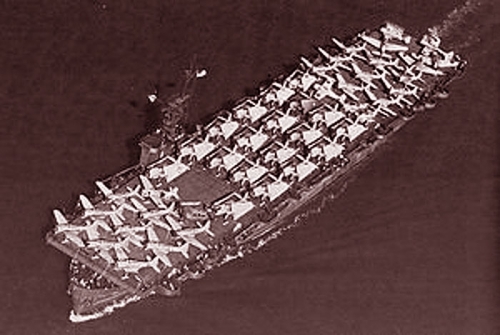
The baby flat-top Liscome Bay was sunk by a torpedo from an enemy submarine on the day before Thanksgiving of 1943. The Liscome Bay was on her first battle assignment, covering the occupation of Makin in the Gilbert [islands]…The torpedo struck a half an hour before dawn and it was still dark when Liscome Bay sank.


The ship went under in less than twenty-four minutes; up to that time it was the U.S. Navy’s second largest loss since the sinking of the Arizona at Pearl Harbor. Only 260 men survived.

1943 Battle for the North Atlantic
1943, Pathfinder Magazine, Submarines

The Battle for the Atlantic
(Pathfinder Magazine, 1943)

The attached is an uncredited article from the later days of 1943 concerning the continuing struggle for supremacy of the North Atlantic:

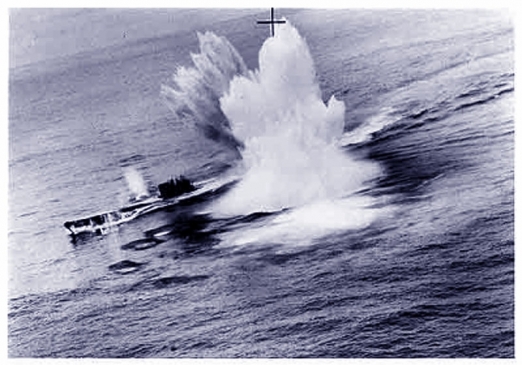
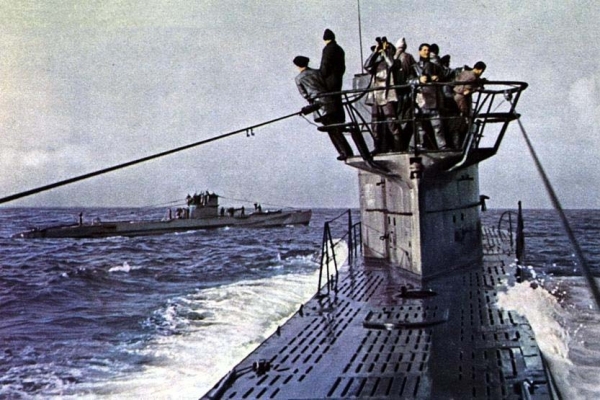
It was plain to see that due to the Allied tactics which drove the U-boats from the seas last summer, sinking 90 subs in 90 days, something new had to be added… the newer [German] subs have larger conning towers, painted white this time instead of black – packing at least two new guns, and shooting it out in the open instead of from ambush… Brazil has recently reported 11 sinkings in the South Atlantic.

The Bizarre End of the USS TANG (Coronet Magazine, 1960)
1960, Coronet Magazine, Submarines

The Bizarre End of the USS TANG
(Coronet Magazine, 1960)

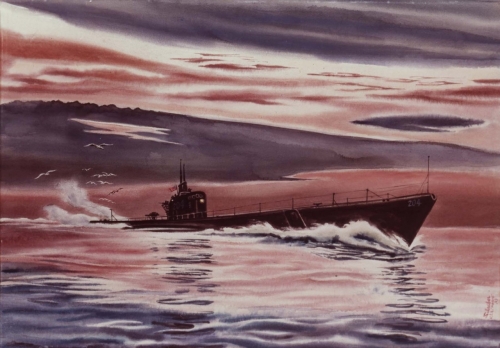
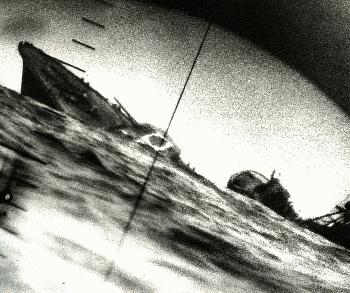
During World War II, the officers and men of the U.S. Navy’s submarine Tang had a proud boast. Their submarine, they crowed, rarely wasted a torpedo. In less than a year of combat, the Tang mowed down Japanese transports, freighters and tankers with deadly accuracy. But it was her fifth patrol from September 27 to October 24, 1944, that gives a unique place in the annals of submarine warfare.


You see, the Tang was sunk by her own torpedo.

Advertisement

Use shortcode [oma_ad position="summary_top"] (or other position) in your theme or widgets to display OMA Promotions here.

Our Worst Enemy: The U-Boat (Click Magazine, 1943)
1943, Click Magazine, Submarines

Our Worst Enemy: The U-Boat
(Click Magazine, 1943)

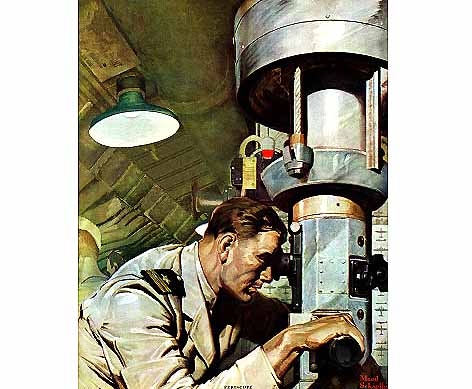
Attached herein are a few authentic sketches [that] show the nerve center of a captured Nazi sub. accompanied by a few informative paragraphs about the beast:

Every inch of a U-boats space, every one of its 45 men, is utilized to the maximum. Each serves the sub’s principal weapon, the torpedoes which speed toward an objective at 45 knots. New models have one or two guns of 3.5-inch caliber or more which are effective against unarmored ships at ranges up to five miles.

Life on a U.S. Navy Sub (Click Magazine, 1943)
1943, Click Magazine, Submarines

Life on a U.S. Navy Sub
(Click Magazine, 1943)

Illustrated with seven color pictures, this wartime magazine article served to give the folks back home a sense of what an U.S. Navy sub is capable of doing:

With a crew of 44 men, an American submarine in Pacific waters may reasonably hope to sink twenty or more enemy ships before the end of this war… By its very limitations, the submarine offers its crew opportunities to do damage to the enemy which are not given to sailors on other types of vessels. Ninety percent of the time during the war our pig boats (ie. submarines) are looking for the enemy. Cruisers and destroyers, on the other hand must often pass up the privilege of fighting in order to carry out some broad strategy objective; thus convoying, reconnaissance and scouting are a kind of boresome duty the submariner seldom knows.

They are a proud lot, our submarine men, but not boastful. They talk less of their exploits than the public likes. The brass hats apparently have decided to keep it that way.


Click here to read a unique story about the Battle of the Sula Straits…

Advertisement

Use shortcode [oma_ad position="summary_top"] (or other position) in your theme or widgets to display OMA Promotions here.

Scroll to Top