Author name: editor

Wits in Hollywood | Mean People in Hollywood
1945, Hollywood History, Pageant Magazine

‘Celebrity Services”
(Pageant Magazine, 1945)

Earl Blackwell and Ted Strongstyle=border:none founded a curious institution that they called Celebrity Services, Inc. in 1938 – figuring, as they did, that

Today America has more celebrities than it can keep track of and Celebrity Services aims, simply, to keep track of them.

Celebrity Services’ office is a busy hodge-podge of files, cross-files, indices, cards folders, stuffed pigeonholes, telephones, confidential memos address books, private dossiers and fat envelopes – all pertaining to the lives of 50,000 celeb-utopians.

A' is for Acting (People Today Magazine, 1955)
1955, Hollywood History, People Today Magazine

A’ is for Acting
(People Today Magazine, 1955)

It was called the Universal-International School of Motion Picture Drama and it was established in 1948 (the year of it’s closing is not so easy to find). The school’s young students were all Universal contract players who had been chosen by legendary casting agent Robert Palmer; a few illustrious names from the alumni list include Rock Hudson, Tony Curtis, Shelley Winters, Jeff Chandler and Piper Laurie.


Although he is not listed as a student in that program, Clint Eastwood can clearly be seen in the center of the attached class photo.

H.L. Mencken on Immigration (The Smart Set, 1921)
1921, Immigration History, The Smart Set

H.L. Mencken on Immigration
(The Smart Set, 1921)

This article from THE SMART SET was published at a time when America was marking the three-hundredth anniversary of the Puritan arrival at Cape Cod and written by H.L. Mencken with his characteristic sense of hopelessness, this small piece remarks that (up to that point in time) immigrants to America were all cut from the same Puritan cloth. The Puritan has been a reoccurring figure in America

and will not die out…until the delusion of moral perfection is lost and forgotten.

Advertisement

Use shortcode [oma_ad position="summary_top"] (or other position) in your theme or widgets to display OMA Promotions here.

1921, Mahatma Gandhi, The Independent

A Profile of Mahatma Gandhi
(The Independent, 1921)

Attached is a 1921 account of the anti-colonial struggles waged by the forty-eight year old Mahatma Mohandas Karamachand Gandhi (1869 – 1948). This well-illustrated article from THE INDEPENDENT touched on Gandhi’s popularity among the Indian people of all faiths, his various boycotts and acts of non-cooperation as well as comments made by his admiring British adversaries.

Advertisement

Use shortcode [oma_ad position="summary_top"] (or other position) in your theme or widgets to display OMA Promotions here.

WW I American Slang | American Soldier Slang W.W. I
1918, Stars and Stripes Archive, The Stars and Stripes

Something Was Lacking in the Slang of the Doughboys
(The Stars and Stripes, 1918)

The American poet Carl Sandburg once wrote words to the effect that Slang is language that takes off its coat, spits on its hands, and goes to work – a very soldierly description it was, too. That said, an anonymous Journalist from The Stars and Stripes examined the casual lingo muttered by the Doughboys in France and surmised that a

universal slang in this man’s army is as hard to find as universal peace in this man’s world.


Perhaps it was all due to the fact that we weren’t in that war long enough to make it our own.

1939, Design, The Art Digest

Bauhaus Exhibit Smeared by Critics
(Art Digest, 1939)

With all the best wishes in the world, it is impossible to suppress the feeling that there is something essentially heavy, forced and repellent in most of the Bauhaus work. They are under suspicion of being modern for the sake of being modern and not because of any necessities of their system of living.


-so wrote the well-respected art critic Henry McBride (1867 – 1962) in response to the groundbreaking 1938 exhibit at the Museum of Modern Art, Bauhaus 1919 – 1928. McBride did not mince words in expressing his belief that the Bauhaus was not a genuine art school and that the MoMA showed poor judgment by lamenting it’s passing. McBride is remembered as having been a longtime advocate of modernism, a champion of the 1913 Armory Show, and supporter of the new and untried, but for him, the Bauhaus represented the art of the poseur.

Advertisement

Use shortcode [oma_ad position="summary_top"] (or other position) in your theme or widgets to display OMA Promotions here.

Remembering the Americans Who Didn't Make It to Paris (Yank Magazine, 1944)
1944, France, Yank Magazine

Remembering the Americans Who Didn’t Make It to Paris
(Yank Magazine, 1944)

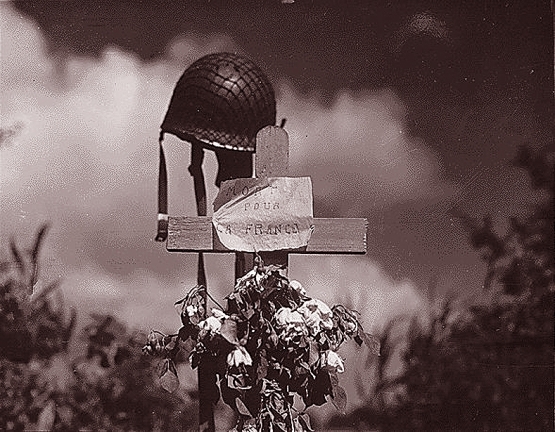
YANK correspondent Saul Levitt was eyewitness to all the merriment that kicked-in when Paris was liberated. Regardless of the gaiety, he could not forget all the American blood that had so liberally been spilled during the previous weeks:

Despite all the bottles of champagne, all the tears, and all the kisses, it is impossible for those of us who are here to forget that we are here for the men of the American divisions who died or were wounded on the way to Paris… for all of those men who started out toward Paris but are not here to see it. We are here for the men of the 48 states who dream of home, and for whom the freeing of Paris is the way home.


Click here to read about the celebrations that took place in Paris the day World War One ended.

Advertisement

Use shortcode [oma_ad position="summary_top"] (or other position) in your theme or widgets to display OMA Promotions here.

Napoleon Takes Charge (Literary Digest, 1922)
1922, The Literary Digest, World War One

Napoleon Takes Charge
(Literary Digest, 1922)

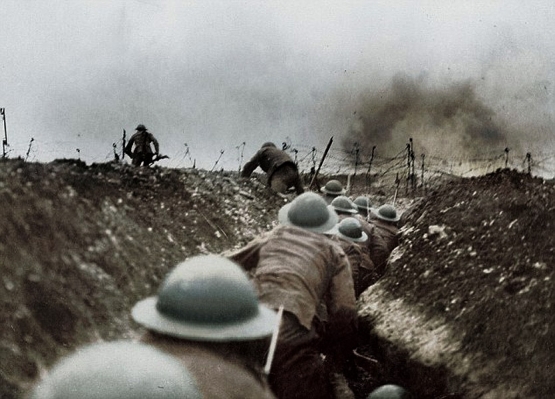
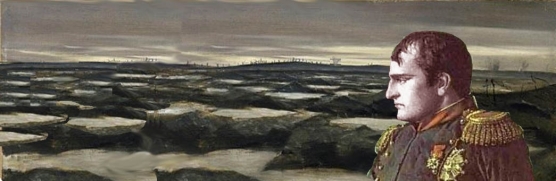
The Napoleon who plays the Monday-morning-quarterback in these columns was created by the tireless researcher Walter Noble Burns (1872 – 1932); his version of Bonaparte explains what went wrong on the Western Front and how he would have beat the Kaiser – but not before he dishes out liberal amounts of defamation for the senior commands on both sides of No Man’s Land.

The war’s stupendous blunders and stupendous, useless tragedies made me turn over in my sarcophagus beneath the dome of the Invalides. I can not conceive how military men of even mediocre intelligence could have permitted the Allied Army to waste its time by idly lobbing over shells during a three-years’ insanity of deadlocked trench warfare.


Click here to read an article about life in a W.W. I German listening post…

Military Panic in the Cold War | Cold War Lack of Military Preparedness | 1946 Military Preparedness Failure
1946, Pathfinder Magazine, The Cold War

Hiding A Military Error
(Pathfinder Magazine, 1946)

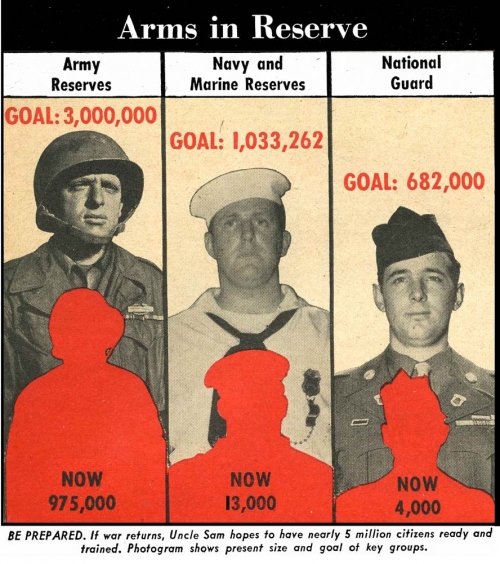
This 1946 article puts a nice face on a subject that both American diplomats and military men were eager to hide from the world – the issue involving a total lack of military preparedness. The journalist reported on the military’s push to bulk-up the reserves to an acceptable level, but the real story was that all branches of the armed services were on a recruiting drive for more men (and women) to make up for the fact that the post-war deployment program had drastically reduced the combat effectiveness of practically every unit. Under heavy pressure from civil authorities to save money, military planners failed to retain the services of numerous combat veterans to train the newest recruits. This partially explains the lack of accomplishments attained by the earliest divisions deployed to halt the North Korean advances in 1950.

Building the Suburban Dream (Pic Magazine, 1955)
1955, Pic Magazine, Suburbia

Building the Suburban Dream
(Pic Magazine, 1955)

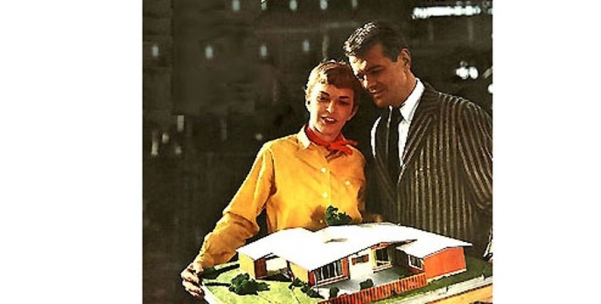
The author Thomas Hine pointed out in his 1986 tour-de-force, Populuxestyle=border:none, that by the time the Eisenhower years rolled around, suburban houses were growing in size, as is typified in the attached article that was created to sell the plans for a 1,290 square foot piece of suburban splendorstyle=border:none. Gone were the days of the little boxes that dotted the countryside throughout the late Forties and early Fifties; these newer and larger domiciles were built in the shapes of U or L and the most popular models were built in the Ranch House style with attached garages (gasp!).

Advertisement

Use shortcode [oma_ad position="summary_top"] (or other position) in your theme or widgets to display OMA Promotions here.

Herman J Koehler Newspaper Article | Herman J Koehler Officer Training | Optimistic Thinking in the US Army
1918, Outing Magazine, World War One

The Power of Positive Thought in Military Training
(Outing Magazine, 1918)

The power of positive thinking is one of the necessary elements that has been ingrained within the psyche of every U.S. Army recruit for at least the past 100 years. Positive thought is the topic of this 1918 article about the wartime training of U.S. Army officer cadets at Camp Grant, Illinois, by Major Herman J. Koehler (1859 – 1927), who believed deeply that there is no limit to human endurance.


Read what the U.S. Army psychologists had to say about courage.

The U.S. First Division at Cantigny (The Stars and Stripes, 1918)
1918, The Stars and Stripes, World War One

The U.S. First Division at Cantigny
(The Stars and Stripes, 1918)

The battle of Cantigny (May 28 – 31, 1918) was America’s first division sized engagement during the First World War; George Marshall would later opine that the objective was of no strategic importance and of small tactical value. General Pershing was hellbent on eradicating from the popular memory any mention of the A.E.F.’s poor performance at Seicheprey some weeks earlier, and Cantigny was as good a battleground in which to do it as any. Assessing the battle two weeks after the Armistice, Pershing’s yes men at the STARS AND STRIPES wrote:

But at Cantigny it had been taught to the world the significant lesson that the American soldier was fully equal to the soldier of any other nation on the field of battle.


An article from THE NEW REPUBLIC recognizing that 1914 marked the end of an era.

Supplying Tobacco to the AEF (America's Munitions, 1919)
1919, America's Munitions, World War One

Supplying Tobacco to the AEF
(America’s Munitions, 1919)

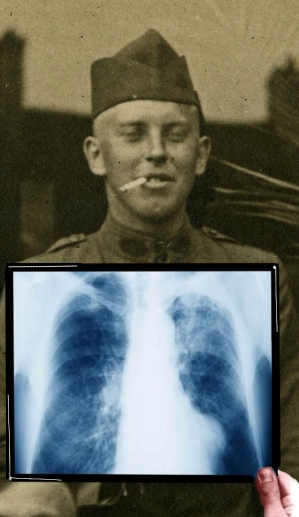
Cigarette smoking was far more prevalent in the United States after the First World War than it was in earlier days; this is largely due to the free cigarettes that were widely distributed among the nations soldiers, sailors and Marines during that conflict – and this is the subject of the attached article. It was written by Benedict Crowell (1869 – 1952), who served as both the Assistant Secretary of War and Director of Munitions between 1918 and 1920 – and although his column informs us that numerous tobacco products were dispersed throughout the ranks on a seemingly biblical scale, he does not touch upon the tragic topic of the addictions that soon followed (contrary to popular belief, the American medical establishment had their suspicions about tobacco long before the war).

Advertisement

Use shortcode [oma_ad position="summary_top"] (or other position) in your theme or widgets to display OMA Promotions here.

Scroll to Top