Author name: editor

New York State Suffrage Amendment 1917 | Melting Pot Americanization 1917
1917, Immigration History, Vogue Magazine

Getting the Immigrant Vote
(Vogue Magazine, 1917)

Upon learning that the Woman Suffrage Amendment passed the New York legislature quite handily, the Suffrage Party lost no time in solidifying their base and quickly set to work locating additional voters for future state elections. They discovered that there were five hundred thousand new voters in New York City alone; two hundred thousand of them were foreign-born women.

This VOGUE article is a fun read for a number of reasons, the first one being that it seems that nothing ever really changes in America and the second reason is because this article was written by a pampered patrician of the first order and when you read between the lines you get the sense that she would rather not breathe the same air as Italian and Jewish Immigrants:

As well-born American women, we can never out-vote the immigrant; we must make her an all-American citizen and voter.

The Problem with Chain Stores 1933 | Chain Stores in the 1930s
1933, New Outlook Magazine, The Great Depression

The Chain Store Problem
(New Outlook Magazine, 1933)

The total amount of retail trade in 1929 was approximately $50,033,850,792 in net sales, but the ten percent of chain stores did $10,771,934,034 of this trade – or twenty-one and a half percent of the total! In the miniature department store field, selling articles for nickles, dime, quarters and dollars, earning charts show an average return on capital invested in 1920 of nearly fourteen percent. In 1925, this percentage rose to twenty-five. In 1930, after trade had begun to suffer, earnings still were in excess of of thirteen percent.

Illiterate Immigrant Soldiers (Current Opinion, 1920)
1920, Current Opinion Magazine, Immigration History

Illiterate Immigrant Soldiers
(Current Opinion, 1920)

So deep were the ranks of khaki-clad immigrants who filled the U.S. military’s regiments and divisions throughout the course the First World War that our British allies would often refer to the U.S. Army as the American Foreign Legion; yet as grateful as the services were to have so many additional strong arms to deploy during a time of national emergency, it was not without a cost.

This article is all about how the army addressed the issue regarding the high number of illiterate immigrants who broadened their phalanx spanning the years 1917 through 1920.

Advertisement

Use shortcode [oma_ad position="summary_top"] (or other position) in your theme or widgets to display OMA Promotions here.

Junk Science and Immigration Policy (Literary Digest, 1917)
1917, Immigration History, The Literary Digest

Junk Science and Immigration Policy
(Literary Digest, 1917)

The melting pot in this sense is applied to the race-conscious study of forensic anthropology. This article concerns the work of Dr. Ales Hrdlika (1869-1943) of the National Museum of Washington, and the records that he maintained regarding the physical features of the earliest European settlers compared to the Americans of the early Twentieth Century (read: Jews and Italians), following so many generations of immigration and intermarriage.


What is amusing is the illustration of The American Facestyle=border:none:

…the diagram drawn to scale from Dr. Hrdlicka’s data… shows the mean man of the old American stock. It is pointed out that the most conspicuous peculiarities of the type are the oblong outline of the face and the well-developed forehead.

A Fiscal Report on the Immigrants of 1911 (America Magazine, 1912)
1912, America Magazine, Immigration History

A Fiscal Report on the Immigrants of 1911
(America Magazine, 1912)

This is a short notice concerning which of the prominent immigrant groups were the poorest and the richest in the year 1911 – and from which nations did they originate.

Of the arrivals during the fiscal year, 1.6 percent were debarred from entering this country. Special mention is made of the fact that immigrants from Canada carried the greatest amount per capita, and those crossing the Mexican border brought with them the least money.

Advertisement

Use shortcode [oma_ad position="summary_top"] (or other position) in your theme or widgets to display OMA Promotions here.

The Case Against Football (Literary Digest, 1897)
1897, Football History, The Literary Digest

The Case Against Football
(Literary Digest, 1897)

Today the word football summons forth images of gigantic, vigorous and fully televised athletes sporting protective padding while surrounded by enthusiastic fans and well-compensated cheerleaders; yet, one hundred years ago, that same word made one think of embalmers, tombstones and weeping mothers. Football’s popularity had been increasing since the 1870s, and by the end of the Nineteenth Century the sport had amassed a lengthy casualty list. Footballers continued to keep the American medical establishment and sundry funeral directors fully employed up to the year 1910, when helmets and padding were introduced with some success.

The attached article is from an 1897 issue of THE LITERARY DIGEST and it reported on a strong civic movement to ban the sport of football.

Click here if you would like to see three editorial cartoons denouncing football from the same era.

The Obituary of J.M. Studebaker (The Atlanta Georgian, 1917)
1917, Cars, The Atlanta Georgian

The Obituary of
J.M. Studebaker
(The Atlanta Georgian, 1917)

J.M Studebaker (1833 – 1917) was a pioneer in vehicle building and lived to see the change in locomotion from oxcarts to automobiles. He had been engaged
in the manufacture of vehicles for sixty-five years.

This is a very quick and interesting read, highlighting the key events in the life of this automotive engineer whose name is so readily recognized some eighty-five years after his death.

Advertisement

Use shortcode [oma_ad position="summary_top"] (or other position) in your theme or widgets to display OMA Promotions here.

Men's Suits in the Summer of 1941 (Collier's Magazine, 1941)
1940s Men's Fashions, 1941, Collier's Magazine

Men’s Suits in the Summer of 1941
(Collier’s Magazine, 1941)

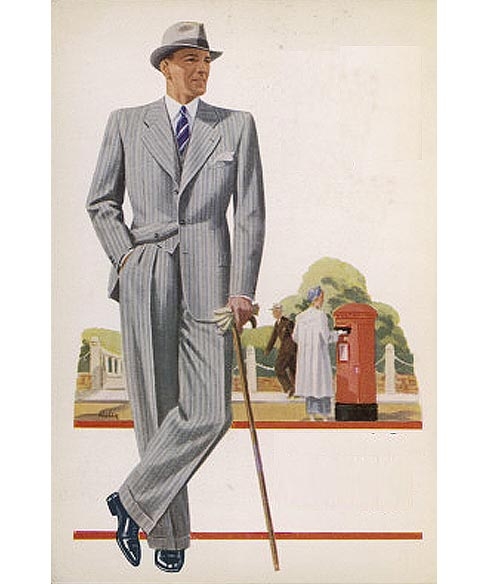
If you’ve been wondering what the stylish Yankee beaus of yore used to wear during the Summer of 1941 when they plopped themselves down to read about the British occupation of Syria or the Nazi siege of Leningrad, then you can stop looking because we have the article right here – it is the summer fashion forecast from COLLIER’S MAGAZINE of May 24, 1941 – illustrated with no fewer than three color images:

The newest color for vacation clothes is parchment, one of the natural tan shades. Don’t be afraid that you’ll look like a member of the street-cleaning department in a white linen suit. Even the Duke of Windsor wears one. It is ideal for vacation wear, as the jacket may be worn with colored slacks, the trousers with other light weight jackets…. For week-end and vacation wear you can choose from tropical worsteds, Palm Beach cloth, tropical weight flannels, linen, seersucker and tropical weight tweeds.

Belgian fascist leader Léon Degrelle
1943, Allies, Collier's Magazine

Berlin’s Man In Brussels
(Collier’s Magazine, 1943)

Léon Degrelle (1906 – 1994) was a Belgian con-man and Nazi collaborator:

Handsome, plausible and glib, politics eventually appealed to him as a field for his talents, but repeated bids for office resulted in defeat. Nothing seemed more certain than that the ‘man with the electric voice’ would remain a local windbag, but in 1935, Adolf Hitler began the development of fifth columns in other countries, and Léon Degrelle was his choice in Belgium.

Advertisement

Use shortcode [oma_ad position="summary_top"] (or other position) in your theme or widgets to display OMA Promotions here.

Timeless Advice Regarding Skin Care (McCall's Magazine, 1920)
1920, Cosmetics, McCall's Magazine

Timeless Advice Regarding Skin Care
(McCall’s Magazine, 1920)

Some tend to think that 1920s concepts concerning skin care are very different from our own – and in many cases they would be absolutely right; that is why we were so charmed to stumble upon this 1920 article written by the Broadway actress Suzanne Sheldon. The actress emphasizes 6 to 8 glasses of water each day, a sensible exercise regimen and washing the face each evening.

Ruth Elder: American Super-Girl (Literary Digest, 1927)
1927, The Literary Digest, Women Pilots

Ruth Elder: American Super-Girl
(Literary Digest, 1927)

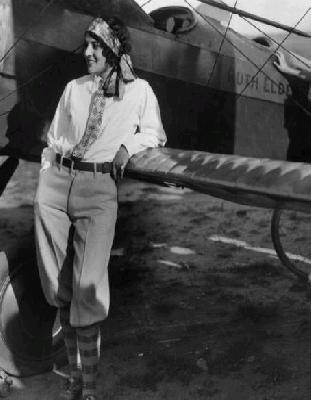
An article about American pilot Ruth Elder (1902 – 1977), who attempted to be the first woman aviator to fly to Paris; crashing in the Atlantic mid-flight:

she has to her credit the longest flight made entirely over water, beating the Pacific fliers by about 200 miles…She will rank with the most daring fliers of this year of aerial wonders.

Elder parlayed her notoriety into a starring roll in a Hollywood movie that came out the following year: Moran of the Marines.


Read a 1918 article about the women’s city.

Verdun, 1944 (Yank Magazine, 1944)
1944, World War Two, Yank Magazine

Verdun, 1944
(Yank Magazine, 1944)

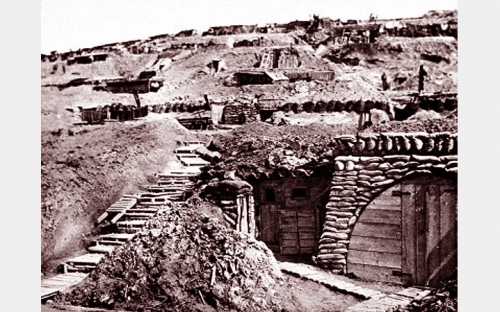
The contested forts of Verdun (Battle of Verdun, 1916), Fort Douamont, Fort Souville and Fort Vaux, were little more than storage sheds to the American army of World War Two; and during the four years of German occupation, the forts played a similar roll for the German army as well. This is a neat article that briefly touches on the importance of these structures during the previous war and what kind of flotsam and jetsam the GIs were able to find as they wandered about the forts (like a W.W. I skeleton). Of particular interest was a wall that was covered with the names of various combatants from all sides and from both wars:

The American names are big and black and seem to blot out the others. One of them says:

Austin White, Chicago, Ill., 1918 and 1944.

This is the last time I want to write my name here.

Click here to read more magazine articles about the African-American efforts during the First World War.

Advertisement

Use shortcode [oma_ad position="summary_top"] (or other position) in your theme or widgets to display OMA Promotions here.

Rube Goldberg on Hollywood (Photoplay Magazine, 1930)
1930, Hollywood History, Photoplay Magazine

Rube Goldberg on Hollywood
(Photoplay Magazine, 1930)

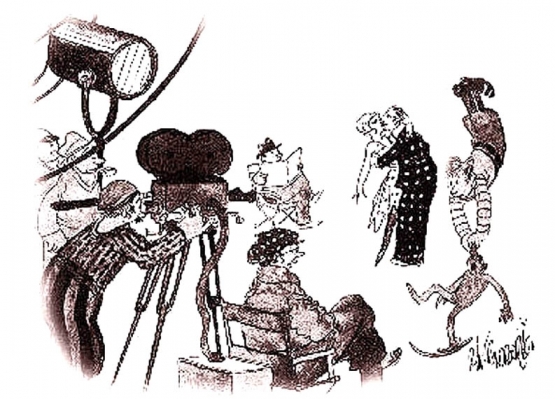
Hired to write dialogue for the king makers at Twentieth Century Fox, cartoonist Rube Goldberg (1890 – 1970) jotted down his impressions of 1930s Hollywood.

The chief mogul did all the ordering and I must say that he knew food. The lavish way in which he ordered bore out some of the glittering tales I had read about the grandeur of the movies. I think I ate six helpings of caviar and four tenderloin steaks. I wanted to make them believe I was no slouch myself.

If you would like to read a Rube Goldberg interview from 1914, click here.

Howard Hughes Buys Multicolor (Film Spectator, 1930)
1930, Hollywood History, The Film Spectator Magazine

Howard Hughes Buys Multicolor
(Film Spectator, 1930)

When the deep-pocketed film director Howard Hughes (1905 – 1976) decided to tint a few sequences from his film HELL’S ANGELS (1930) he purchased the company that he believed capable of filling such an order: Multicolor in Hollywood, California (as it turned out, the work was actually done by Technicolor). Hughes was such a curiosity to the press and they followed his every whim; in this article, critic Donald Beaton refers to Hughes as a pioneer and salutes him for experimenting with color.

1946, Early Television, Pathfinder Magazine

Smellivision Arrives
(Pathfinder Magazine, 1946)

Technology blogs on the net have users who frequently post the question When will T.V. be able to ‘broadcast’ smells?: the ability existed as early as 1946 – but there was no interest – or so this article has lead us to believe:

Optimistic scientists visualized the day when television sets would come equipped with 200 to 300 different smells. (Aromas are automatically concocted by chemicals in the set, mixed by radio-remote-control from the studio.) Faint nostrils quavered at the thought of several odors on the same program…

Advertisement

Use shortcode [oma_ad position="summary_top"] (or other position) in your theme or widgets to display OMA Promotions here.

Scroll to Top