"Les Américains Sont Là!"
"Those were the words on everybody's lips as the first big detachments of United States troops began to appear on the Paris streets... I think there is a simple politeness in these young warriors from across the sea, whether they come from some of the big cities, New York, Boston, Chicago or from some far-away states on the other side of the Rockies."
Click here to read an article that compares the two world wars.
So numerous were the khaki-clad immigrants who filled the ranks of the U.S. Army during the First World War that our British allies would often refer to the A.E.F. as the "American Foreign Legion"; yet as grateful as the services were to have so many additional strong backs to deploy during a time of national emergency, it was not without a cost. The attached article was all about how the army addressed this issue regarding the high number of illiterate immigrants who filled their divisions spanning the years 1917 through 1920.
For further reading about the American immigrants who fought in the U.S. Military during the First World War, we recommend: Americans All!: Foreign-Born Soldiers in World War I . .
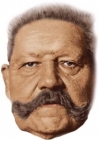
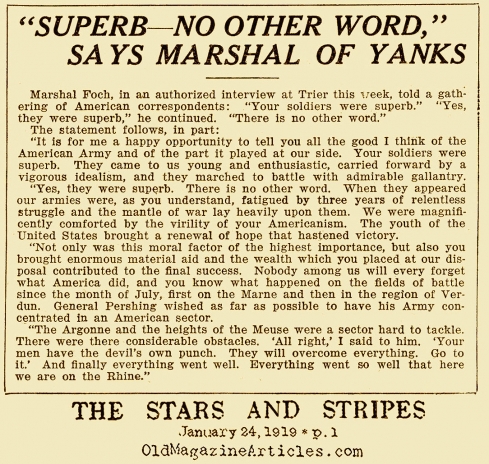
Here is a segment of the famous interview with General Paul von Hindenburg that was conducted just days after the close of hostilities in which the journalist George Seldes (1890 – 1995) posed the question as to which of the Allied Armies played the most decisive roll in defeating Germany; whereupon the General responded:
"The American infantry in the Argonne won the war".
Read on...
Click here to read about sexually transmitted diseases among the American soldiers of the First World War...
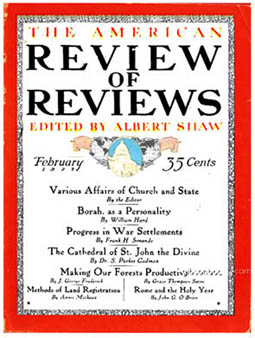
What we enjoyed about this piece by the Muckraking Ida Tarbell (1857 - 1944) was that it was written some six months after the heavy handed George Creel had ceased influencing Yankee magazine editors into printing pro-American blather, and so we tend to feel that her praise of the American Doughboys was quite sincere - and praise she does! Up hill and down dale, the Doughboys can do no wrong in her eyes.
This essay appeared in print around the same time the French had decided that all the Doughboys were just a bunch of racist hurrah-boys and were becoming increasingly sick of them. The Yanks might have squared their debt with the Marquis de Lafayette, but the recently returned Poilus were not above taking an occasional swipe at Ida Tarbell's Doughboys... Click here to read some statistical data about the American Doughboys of the First World War. Two remarkably brief paragraphs concerning the required military training of the average American Doughboy throughout the course of America's blessedly short participation in the First World War: "The average American soldier who went to France received six months of training in this country before he sailed. After he landed overseas he had two months of training before entering the battle line. The part of the battle line that he entered was in a quiet sector and here he remained one month before going into an active sector and taking part in hard fighting." Click here to read a 1918 magazine article about the Doughboy training camps. A black and white map indicating the Atlantic ports up and down North America where the A.E.F. boarded troop ships, their trans-Atlantic routes and their French and British points of arrival. The map is also accompanied by a few facts concerning this remarkable trip across U-boat infested waters.
Click here to read an article about the sexually-transmitted diseases among the American Army of W.W. I...
When the Doughboys complained, they complained heavily about their uniforms; read about it here. |