World War One Film Clips
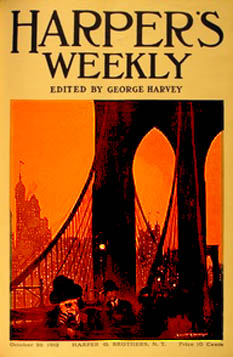
Wounds That Had Never been Seen Before (Harper's Weekly, 1915)
An informative article concentrating on how the doctors of all the combatant nations dealt with the filthy conditions of stagnant warfare and all the different sorts of wounds that were created as a result of this very different war:"This is a dirty war. Gaseous, gangrene, lockjaw, blood poisoning, all dirt diseases...Colonel G.H. Makins of the Royal Army Medical Corps longs for the clean dust of the Veldt, which the British soldier cursed in the Boer War."
| 1914: The End of an Era (The New Republic, 1915)
World War I had only been raging for six months when this article first appeared. As the journalist makes clear, one did not have to have an advanced degree in history to recognize that this war was unique; it involved almost every wealthy, industrialized European nation and their far-flung colonies; thousands of men were killed daily and many more thousands stepped forward to take their places. The writer recognized that this long anticipated war was an epic event and that, like the French Revolution, it would be seen by future generations as a marker which indicated that all changes began at that point:"Those who were but a few months ago assuring us that there never could be another general war are most vociferously informing the same audience that this will be the last."
| A War Like No Other (Hearst's Sunday American, 1917)
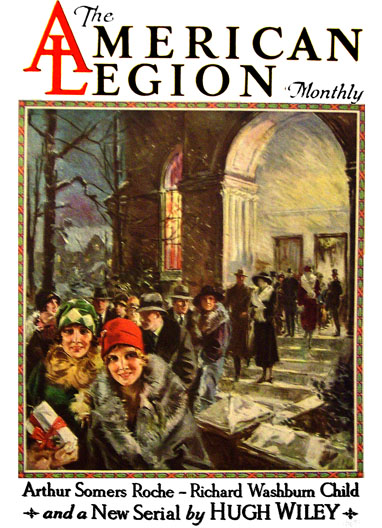
An article by the admired British war correspondent, Ellis Ashmead-Bartlett (1881-1931), concerning the unique aspects of the Great War which combined to make that the sort of war that had never been seen before: "Everything has changed; uniforms, weapons, methods, tactics. Cavalry had been rendered obsolete by trenches, machine guns and modern artillery; untrained soldiers proved useless, special battalions were needed on both sides to fight this particular kind of war that, in no way, resembled the battles your father or grand-fathers had once fought. A good read. If you would like to see color photographs from World War One, click here.
| |

| Trench Fighting (The New Republic, 1915)
The seasoned war correspondent from "The New Republic" filed this essay some five months into the war in order to clarify for his American readers the exact nature of trench warfare. His observations are based upon the trench fighting that he witnessed both in France and during the Russo-Japanese War, some nine years earlier:
"There is an illusion that the range and effectiveness of modern arms tend to keep armies far apart. On the contrary, there is more hand-to-hand fighting today than at any time since gunpowder was invented... at this rate the French will not drive out the Germans in months, but on the other hand a frontal attack, and every attack must now be frontal, even if successful would cost several hundred thousand men."
The article was written by Gerald Morgan; by war's end he would serve as General Pershing's press chief (ie.censor).
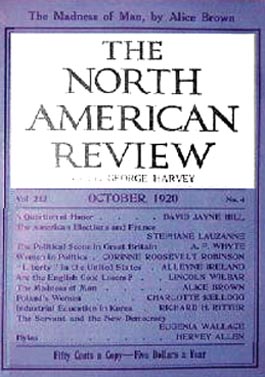
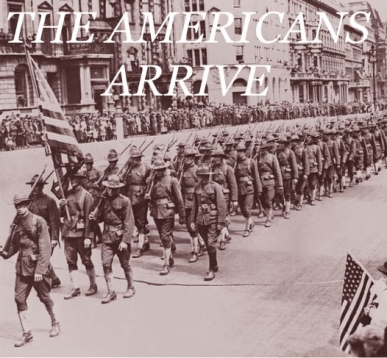
| America Commits Itself to the War (Literary Digest, 1928)
In writing a piece for "La Revue Mondiale" ten years after the Armistice, Stéphane Lauzanne (1887 - 1928), Editor-in-Chief of the semi-official Paris "Matin" wrote a few bitter-sweet words about the American character and how it was both a hindrance and a benefit to the Allies in the war. Yet he was full of praise when he recalled the bold and forward-thinking manner in which America entered the war and committed both blood and treasure:
"...all America sees far ahead and sees on a grand scale...when America entered the war, it did not say: 'Let us get a few regiments together, give some money to our allies, and send some bushels of wheat to various ports.' No, America envisioned the matter on a big scale. Men were recruited by the millions, and the money to be sent to the Allies was calculated in the millions. The wheat for Europe was grouped in millions of bushels. The material necessary for construction of sixteen great camps was gathered in millions of cubic yards. If America had not seen the problem on this grand scale, would the war have ended as quickly?"
| Psychology and the Training of American Army Officers (Outing Magazine, 1918)
Any ol' couch-jockey well schooled in the viewing of History Channel documentaries about GIs during W.W. II can tell you that this diverse soldiery had one strong psychological element in common: they could not envision failure. The power of positive thought is still very much a vital particle ingrained within the psyche of today's recruits training within the American military behemoth, and this is the topic of the attached magazine article from 1918. This is an article about the wartime training of U.S. Army officers by Major Hermann J. Koehler, who believed deeply that "there is no limit to human endurance".
| MORE ARTICLES >>> PAGE: * 1 * 2 * 3 * 4 * 5 * 6 * 7 * 8 * 9 * 10 * 11 * 12 * 13 * > NEXT |
| BBC On This Day | Front Page |
|
| 10/19/2005 10:17 AM |
| 1945: Nuremberg trial of Nazis begins
|
Twenty of Germany's Nazi leaders go on trial in Nuremberg charged with war crimes. |
| |
| BBC On This Day | Front Page |
|
| 10/14/2005 12:45 PM |
| 1995: Diana admits adultery in TV interview
|
Diana Princess of Wales speaks openly for the first time about her separation from the Prince of Wales in a frank interview for BBC Television. |
| |
| BBC On This Day | Front Page |
|
| 11/15/2005 06:04 AM |
| 1975: Spanish dictator Franco dies
|
Hopes for democracy run high as Prince Juan Carlos prepares to take the reins of power following the death of General Franco. |
| |
| BBC On This Day | Front Page |
|
| 10/07/2005 08:02 AM |
| 1990: Thatcher fails to win party mandate
|
The Prime Minister, Margaret Thatcher, fails to win outright victory in her battle for the leadership of the Conservative Party. |
| |
| BBC On This Day | Front Page |
|
| 12/06/2002 10:27 AM |
| 1978: Liberal MP accused of murder plot
|
Former Liberal Party leader Jeremy Thorpe is accused in court of plotting to kill his former homosexual lover. |
| |
| BBC On This Day | Front Page |
|
| 11/06/2003 12:01 PM |
| 1951: British families leave Egypt's Canal Zone
|
More than 1,000 families of British service men have begun moving out of the Canal Zone town of Ismailia. |
| |
| BBC On This Day | Front Page |
|
| 12/06/2002 11:02 AM |
| 1992: Blaze rages in Windsor Castle
|
A fierce blaze is raging through Windsor Castle in Berkshire, threatening one of the world's greatest collections of art. |
| |
| BBC On This Day | Front Page |
|
| 10/15/2004 09:51 AM |
| 2003: British targets bombed in Istanbul
|
At least 27 people, including the British consul-general, die in two suicide bomb attacks in Istanbul, Turkey. |
| |
| BBC On This Day | Front Page |
|
| 12/06/2002 10:48 AM |
| 1986: Police renew hunt for Moors victims
|
Police begin a search for more victims of the Moors murderers, after receiving new information from Myra Hindley. |
| |
|