old magazine article typewriter
   
 
  Home
  About Us
  Log In / Register
  Contact Us
  Legal Disclaimer


Recently Added Articles
 1925: Going Green
 American Civil War Magazine Articles
 Chronology
 Gettysburg
 Lincoln
 Assorted Famous People and Celebrities
 Aviation Magazine Articles
 Charles Lindbergh
 Women Pilots
 Zeppelins and Dirigibles
 Benito Mussolini
 Black American Magazine Articles
 Ku Klux Klan
 Lynchings
 Cartoons 1914-1922
 China - 20th Century
 Sino-Japanese War
 Early Cars & Automotive History
 1950s Cars
 Early Television
 European Royalty
 Duke of Windsor
 Elizabeth II
 F.D.R. and the Depression
 Fashion
 1930s
 1940s
 Flappers
 Men’s Fashion
 Personal Beauty
 Football
 Golf Magazine Articles
 Immigration
 Canadian Immigration
 Jews in the 20th Century
 College Antisemitism
 Living History
 Mahatma Gandhi
 Manners and Society
 Modern Art
 Dada
 Movies
 Animation
 Gone with the Wind Articles
 Hollywood Blacklist
 It's A Wonderful Life
 Music
 Big Band 1930s-1940s
 Eric Satie
 Native Americans
 New York Magazine Articles
 Old Iraq
 Opinions About Americans
 American English
 Prohibition Cartoons
 Prohibition Magazine Articles
 Religion
 Silent Movie Articles
 Cartoons
 Charlie Chaplin
 D.W. Griffith
 Douglas Fairbanks & Mary Pickford
 Soviet History Articles
 Tennis Articles
 The Nazis
 Adolf Hitler
 Titanic Magazine Articles
 Twentieth Century Writers
 U.S. Army Uniforms of World War One
 Overseas Caps
 Trench Coats
 U.S. Armies, Corps and Divisions
 U.S. Navy Uniforms of World War One
 U.S. Marine Corps Uniforms
 Weird Inventions
 Women’s Suffrage
 Woodrow Wilson
 World War I Posters
 World War One
 African Americans
 Aftermath
 Animals
 Artists
 Belleau Wood
 British Uniforms
 Cemeteries
 Clip Art
 Color Photographs
 Doughboys
 Gas Warfare
 Inventions and Weapons
 Letters
 Lusitania
 Prelude
 Snipers
 Stars and Stripes Articles
 Versailles Treaty
 Women
 Writing
 World War Two
  Combat Training
 Aftermath
 At Home
 Atomic Bomb
 D-Day
 General Eisenhower
 Japanese Internment
 Kamikaze Attacks
 Paris
 Post-War Japan
 Prelude
 Prisoners of War
 VE Day
 VJ Day
 Weapons and Inventions
 Yank Magazine Articles
 General Marshall
  

World War One - Belleau Wood

Click here to email this page to a friend

Buy at Art.com
Be a US Marine

A Marine Tells it to You

The Decorated Marines from Belleau Wood (N.Y. Times, 1918)

Filed by Edwin L. James (1890 - 1951) of the New York Times was his eyewitness account of the decoration ceremony that took place on a sweeping lawn of an unnamed French chateau in the Marne Valley on July 11, 1918. Presided over by U.S. Army General James Harbord (1866 – 1947), over 100 Marines of the U.S. Second Division were cited for their "deeds in the fighting North-West of Chateau-Thierry":

"It is with inexpressible pride and satisfaction that your commander recounts your glorious deeds on the field of battle. In the early days of of June on a front of twenty kilometers, after night marches and with only the reserve rations which you carried, you stood like a wall against the enemy advance on Paris. For this timely action you have received the thanks of the French people whose homes you saved and the generous praise of your comrades in arms..."

Listed are the names of 37 Marines who were decorated that day; including the name of Lieutenant Louis F. Timmerman, who was to receive the Distinguished Cross (the bureaucracy didn't get the medal to him until 1942!)

The Battle of Belleau Wood in Retropspect (Literary Digest, 1927)

Nine years after he commanded the U.S. Fourth Corps during World War One, Major General Joseph T. Dickman (1857 - 1928) reconsidered the necessity of fighting for that ground in his memoir, The Great Crusade, and concluded that:

"Belleau Wood was a glorious, but an unnecessary sacrifice...It was magnificent fighting, but not modern war."

The battle was fought by the U.S. Marines attached to the Second Division, which was under the command of General Dickman. If you would like to read a small piece regarding the war record of the U.S. Fourth Corps in France, click here.

Click here to read about the celebrations that took place in Paris the day World War One ended.

Click here to read some statistical data about the American Doughboys of the First World War.

Letter from Belleau Wood (With the Help of God and A Few Marines, 1919)

The following letter was written by a Belleau Wood veteran of the U.S. Marine Corp's Sixth Regiment, Private Hiram B. Pottinger. It was included the World War One memoir, "With the Help of God and a Few Marines" (1919) by Brigadier General A.W. Catlin, U.S.M.C. (1868-1933), who believed it rendered accurately the enlisted man's view of the battle.

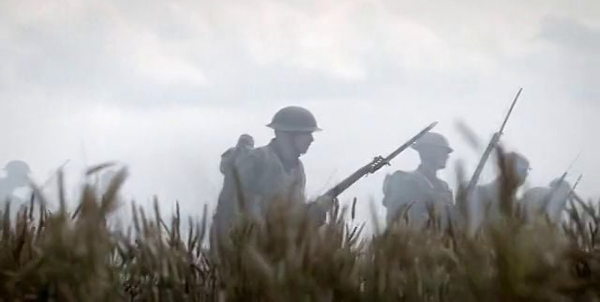
The letter is accompanied by a black and white photograph depicting what is clearly a re-staging of the Marines mad dash across the wheat fields that sit just outside the Bois de Belleau.

Click here to read about the U.S. Navy railroad artillery of W.W. I.

Eye-Deep in Hell: Trench Warfare in World War I
The U.S. Marines Land Over There (The Spectator, 1918)

A British journalist encountered the United States Marine Corps and found them to be an impressive curiosity that spoke an odd nautical language. One Marine in particular was singled out and, although anonymous, some of you will recognize right away that he could only be one man: Sergeant Dan Daily of the Fifth Marines.

Click here to read about the high desertion rate within the U.S. Army of 1910.


© Copyright 2005 Old Magazine Articles