








World War One

Find old World War 1 articles here. Find information on uniforms, women, gas warfare, prisoners of war and more.

Eastern European Jews Slaughtered
(Current Opinion, 1920)

One of the most sinister results of the war has been a new wave of anti-Semitism in Europe. Recent dispatches from Berlin describe street demonstrations against Jews and speak of a veritable pogrom atmosphere in Munich and Budapest. In Poland, Jewish blood has flown freely, amid scenes of horror described by Herman Bernstein and other writers in American newspapers. In Ukraine the number of Jews massacred during the early part of the present year is estimated anywhere from 40,000 to 100,000.

The Crown Prince in Exile
(The Literary Digest, 1919)

In the attached magazine interview, Kaiser Wilhelm’s son and fellow exile, Crown Prince Wilhelm III (1882 – 1951, a.k.a. The Butcher of Verdun), catalogs his many discomforts as a refugee in Holland. At this point in his life, the former heir apparent was dictating his memoir (click here to read the book review) and following closely the goings-on at Versailles.


Click here to read an article about the German veterans of W.W. I.

Advertisement

Use shortcode [oma_ad position="summary_top"] (or other position) in your theme or widgets to display OMA Promotions here.

German Mortars and Field Guns
(Almanach Hachette, 1919)

A couple of the primary field guns of the German artillery corps are clearly rendered in black and white on the attached file: the 105mm field gun and the 150mm howitzer. Also illustrated are two German trench mortars; 240mm and 305mm, respectively.

Supplying the A.E.F. in Siberia
(The Stars and Stripes, 1918)

Special woolen coats and breeches and underwear, long mufflers, worsted socks and long stockings, gloves and gauntlets are other things which are being issued to the Doughboys in Russia. Alaska Yanks are said to be right at home in their new surroundings, although they complain sometimes of the heat.


An additional article is attached concerning the supply of medals that had to be shipped North; reading between the lines, you will get a sense that much gallantry was expected…


When the Doughboys complained, they complained heavily about their uniforms; read about it here.

Something Was Lacking in the Slang of the Doughboys
(The Stars and Stripes, 1918)

The American poet Carl Sandburg once wrote words to the effect that Slang is language that takes off its coat, spits on its hands, and goes to work – a very soldierly description it was, too. That said, an anonymous Journalist from The Stars and Stripes examined the casual lingo muttered by the Doughboys in France and surmised that a

universal slang in this man’s army is as hard to find as universal peace in this man’s world.


Perhaps it was all due to the fact that we weren’t in that war long enough to make it our own.

Advertisement

Use shortcode [oma_ad position="summary_top"] (or other position) in your theme or widgets to display OMA Promotions here.

Sniper Mask
(The Great War, 1918)

As if simply having to be mindful of wind velocity and camouflage was not enough to occupy the thoughts of your average World War I German sniper, some were burdened to a further degree by having to affix this half-inch steel sniper mask to their faces…

Napoleon Takes Charge
(Literary Digest, 1922)

The Napoleon who plays the Monday-morning-quarterback in these columns was created by the tireless researcher Walter Noble Burns (1872 – 1932); his version of Bonaparte explains what went wrong on the Western Front and how he would have beat the Kaiser – but not before he dishes out liberal amounts of defamation for the senior commands on both sides of No Man’s Land.

The war’s stupendous blunders and stupendous, useless tragedies made me turn over in my sarcophagus beneath the dome of the Invalides. I can not conceive how military men of even mediocre intelligence could have permitted the Allied Army to waste its time by idly lobbing over shells during a three-years’ insanity of deadlocked trench warfare.


Click here to read an article about life in a W.W. I German listening post…

The Power of Positive Thought in Military Training
(Outing Magazine, 1918)

The power of positive thinking is one of the necessary elements that has been ingrained within the psyche of every U.S. Army recruit for at least the past 100 years. Positive thought is the topic of this 1918 article about the wartime training of U.S. Army officer cadets at Camp Grant, Illinois, by Major Herman J. Koehler (1859 – 1927), who believed deeply that there is no limit to human endurance.


Read what the U.S. Army psychologists had to say about courage.

Advertisement

Use shortcode [oma_ad position="summary_top"] (or other position) in your theme or widgets to display OMA Promotions here.

The U.S. First Division at Cantigny
(The Stars and Stripes, 1918)

The battle of Cantigny (May 28 – 31, 1918) was America’s first division sized engagement during the First World War; George Marshall would later opine that the objective was of no strategic importance and of small tactical value. General Pershing was hellbent on eradicating from the popular memory any mention of the A.E.F.’s poor performance at Seicheprey some weeks earlier, and Cantigny was as good a battleground in which to do it as any. Assessing the battle two weeks after the Armistice, Pershing’s yes men at the STARS AND STRIPES wrote:

But at Cantigny it had been taught to the world the significant lesson that the American soldier was fully equal to the soldier of any other nation on the field of battle.


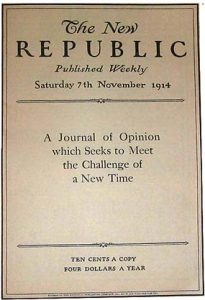
An article from THE NEW REPUBLIC recognizing that 1914 marked the end of an era.

Supplying Tobacco to the AEF
(America’s Munitions, 1919)

Cigarette smoking was far more prevalent in the United States after the First World War than it was in earlier days; this is largely due to the free cigarettes that were widely distributed among the nations soldiers, sailors and Marines during that conflict – and this is the subject of the attached article. It was written by Benedict Crowell (1869 – 1952), who served as both the Assistant Secretary of War and Director of Munitions between 1918 and 1920 – and although his column informs us that numerous tobacco products were dispersed throughout the ranks on a seemingly biblical scale, he does not touch upon the tragic topic of the addictions that soon followed (contrary to popular belief, the American medical establishment had their suspicions about tobacco long before the war).

Advertisement

Use shortcode [oma_ad position="summary_top"] (or other position) in your theme or widgets to display OMA Promotions here.

The French Army in Africa
(The Commonweal, 1941)

Attached is a history article concerning the various organizations that made up the French Colonial Army in Africa:

Before and during the World War, all the different races serving in the French Army were excellently officered by subalterns and non-coms born in North Africa, but of European ancestry: by sons of immigrated colonists of French, Spanish and Italian extraction.

The late Marshal Lyautey used to say of these sons of European settlers: ‘Their knowledge of the ways of the natives is priceless, because they have assimilated it from childhood. In the native regiments, they constitute a human concrete, which keeps together men of antagonistic races and beliefs’

Advertisement

Use shortcode [oma_ad position="summary_top"] (or other position) in your theme or widgets to display OMA Promotions here.

Gassing as Crime
(H.W. Wilson, 1917)

When the United States Congress declared war on Imperial Germany in April of 1917, the New York pamphleteer Halsey William Wilson (1868 – 1954) wasted little time in collecting a list of the numerous war crimes committed by the Germans up to that time in order to launch a mass printing of a 31 page pamphlet that would sell for five cents each. The heinous use of poison gas was listed on page nine.

German Cavalry Memoir
(Leslie’s Weekly, 1915)

Fritz Arno Wagner (1894 – 1958) is best remembered as a pioneering cinematographer from the earliest days of the German film industry, however before he could gain the experiences necessary to become the director of photography for such films as Nosferatu, and Westfront he had to first fulfill his obligations to the Kaiser. This article is an account of his brief stint in the Hussars (ie. lancers) that he gave to the editor’s of Leslie’s Illustrated Weekly Newspaper. Although the article only covers his training period, it does give the reader a sense of what life was like for an enlisted man serving in one of highly prized regiments in the Imperial German Army.

It is believed that this magazine article was written during his days with Pathe News in New York.

Click here to read about the U.S. Navy railroad artillery of W.W. I.

German Cavalry Memoir
(Leslie’s Weekly, 1915)

Fritz Arno Wagner (1894 – 1958) is best remembered as a pioneering cinematographer from the earliest days of the German film industry, however before he could gain the experiences necessary to become the director of photography for such films as Nosferatu, and Westfront he had to first fulfill his obligations to the Kaiser. This article is an account of his brief stint in the Hussars (ie. lancers) that he gave to the editor’s of Leslie’s Illustrated Weekly Newspaper. Although the article only covers his training period, it does give the reader a sense of what life was like for an enlisted man serving in one of highly prized regiments in the Imperial German Army.

It is believed that this magazine article was written during his days with Pathe News in New York.

Click here to read about the U.S. Navy railroad artillery of W.W. I.

Advertisement

Use shortcode [oma_ad position="summary_top"] (or other position) in your theme or widgets to display OMA Promotions here.

Scroll to Top