Author name: editor

A German Dissident Recalls His Incarceration (Ken Magazine, 1938)
1938, Ken Magazine, Recent Articles, The Nazis

A German Dissident Recalls His Incarceration
(Ken Magazine, 1938)

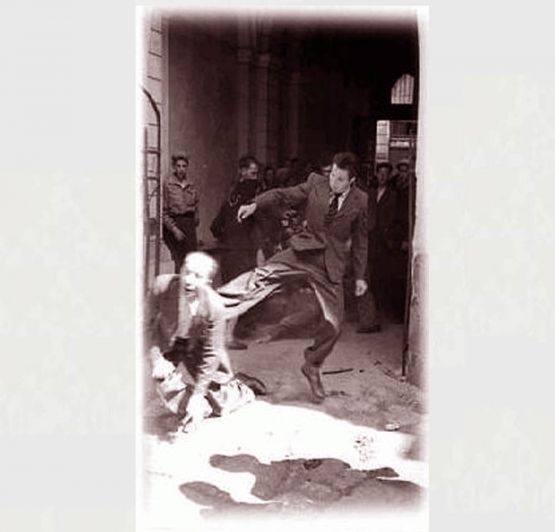
Locked-up for having run an underground newspaper in the Third Reich, this is the harrowing story one dissident’s experiences in the Nazi concentration camps:

What a relief it would be to take that uniformed scoundrel by the throat, throw him on the floor, pay him back for his beating, yell ‘You dog! You swine!’

Read about the American reporter who became a Nazi…

1939, Ken Magazine, Pseudotheology, Recent Articles

Nazis Against the Christian Churches
(Ken Magazine, 1939)

As pastor of the little Austrian church, the good father was happy until Nazis swallowed the country, mistreated his Jewish converts and threw many of his colleagues into the dreaded concentration camp of Dachau. Shocked, he attempted to preserve a fragmentary picture of events for posterity – and found himself in Dachau. Similar episodes, which are today common throughout Nazidom, only succeed in stiffening the Catholic fight against Nazism.

Advertisement

Use shortcode [oma_ad position="summary_top"] (or other position) in your theme or widgets to display OMA Promotions here.

He was a Dirty Campaigner... (Collier's Magazine, 1952)
1952, Collier's Magazine, F.D.R.

He was a Dirty Campaigner…
(Collier’s Magazine, 1952)

FDR’s predecessor, Herbert Hoover, wrote a series of articles concerning his own presidency that appeared on the pages of COLLIER’S MAGAZINE throughout the spring of 1952. The sixth installment was devoted to his 1932 reelection bid against FDR and the Roosevelt Hoover remembered was an under-handed campaigner who surrounded himself with liars and all sorts of other aids and speechwriters who took liberties with the truth in all matter’s involving the record of Hoover’s administration.


CLICK HERE to read about President Hoover and the Bonus Army…

Inchon Definition
1950, Pathfinder Magazine, The Korean War

False Hope in Washington
(Pathfinder Magazine, 1950)

This snippet appeared on the newsstands shortly after Halloween, 1950. It will give you a sense of the great relief that was felt not simply in the halls of Congress and the Pentagon, but all across the country. The journalist wrote this report as if decades had past and a distant memory was being recalled about a five month-long war that was once fought and won by the all-suffering Americans and their U.N. Allies, but the Communists learned their lesson, so we don’t have to worry about them anymore. The war’s turning point is hailed (The Inchon Landings), as is General MacArthur, American casualty figures are listed and mention is made of the South Koreans moving into the recently liberated towns of the North. But this same reporter would write a very different article for the next issue of the magazine when he would relay that the war had expanded, and casualty figures had ballooned with the intervention of the Chinese Army.

Advertisement

Use shortcode [oma_ad position="summary_top"] (or other position) in your theme or widgets to display OMA Promotions here.

Is Bobby Jones Losing Interest in Golf? (Literary Digest, 1929)
1929, Golf History, Recent Articles, The Literary Digest

Is Bobby Jones Losing Interest in Golf?
(Literary Digest, 1929)

The two page article attached herein addresses the meteoric rise of the American golf legend Bobby Jones (1902 – 1971). Said to have been a child prodigy in the game, he made his mark early, winning the 1923 U.S. Open against Bobby Cruickshank (1894 – 1975) at the age of 19. Trophies came to him effortlessly during the course of the following six years and, judging from the question posed above, the golf journalists were right: Bobby Jones was losing interest in the game – he would leave competitive golf the following year.

Max Beckman Since the War (Art Digest, 1946)
1946, Modern Art, Recent Articles, The Art Digest

Max Beckman Since the War
(Art Digest, 1946)

Max Beckmann (1884 – 1950), having fled to Holland from his native Germany in order to escape Hitler, arrived in New York shortly after the end of the war and wasted no time in securing an aggressive dealer eager to arrange liasons between him and the the post-war dollar.

The first exhibition of Max Beckman’s work since 1941 is currently being held at the Bucholz Gallery in New York. Director Kurt Valentin has assembled for this event important examples of Beckman’s brush dating from 1939 to the present…Among the many drawings particularly remembered are a satirical ‘Radio Singer’ and a tongue-in-cheek ‘Anglers’, along with ‘Head Waiters’.

Advertisement

Use shortcode [oma_ad position="summary_top"] (or other position) in your theme or widgets to display OMA Promotions here.

archived article about artist s model who posed for BALZAC by Rodin
1955, Modern Art, People Today Magazine, Recent Articles

He Posed for Auguste Rodin
(People Today Magazine, 1955)

Sixty years before this article was published, Libero Nardonne, who posed for the Rodin’s celebrated sculpture, The Kiss (1885), enjoyed a life as one of the most popular artist’s model in all of Paris – at a time when the greatest artist’s in the world were residences of that famous burg. Jump forward to 1955 and you would find him a broke and broken man who lived on the streets – nonetheless, he showed the American photographers through the art museums to point out all the masterpieces he had played a part in creating.

A W.W. II Hero Speaks Out About Heroes and Heroism (Collier's, 1945)
1945, Collier's Magazine, Medal of Honor Recipients

A W.W. II Hero Speaks Out About Heroes and Heroism
(Collier’s, 1945)

Carlton Rouh was awarded the M.o.H. for performing numerous acts of courage on the South Pacific island of Peleliu during the September of 1944; in this article he speaks bluntly about the nature of heroes and the discomfort they experience when being praised in a nation that was so deeply in need for such men.

Click here to read about another W.W. II Medal of Honor recipient.

Advertisement

Use shortcode [oma_ad position="summary_top"] (or other position) in your theme or widgets to display OMA Promotions here.

Changing the Uniforms to Fit the Climate (The Stars and Stripes, 1918)
1918, The Stars and Stripes, U.S. Army Uniforms of World War One

Changing the Uniforms to Fit the Climate
(The Stars and Stripes, 1918)

A short notice printed in May of 1918 which intended to let the Doughboys know that the U.S. Army Quartermaster Corps was well aware that changes needed to be made in the American uniform in response to the damp French climate.

The additional uniform items never went into production in light of the fact that the war ended six months later.

'Failure of Indians as Soldiers'' (The Literary Digest, 1897)
1897, First Nations, The Literary Digest

‘Failure of Indians as Soldiers”
(The Literary Digest, 1897)

The last of the companies of Indians enlisted in the regular army of the United States has been mustered out after six years trial, at Omaha, Nebraska. The Omaha WORLD-HERALD intimates that the failure of the experiment may not be entirely due to the Indians.


The journalist reporting on this matter opined that all subjugated people should never be expected to fight for a tyrannical government.

The Marx Brothers & the Joke Development Process (Stage Magazine, 1937)
1937, Hollywood History, Recent Articles, Stage Magazine

The Marx Brothers & the Joke Development Process
(Stage Magazine, 1937)

A late Thirties article by Teet Carle (the old publicist for MGM) on how the brothers Marx figured out which gag created the biggest laughs; a few words about how the movies were tested in various cities prior to each release and how assorted jokes were recited to all manner of passersby for their effect.

Click here to read a 1951 article that Harpo Marx wrote about Groucho.

Advertisement

Use shortcode [oma_ad position="summary_top"] (or other position) in your theme or widgets to display OMA Promotions here.

1936 National Income Rise | 1936 A Good Year in the Great Depression
1937, Pathfinder Magazine, The Great Depression

I936 Saw A Wee-Bit of Prosperity
(Pathfinder Magazine, 1937)

This article sums up the income data that was collected by the U.S. Department of Commerce and published in June of 1937. The report stated that

The national income increased in 1936 by a larger amount, absolutely and relatively, than in 1935. Income produced rose to 63.8 billion dollars, an increase of 8.8 billion dollars, an increase over the 1935 total.


A chart has been provided.


Click here to read about the economic disaster that 1937 was

Employment 1937
1937, Pathfinder Magazine, Recent Articles, The Great Depression

False Hope for 1937
(Pathfinder Magazine, 1937)

Perhaps it was the practice of magazine editors during the Great Depression to instruct their reporters to find hope where none existed; that must have been the case for this article. The unnamed journalist who wrote this slender column reported on a few rare cases involving real jobs with real salaries being offered to recent graduates; the reporter wished to believe that this was a sign that the end was nigh – but these few jobs were flukes. The author saw economic growth where there really wasn’t any at all, however he certainly made the case for its existence. The title link posted above leads to a passage from FDR’s Folly: How Roosevelt and His New Deal Prolonged the Great Depressionstyle=border:none by Jim Powell that explains the true situation that existed in 1937, when unemployment stood at 20 percent by Summer.

Fascism Political Religion | Political Religions of the 1930s
1935, Pseudotheology, The Literary Digest

The Era of Nationalized Religions
(The Literary Digest, 1935)

In 1935 the Biennial Congress of the Western Section of the World Alliance of Reformed Churches (13,000,000 strong) gathered in Richmond, Virginia in order to discuss their concerns regarding the spread of nationalized religions in such nations as Soviet Russia and Nazi Germany:

As for anti-religious communism, said Doctor Charles S. Cleland, ‘In our missionary circles this is more to be feared than nationalism. The latter may be, and oftentimes is, a patriotic movement, while the former aims only at destruction. Communism of the type now referred to seeks not only the suppression of Christianity, but of all religions. Its purpose is to make governments entirely secular, and to free the national life from all forms of faith and worship.


Advertisement

Use shortcode [oma_ad position="summary_top"] (or other position) in your theme or widgets to display OMA Promotions here.

Scroll to Top